



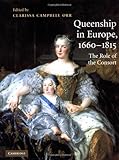
Clarissa Campbell Orr, ed. Queenship in Europe, 1660-1815: The Role of the Consort. Cambridge: Cambridge University Press, 2004. xvii + 419 pp. $129.00 (cloth), ISBN 978-0-521-81422-5.
Reviewed by Joseph F. Patrouch (Department of History, Florida International University)
Published on H-HRE (May, 2006)
The Holy Roman Empire as Web of Dynastic Relations
Clarissa Campbell Orr of the Anglia Polytechnic University has followed her 2002 collection of essays Queenship in Britain, 1660-1837: Royal Patronage, Court Culture and Dynastic Politics, with another important volume of articles on early modern queens and empresses, this one titled Queenship in Europe, 1660-1815: The Role of the Consort. This second volume broadens the geographic scope of the earlier volume to include examples from Sweden, France, Russia, Spain, Denmark, and the Holy Roman Empire. Fifteen scholars from the United Kingdom, Denmark, Sweden, Ireland, France, and the United States contributed fourteen chapters that deepen our understanding of the varieties of female rule and influence in early modern Europe. The chapters are supplemented by Orr's inclusion of numerous complex genealogical charts that are essential to understanding the lives and significance of the various women mentioned.
Back in 1987, at a groundbreaking conference on court studies, R. J. W. Evans pointed out some areas for future study in the field, including questions about consorts and their entourages.[1] As the field has blossomed in the last decades, scholarly organizations such as the Society for Court Studies and the Society for the Study of Early Modern Women have been founded, and their members have heeded this call. They have initiated interdisciplinary and comparative studies of female rulers and nobles, placing these women in the specific contexts of their courts and of those of their relatives. The book under review is one such study, as it grew out of a conference sponsored by the Society for Court Studies in 1999. The women analyzed in this collection also fit into the framework of discussion outlined in Olwen Hufton's essay "Reflections on the Role of Women in the Early Modern Court," especially in the authors' focus on the importance of women in the field of international relations and diplomacy.[2] This review will briefly summarize many of the articles in this collection, highlighting how each relates to the princesses of the Holy Roman Empire, and will then conclude with a general analysis of the collection.
The contested duchy of Savoy, situated on the borders between the Empire and France, is the arena for Robert Oresko's study of the Paris-born consort to Duke Carlo Emanuele II, the woman known as Maria Giovanna Battista (1644-1724). Titular queen of Cyprus, Maria Giovanna Battista ruled the duchy of Savoy after the death of her husband in 1675. She also helped push the territory closer to France, eventually negotiating the marriage of her eldest son to a niece of King Louis XIV. Oresko places Maria Giovanna Battista's policies not simply in the context of her family ties to France, but also in the context of the conflicts between Savoy and Mantua over the Reichsvikariat in Italy--conflicts that were reflected in the marriages of emperors Ferdinand II and III to women from the Gonzaga dynasty. Oresko also views Louis XIV's famous hostility to the Habsburg general Prinz Eugen of Savoy in terms of these machinations over the duchy, and of the role of Maria Giovanna Battista in them (pp. 32-34). Oresko's study, part of a larger project on this duchess-queen, is firmly founded on archival evidence found in the French Archives des Affaires Etrangères, Correspondance Politique Sardaigne. The article demonstrates his continued interest in what he has previously called "public policy and private strategy," a theme that he used in an earlier article on the marriage strategies undertaken by Cardinal Mazarin of France in connection with his nieces.[3] Here, he nicely illuminates the complex relations in imperial Italy during the charged decades around the end of the Spanish Habsburgs' rule in the Italian and Iberian peninsulas.
Lis Granlund, a former curator from Sweden, concentrates her contribution on Hedwig Eleonora of Holstein-Gottorp, who, as wife of King Karl X Gustav and mother of King Karl XI, served as regent and dowager of Sweden in the late seventeenth century. Hedwig Eleonora's activities as art patron and collector serve as particular emphases for Granlund's analysis. She points out how important it was for the queen to rebuild the Swedish monarchy's image after her famous predecessor Queen Christina had, as Granlund points out, "denuded the monarchy of most of its treasures" (p. 56). As the younger of two daughters of Duke Fredrik III of Holstein and his wife Maria Elisabeth of Saxony, Hedwig Eleonora represents both physically and politically the attempts by the imperial duchy of Holstein to separate itself from the influence of the Danish kings by building close ties to Sweden instead. As in the one by Oresko, this chapter shows clearly how the rulers of the duchies on the borders of the Holy Roman Empire used dynastic ties to advance their foreign policies. Granlund also shows how the Holstein princess's activities transformed her new homeland: she provided them with numerous buildings and art collections (in addition to the heir).
The role of the important duchy of Holstein (as well as the related county of Oldenburg-Delmenhorst) in relations with the kingdom of Denmark is similarly touched upon in Michael Bregnsbo's chapter on three Danish queens of the eighteenth century: Louisa of Hanover (d. 1751), Carolina Matilda of Hanover (d. 1775), and Julian Maria of Brunswick-Wolfenbuettel (d. 1796). All of these women came from important dynasties in the Holy Roman Empire and have been, Bregnsbo argues, largely overlooked in Danish historiography due to nationalistic, democratic, and anti-German tendencies in the field (p. 345). As is the case in the study of many foreign queens, he argues, their foreign origins have led to a devaluation (or ignorance!) of their historical contributions.
Charles W. Ingrao, a well-known name in the field of Holy Roman Empire studies, and Andrew L. Thomas, a doctoral student also at Purdue University, have republished in this collection a revised study of empresses-consort that originally appeared in the Journal of German History in 2002.[4] Complete with two genealogical tables detailing imperial marriages in the seventeenth and eighteenth centuries as well as the family connections of the house of Pfalz-Neuberg, this chapter should be of particular interest to readers of H-HRE. Based to a large extent on published primary and secondary sources, Ingrao and Thomas's chapter also refers to some unpublished correspondence found in the Staatsarchiv Hannover as well as in the Haus-, Hof- und Staatsarchiv in Vienna, particularly letters dealing with the private lives and loves of the emperors Joseph I and Charles VI. This evidence serves to remind us of the empresses' lack of a monopoly on the affections and physical attention of their spouses (pp. 116-117).
As Ingrao and Thomas point out, much is generally known about the fifteen Habsburg emperors from Frederick III to Francis II, but not as much is known about the twenty empresses who ruled during this same period. Empress Maria Theresa is the primary exception to this rule, and Magdalena Sanchez's book, The Empress, the Queen and the Nun: Women and Power at the Court of Philip III of Spain, 1998, dealing with the Empress Maria's activities during her widowhood, has recently increased our knowledge of this Habsburg ruler. Ingrao and Thomas concentrate, in their relatively brief contribution, on the activities of three women who were active at the Habsburg court in the decades around 1700: the empresses Eleonore of Pfalz-Neuburg, Wilhelmine Amalia of Braunschweig-Luneburg, and Elizabeth Christine of Braunschweig-Wolfenbuettel. By 1711, all three women were holding various influential court positions, one as reigning empress and the other two as dowager-empresses. Elizabeth Christine also served as regent of Spain for a number of years around this time.
In their discussion, the authors address some of the political and personal considerations that led the Habsburgs into alliances with princesses from important houses within the Empire instead of outside of it, as had often previously been the case. (Particularly in the longstanding tradition of marrying into the ruling house of Spain in order to ensue dynastic unity between various branches of the Habsburg family.) Ties first to the electors Palatine and then to the electors of Hanover helped assure support from those quarters, as did other marriages of Habsburg archduchesses into the families of the electors of Bavaria and Saxony. The Hanoverian alliance looked all the more important and attractive, the authors argue, as those electors' claims to the British throne looked more and more certain (p. 111). While more impressionistic than exhaustive, Ingrao and Thomas's chapter sketches important themes concerning Holy Roman Empresses and their roles. They point, for example, to these women's religious influence, such as in the area of Marian devotions, and they also add to the by-now-famous picture of pietas austriaca by pointing out how many devotees of this form of religious piety were not Habsburgs by birth, but by marriage.[5] (Empress Elizabeth Christine was also a convert from Lutheranism.) The authors mention the elaborate patronage networks these empresses built up and utilized across the Empire, and discuss the women's dynastic machinations on behalf of both their birth families and their children.
Lindsey Hughes's chapter on Czar Peter I "the Great's" consort Catherine I of Russia, (crowned 1724) touches only briefly on issues relating to the Holy Roman Empire. Hughes points out, for example, how Peter established a formal court for Catherine, following German models and including court officials with German ranks such as oberhofmeister and oberkamerger (p. 144). Some mention of Russian foreign relations with Austria is made, but the dynastic ties that saw Catherine's daughter Anna marry the duke of Holstein (they would parent the future Russian Emperor Peter III, born Karl Peter Ulrich in Holstein in 1728) are not developed. Peter’s wife, Sophie Fredericke Auguste of Anhalt-Zerbst, would go on to a successful career as Empress Catherine II of Russia.
In Charles C. Noel's contribution, titled "The Feminisation of the Spanish Monarchy, 1701-1759," the author details the policies of Philip V of Spain as they related to imperial Italy and the Habsburgs' claims there. His second wife, Elisabetta Farnese, embodied Bourbon attempts to reclaim or assert Spanish influence on the Italian peninsula in the early-eighteenth century. Elizabeth's aunt, Maria Anna of Pfalz-Neuburg, was the exiled dowager queen of Spain at the time. Once again, dynastic ties and female relatives reveal a complex interchange between families within and without the Empire. As Noel points out, "by 1766, Farnese had seen her offspring married into every significant Catholic ruling family from Portugal to Saxony-Poland, except Bavaria" (p. 180).
Using sources from, among other places, the Archives de la Maison de France, John Rogister produces a study of factions at the French court during the reign of Queen Marie Leszczynska. Marie, the daughter of a supporter of the Saxon kings of Poland (he himself was even briefly king there) and administrator of Zweibruecken, married King Louis XV in Strasburg in 1725. While Rogister depicts her as "without any real political or dynastic influence" (p. 202), her father was an important figure in French foreign policy, becoming duke of Lorraine in the 1730s and also a candidate for the Polish throne.
Peter H. Wilson, another well-known name in the field of Holy Roman Empire studies, contributed to this volume with a chapter on the Wuerttemberg consorts between 1674 and 1757. Specifically, Wilson examines three women active in the court at Wuerttemberg: Johanne Elisabethe von Baden-Durlach (d. 1757), Christina Wilhelmina von Graevenitz (d. 1744), and Marie Auguste von Thurn und Taxis (d. 1756). After briefly mentioning how the women of the smaller German courts have rarely been studied except as royal marriage partners (e.g. Anne of Cleves) or as linked to court scandal, Wilson argues that "it is only through a detailed examination of the web of intrigue that we can appreciate the true role of women in the politics of the Holy Roman Empire" (p. 221). Using sources from the Hauptstaatsarchiv Stuttgart, particularly the Wuerttemberg Hausarchiv and various administrative records, Wilson then analyzes the important distinction between female "power" and female "influence" in the post-1648 period. He stresses the particular characteristics of the imperial revival that took place especially from the 1670's on, as the rulers of smaller imperial territories increasingly turned to the Empire's institutions in the face of French and Ottoman threats and attacks (p. 223). Women at local courts were then able to appeal to, or at least use politically, the various extra-local instances so characteristic of the Empire, thus providing them with some independence from or counterweight to their husbands. For example, Wilson describes how Johanne Elisabethe appealed to both the dowager empress Eleonore and the empress Amalie Wilhelmine in a dispute with her husband. Once she had won over most of the woman at the imperial court to her side, a formal imperial dispute resolution commission was set up (p. 233).
In her contribution to this volume, Helen Watanabe-O'Kelly studies two electresses of Lutheran Saxony who also ruled as queens of Catholic Poland: Christiane Eberhardine, margravine of Brandenburg-Bayreuth, and Maria Josepha, an imperial princess. While the elector of Saxony, Friedrich August I, converted to Catholicism in 1697 in order to become the first German prince to achieve royal status since the Habsburgs acquired Bohemia in the sixteenth century, his consort Christiane Eberhardine refused to convert or even to visit the Polish kingdom and was thus never crowned. Watanabe-O'Kelly points out that the couple often did not see each other for years at a time, and that Christiane Eberhardine built up a separate court presiding over a number of young female relatives for whom she would arrange advantageous matches. Friedrich August also managed to arrange an advantageous marriage: his son Friedrich August II was betrothed to the eldest daughter of Emperor Joseph I, Maria Josepha. Unlike her predecessor Christiane Eberhardine, however, this Polish queen was often present in the kingdom. Maria Josepha is credited by Watanabe-O'Kelly with supporting an array of pious Roman Catholic customs and practices and building up, with the support of her husband, the famous Dresden Hofkirche, along with an impressive relic collection. Watanabe-O'Kelly also argues that Maria Josepha's mother, Empress Wilhelmine Amalia, had educated her daughters with a strong belief in saints' veneration and the Eucharistic piety now often known by the term "pietas austriaca." Maria Josepha stayed behind in Dresden after her husband and his court fled before the 1756 invasion by the Prussian army of Frederick II. She never saw Friedrich August again, but according to Watanabe-O'Kelly she "did her best to save Saxony from total destruction" (p. 270).
Of course, when one thinks of the Holy Roman Empire in the early eighteenth century, its close ties to the United Kingdom through the House of Brunswick-Luneberg (Hanover) must be taken into account. Andrew Hanham, a former research staff member of the History of Parliament Trust, does precisely this with his engaging contribution centering on the anointed queen of Great Britain, Caroline of Brandenburg-Ansbach (crowned 1727, d. 1737). Consort to Georg Augustus, the later George II of Great Britain, Caroline was the daughter of Johann Friedrich, margrave of Brandenburg-Ansbach, and his wife Eleonore Erdmuth Luise of Saxe-Eisenach. Hanham, using manuscript evidence from the British Library, details what he calls the "anglicisation" of the House of Brunswick-Luneberg/Hanover and Queen Caroline's important roles therein. Brought up at the court of Electress Sophia Charlotte at Lutzenburg (later Charlottenburg) outside of Berlin, Caroline was a keen observer of the accession of the elector to the title of "King in Prussia" as Friedrich I in 1701 (p. 280). The lessons she learned, Hanhan argues, would stand her in good stead as the Hanoverian electors similarly climbed up the ladder to royal status after the death of Anne I of Great Britain thirteen years later. Queen Caroline became famous and popular in England partly through the circulation of the story of how she declined Archduke Charles of Habsburg's hand in 1704, refusing to convert to Roman Catholicism. This story became even more dramatic after the archduke ascended the imperial throne as Charles VI in 1711: better a Protestant princess than a Catholic empress (p. 281)!
The collection's editor, Clarissa Campbell Orr, continues the concentration on the House of Hanover with her study of Charlotte of Mecklenburg-Strelitz, the electress (and later queen) of Hanover and queen of Great Britain, consort to King George III. Securely based on correspondence found in the Hausarchiv des Mecklenburg-Strelitzschen Fuerstenhauses, Orr's study focuses in part on the intellectual role of the court at Windsor, a role that she claims "can be seen as part of a Protestant international Enlightenment" (p. 374). Orr thus places this chapter in the wider context both of the German Enlightenment and of the discussion of its relationship with the various small and medium-sized courts of the Holy Roman Empire in its final decades (p. 382).
In his chapter on Queen Elisabeth Christine of Prussia (d. 1797), whose father was Duke Ferdinand Albrecht of Brunswick-Wolfenbuettel and whose mother was a niece of Empress Elisabeth Christine, Thomas Biskup forcefully argues that "we need to place the 'forgotten queen' of eighteenth-century Prussia at the heart of the story of Prussia's rise to great power status" (p. 301). After 1740, Elisabeth Christine of Prussia lived a life largely separate from her husband, Frederick II "the Great," leading an influential court in Berlin while Frederick whiled away his time out in Potsdam. (His queen was never invited to his private residence of Sanssouci. As the author points out: "Sanssouci conspicuously lacked the presence of women" [p. 315].) Biskup points out that Elisabeth Christine's Courttage, which occurred three times a week either at the palace in Berlin or at Schoenhausen, were "the only regular occasions where the Court of the country assembled as a whole." She, not her absent husband, was the one situated "at the ceremonial centre of the Court" (p. 308). Intriguingly, Biskup also points to the possible integrative function of this court in relation to the acquisition of the new province of Silesia, noting that Elisabeth Christine's court was frequented by large numbers of aristocrats from that former Habsburg possession. He thus demands a re-evaluation of nineteenth-century notions of state-building, and persuasively points out that "the Court was an indispensable platform for conducting politics on the European stage" (p. 317).
Continuing with the Prussian connections, Marc Serge Riviere's contribution to the volume concentrates on a study of Frederick "the Great's" sister, Louisa Ulrica, who reigned as queen of Sweden. Riviere is Professor of French at the University of Limerick. His chapter is founded on an incomplete memoir written by the queen and now in manuscript form at the Kunglige Biblioteket in Stockholm, as well as on the queen's extensive correspondence with her relatives, mostly in the Geheimes Staatsarchiv preussischer Kulturbesitz in Berlin and the Riksarkivet in Stockholm. As wife of the elected king of Sweden and prince-baron of Luebeck, Adolf Frederick, Louisa Ulrica was famous for her support of the arts (she corresponded with Voltaire and Montesquieu, among other Enlightenment luminaries, and was enamored with French culture), yet was relatively unsuccessful in her foreign policy, which sometimes seemed to reflect stronger connections to her family than to her new country--a standard problem facing foreign queens.
In general, this collection is well produced, with well-chosen illustrations. The single map, taken from Derek Beales's 1987 biography of emperor Joseph II and showing central Europe in the mid-eighteenth century, could have been supplemented with more: who knows where all of these princely houses of the early modern Holy Roman Empire had their seats and residences? The relationships between the Empire and the surrounding political units (such as France, Poland, Denmark, and so on) and the ways in which these relationships were embodied in the persons of the queens studied would also have been better captured with such visual aids.
The articles when taken together reveal how challenging the study of queenship is and will continue to be: many of the names of the principals involved are little known (or unknown) and the sources are piled up in unpublished collections of letters, memoirs, and various administrative documents in an array of archives and libraries. Complicating such studies even further is the importance of the Holy Roman Empire, an institution notorious for its administrative inadequacies and for the challenges it makes to traditional historiographic notions of "state-building" and "bureaucratization." Clarrissa Campbell Orr's rich collection has shown, however, that, for the study of the Empire, it is essential to understand the web of dynastic relations that in many ways held this institution together, a web created as well as manifested by the women who ruled as empresses, queens, electresses, and princesses of various ranks.
Notes
[1]. R. J. W. Evans, "The Court: A Protean Institution and an Elusive Subject," in Princes, Patronage, and the Nobility: The Court at the Beginning of the Modern Age, c. 1450-1650, ed. Ronald G. Asch and Adolf M. Birke (Oxford: Oxford University Press, 1991), p. 482.
[2]. Here Hufton refers to a quotation from Cobban about queens and mistresses in France. Olwen Hufton, "Reflections on the Role of Women in the Early Modern Court," Court Historian 5, no. 1 (2000): p. 5.
[3]. Robert Oresko, "The Marriages of the Nieces of Cardinal Mazarin: Public Policy and Private Strategy in Seventeenth-Century Europe," in Frankreich im europäischen Staatssystem der Frühen Neuzeit, ed. Rainer Babel (Sigmaringen: J. Thorbecke Verlag, 1995): pp. 109-151.
[4]. Charles W. Ingrao and Andrew L. Thomas, "Piety and Patronage: The Empresses-Consort of the High Baroque," Journal of German History 20 (2002): pp. 20-43.
[5]. The classic work on early modern Habsburg piety by Anna Coreth, Pietas Austriaca, has been recently translated into English by William D. Bowman and Anna Maria Leitgeb (West Lafayette, Indiana: Purdue University Press, 2004).
If there is additional discussion of this review, you may access it through the network, at: https://networks.h-net.org/h-hre.
Citation:
Joseph F. Patrouch. Review of Orr, Clarissa Campbell, ed., Queenship in Europe, 1660-1815: The Role of the Consort.
H-HRE, H-Net Reviews.
May, 2006.
URL: http://www.h-net.org/reviews/showrev.php?id=11764
Copyright © 2006 by H-Net, all rights reserved. H-Net permits the redistribution and reprinting of this work for nonprofit, educational purposes, with full and accurate attribution to the author, web location, date of publication, originating list, and H-Net: Humanities & Social Sciences Online. For any other proposed use, contact the Reviews editorial staff at hbooks@mail.h-net.org.

