



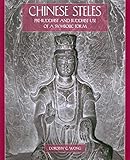
Dorothy C. Wong. Chinese Steles: Pre-Buddhist and Buddhist Use of a Symbolic Form. Honolulu: University of Hawaii Press, 2004. xviii + 227 pp. $50.00 (cloth), ISBN 978-0-8248-2783-0.
Reviewed by Eric Reinders (Department of Religion, Emory University)
Published on H-Buddhism (May, 2006)
This book concerns "a brief but brilliant episode" in Chinese Buddhist art (p. 175), during the fifth and early sixth centuries, in North China generally, but especially in areas controlled by the Northern Wei (386-534). Buddhist steles--monumental stone slabs carved with images and text--were "an independent Chinese Buddhist artistic idiom," in fact "the first truly synthetic style of Chinese Buddhist art" (p. 176). More than two hundred of these monuments survive, previously documented and analyzed mostly as individual case studies. Wong claims that "this book is the first comprehensive study of those Buddhist steles produced in China from the late fifth through the sixth century" (p. 1). It is an elegant volume, amply illustrated, and the photographs are on the whole very clear, carefully placed in the text, and well elucidated.
Wong studies this "unique art form" (p. 8) in terms of its origins and development, as well as various social and historical contexts. Some of the most interesting material concerns the relation of these steles to the earlier Chinese models, and the mingling of meanings when Buddhist and pre-Buddhist content and form were synthesized in stone. Buddhist steles were a compromise of multiple forms, including the icon, the funerary tablet, and the textual propaganda of civil virtues. Whereas Han steles (bei) were mostly text on stone, these steles mixed text with icons, but this synthetic form was not sustained. The proportion of text to image shifted back towards text, and eventually the image and the text diverged again. "Toward the end of the sixth century, the reversal of the stele to its pre-Buddhist form--namely, reliance on inscriptions rather than imagery to convey its content--heralded the consolidation of the country into the unified Sui and Tang empires" (p. 4). At that point, with a few exceptions, "Buddhist steles ceased to be a vital art form" (p. 178).
Part 1 details the etymology of some key terms, such as She (earth god, in the form of an upright stone), and names of groups who erected or maintained them, such as the yishe, which were models for the Buddhist devotional societies yi or yiyi. Chapter 3 in particular examines these societies, especially in the historical context of the Northern Wei which adopted Buddhism as a state religion, and which sponsored a flourishing of Buddhist art (such as at Yungang and Longmen). "The concurrent emergence of Buddhist yiyi devotional societies and Buddhist steles under the Northern Wei affirms the observation that the Buddhist adaptation of the Chinese tablet, the quintessential Chinese monument, occurred only when Buddhism became fully integrated into Chinese society" (pp. 43-44). The discussion on yiyi is very interesting, as through this data we get a sense of the social context. Indeed, the stele inscriptions constitute the principal historical source for such voluntary religious groups. Wong claims that there were no Indian precedents for such societies, and that they were therefore uniquely Chinese (p. 52).
Quite rudimentary compared to the gorgeous examples from later periods, the Han stele became "a main vehicle for ritual inscriptions" with four main functions: "funerary/commemorative steles that honor individuals"; religious steles commemorating nature deities, Confucius, Heaven, and She; secular steles which were emblems of political, military, and territorial power; and stone texts with cultural and political content, especially Confucian virtues (p. 25). This classification forms the structure of chapter 2, "The Origins and Rise of Han Steles." Wong gives three reasons for the fact that Buddhist steles had a much wider range of styles, shapes, and sizes, than Han bei. First, sumptuary laws had regulated the forms of Han bei; second, the Buddhist artistic inheritance was already greatly diversified; and third, foreign influence stimulated "dialogue and ... innovation in visual vocabulary" (p. 176). Some of the steles under consideration are magnificent, while others posses "an unpretentious charm" (p. 131), or "a rustic charm" (p. 130). Also, it is interesting that some of the inscriptions were "crudely scribbled and written in variations of the standard script" (p. 102).
Chapter 4 also provides a general overview of Buddhist steles, including their "typology, spatial contexts, purposes of donation, patronage, and production" (p. 10). A very interesting section titled "Spatial Contexts of Buddhist Steles," discusses the locations of the free-standing steles: at crossroads, in open fields, and in temple courtyards, with the latter placement echoing the earlier spatial structure of the "spirit path" of larger Han tomb sites (pp. 67-69).
Much of part 2, "The Flourishing of Buddhist Steles," details various case studies arranged by chronology and/or region. It is interesting to see regional variation, especially in terms of the location of the sites on the Silk Road, and in terms of the fluctuating influence of different ethnic groups in North China. Chapter 5 looks at "The Initial Flourishing of Buddhist Steles in Shanxi," especially ca. 500-530, with sections on the Thousand Buddhas stele, the four-sided stele, the monumental complex stele, and the funeral Buddhist stele. Chapter 6 is on "The Maitreya Faith and Henan Steles." Chapter 7 is on steles from Shaanxi (especially regarding their Buddhist-Daoist mixing). In chapter 8 (mainly), we turn from free-standing steles to steles in caves, and to steles inscribed on only one side, meant to be located against cave walls; these in turn merge with stele-like portions of wall carvings. The discussion here is on the Gansu-Ningxia region, mostly the caves at Maijishan.
Chapter 9 concerns the development of steles in general during the sixth century, including the shift toward inscriptions over imagery. The distinct artistic traditions of Sichuan form the basis of chapter 10, including some early images of the Pure Land. Here the discussion revolves around issues of artistic realism and perspective in depictions of landscape, and the stylistic differences of this art from Northern Wei art. In a section titled "Breakthrough in the Depiction of Illusory Space" (pp. 170-171), Wong singles out this stele art as "a brilliant first step toward naturalism and the mastery of pictorial space" (p. 171). There is a brief concluding chapter.
As an outsider to, or a dabbler in, art history, at times I found the text rather dense with descriptive matter. A lot of art historical analysis appears to an outsider as fixated on "purely" formal features, the significance of which non-specialists may be unable to perceive. I make this comment as a reflection of disciplinary differences, not on Wong's book in particular, which, while rooted in the disciplinary conventions of art history, consistently supplies historical, social, and other "extrinsic" contexts. She elucidates the doctrinal meanings (adequately, if not in great depth) if and when the need arises to explain some feature of the steles. The reverse, of course, are treatments of religion which reference and comment on material objects only as illustrations of more important matters of doctrine. In any case, the doctrinal content of the inscriptions on these steles is often formulaic and rudimentary, so that delving too deeply into contemporary intellectual debates would seem unjustified.
In fact, Wong shows that the material objects were not mere reflections but participants in matters doctrinal. "The terminologies used and the rationale given provide clues to understanding how, at the philosophical level, Buddhism interacted with the indigenous traditions of Daoism and Confucianism. The inscriptions also reveal how the three traditions explored their common ground on issues such as the concept of rulership (both divine and secular) and the symbolic value attached to stone" (p. 71). It is interesting to think of stone as a medium that had semantic content: "all three traditions employ the stone as a metaphor for secular or divine rulership" (p. 81). There is a fascinating section on Buddhist-Daoist steles, including an examination of the names inscribed on a stele dated 424, which reveal an extended family of mixed Buddhist and Daoist affiliation (pp. 114-117). Perhaps because syncretism is dealt with first in terms of material objects more than doctrines, Wong tends to interpret the mingling of traditions as evidence of harmonious relations rather than competition. The donors can be identified from the steles themselves, and Wong gives some interesting information on the people commemorated and the people sponsoring the production of the object, principally middle- and low-ranking officials. One could wish for more information about the artisans who actually made these objects, but they tended to be anonymous.
Still, there remain unresolved questions of the iconic value of these objects. The images portrayed were certainly objects of devotion, but it is not clear whether or not they were consecrated, or what kind of divine presence was attributed to them. The steles certainly had a "life," even in social-psychological terms, as embodiments of identity: "In their most fundamental usage, stone steles are emblems of identity that embody the religious, social, cultural, and territorial identity of their users" (p. 9). Furthermore, they were modeled in part on objects which were stand-ins for spirits. There is some insightful discussion of Han steles as funerary/commemorative objects, similar to zhong, the wooden "spirit tablet" used in funerals and ancestral rituals (p. 29), and mingjing, the "inscribed banner" which functioned as "a substitute for the deceased" (p. 29).
Discussing broken stele fragments found under the foundations of a pagoda, Wong comments: "That the broken fragments of the steles were not discarded but deposited underneath the foundation of a later pagoda elucidates certain Buddhist practices. Modeled after the Indian st?pa, the pagoda in China usually has relic-deposits beneath its foundation.... Preserving the stele fragments under the pagoda reflects the Buddhist belief that these steles, and the sacred images carved on them, retained some spiritual value even when they were no longer in use, so that they warranted being treated as though they were relics" (p. 140). Yet the actual ritual usage of the steles as objects of worship receives little consideration in this study.
Reading Wong's careful description and analysis of notable examples of the form, one begins to share her love for them. Some of them are, in a sense, unsurprising icons of Buddhist figures, but many of them are artistically gorgeous, and she draws attention to intriguing and idiosyncratic details. Why, for example, on a stele of the Northern Wei dated 529, are there images of five acrobats standing on each others shoulders, and entertainers on stilts? Wong suggests, "In Han pictorial art, acrobatic performance, along with music and dance, were part of the so-called banquet scene (yanyue) that usually appears in funerary art" (p. 86). This is one of many instances noted throughout the book of older funerary form and content overlaying the steles.
If there is additional discussion of this review, you may access it through the network, at: https://networks.h-net.org/h-buddhism.
Citation:
Eric Reinders. Review of Wong, Dorothy C., Chinese Steles: Pre-Buddhist and Buddhist Use of a Symbolic Form.
H-Buddhism, H-Net Reviews.
May, 2006.
URL: http://www.h-net.org/reviews/showrev.php?id=11723
Copyright © 2006 by H-Net, all rights reserved. H-Net permits the redistribution and reprinting of this work for nonprofit, educational purposes, with full and accurate attribution to the author, web location, date of publication, originating list, and H-Net: Humanities & Social Sciences Online. For any other proposed use, contact the Reviews editorial staff at hbooks@mail.h-net.org.

