

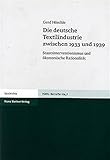
Gerd Höschle. Die deutsche Textilindustrie zwischen 1933 und 1939: Staatsinterventionismus und ökonomische Rationalität. Stuttgart: Franz Steiner Verlag, 2004. 369 S. EUR 64.00 (paper), ISBN 978-3-515-08531-1.
Reviewed by Mark Finlay (Department of History, Armstrong Atlantic State University)
Published on H-German (April, 2006)
Textiles, Autarky and Government Invention
As elsewhere in the industrialized world, the textile industry formed one of the foundations of German industrialization. By 1936, the industry employed nearly 900,000 workers and was responsible for about 8 percent of the value of the nation's industrial production. Yet historians of the Nazi economy have largely overlooked textiles in their work, for most have turned their attention instead to steel, automobiles, chemicals, armaments and other sectors more directly connected with military preparedness.
Yet Gerd Höschle argues that the textile industry was a high priority for National Socialist economic planners. Textiles presented a special problem for the Nazis. It was the largest branch of the economy in terms of employees, yet almost wholly dependent upon imported raw materials. In a nation desperate to restore its balance of payments, to preserve its bullion and to move toward an autarkic economy, government intervention seemed a necessity. According to Höschle, the policies that emerged served as a prototype for Nazi economic and business policy as a whole.
National Socialist direct intervention into the textile sector began early in 1934, when bureaucrats restricted the purchase of cotton, wool or flax from abroad. The government especially sought to end the industry's dependence on cotton imported from the United States and thus developed new agreements with Brazil, India, Egypt and other emerging producer nations. The regime also regulated prices, tried to reduce demand by curtailing working hours for textile workers, controlled hoarding by monitoring warehouses and required all kinds of bureaucratic reports and surveys to keep track of these initiatives. Planners also promoted the native fiber crops of flax and hemp and encouraged farmers to improve sheep breeds to increase domestic wool production. The regime's commitment to rayon and other synthetic fibers was especially significant. By requiring textile firms to invest in local manufacturers of synthetic fibers and to integrate increasing percentages of synthetic material into their products, the Nazis succeeded in building this industry from scratch. By 1939, most German textiles produced had at least some synthetic content.
Höschle also addresses the many discrepancies between government regulations and reality. After all, there was an inherent contradiction between the regime's desire to reduce imports of raw materials yet increase production of finished goods. The government was unable to enforce all of its regulations and firms found ways to trade contracts that provided access to imported raw materials, dodge restrictions on working hours and employ ever more female laborers to offset the increasingly tight labor market. Höschle contends that the textile industry was able to negotiate government textile politics in fairly good shape, and most firms successfully returned to pre-Depression levels of productivity and profitability. On the other hand, ordinary Germans paid a price for the regime's tight regulation of the industry. As the military and other politically important consumers demanded ever more textile products, the quantity and quality of textiles available to German civilian consumers declined significantly.
Without question, the book's many strengths include its remarkable thoroughness, impressive research, and quantitative rigor. The author consulted hundreds of archival collections, trade industry journals and governmental statistical reports to construct a history based upon the experiences of ninety-nine separate textile firms. From these sources--and often pieced together from many different sources--Höschle provides over 140 tables of data that break down the industry's quantitative trends by region, by sector, by calendar year and quarter and by many other variables. Interspersed among the tables, Höschle's prose also displays an analytical sophistication, as the author thoroughly dissects the implications of his data for textile industry leaders and Nazi bureaucrats.
Despite these assets, Höschle's exhaustive study of textile policy may be too narrow to make significant contributions to the historiography on National Socialist economics. The book opens suddenly in the year 1933, and thus provides little historiographic framework for the issues that shaped the textile industry earlier in the century and beyond Germany's borders. In his treatment of the Nazi years, the author's focus on industry leaders and their regulators also essentially leads him to overlook the experiences of textile workers, consumers and retailers. Moreover, the author openly chooses to downplay the moral questions connected with Nazi economic policy or the industry's complicity with Nazi atrocities. Thus he eschews the perspective of Peter Hayes, who, along other historians, has critically examined the Holocaust and the Nazi regime through the lens of its business community. For instance, Höschle devotes fewer than five pages to the "Aryanization" of the textile industry, barely touching upon the ramifications of Nazi textile policies for Jewish and other non-German entrepreneurs and employees. Perhaps most striking, by sharply ending his study in the year 1939, Höschle offers not even a hint of the fate of the German textile industry--not to mention the fate of its workers--during the war years.
In sum, Gerd Höschle has written what may be the last word on the economic history of the German textile industry from 1933 to 1939. For those interested in a broader perspective on the textile industry's place in German history, other works will need to be consulted.
If there is additional discussion of this review, you may access it through the network, at: https://networks.h-net.org/h-german.
Citation:
Mark Finlay. Review of Höschle, Gerd, Die deutsche Textilindustrie zwischen 1933 und 1939: Staatsinterventionismus und ökonomische Rationalität.
H-German, H-Net Reviews.
April, 2006.
URL: http://www.h-net.org/reviews/showrev.php?id=11692
Copyright © 2006 by H-Net, all rights reserved. H-Net permits the redistribution and reprinting of this work for nonprofit, educational purposes, with full and accurate attribution to the author, web location, date of publication, originating list, and H-Net: Humanities & Social Sciences Online. For any other proposed use, contact the Reviews editorial staff at hbooks@mail.h-net.org.

