



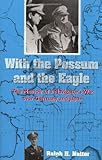
Ralph Nutter. With the Possum and the Eagle: The Memoir of a Navigator's War over Germany and Japan. Denton: University of North Texas Press, 2005. xiv + 328 pp. $29.95 (paper), ISBN 978-1-57441-198-0.
Reviewed by Richard Byers (Department of History, North Georgia College and State University)
Published on H-German (April, 2006)
The View From the Plexiglas Dome
Few subjects remain as controversial in Second World War historiography as the Allied bombing campaigns, particularly the American strategic offensives against Germany and Japan between 1943 and 1945. Such controversy has often expanded beyond academic circles and into the public realm, as scholars, veterans and others contest and recast the history and memory of these events. In 1995, a Smithsonian Institution exhibition commemorating the fiftieth anniversary of the war's end erupted into a bitter debate, with attention focused on the interpretation and presentation of the Enola Gay. The resulting argument between Smithsonian historians, Second World War veterans and others became a cause celebre of the 1990s culture wars, destroying careers and reputations and sparking a Congressional investigation. Ten years later, a substantial body of literature has appeared around these events and their aftermath.[1] At the end of the 1990s, the controversy shifted ground to Germany, where writer W.G. Sebald and journalist Jörg Friedrich revitalized the debate from a different perspective and precipitated an impassioned dialogue among Germans about the consequences of the air war.[2] These are treacherous historical shoals, with many perspectives already actively competing; given this context, Ralph Nutter's memoir appears at a good time, as his account directly addresses many of the debates that surround strategic bombing.
In 1943 and 1944 Nutter served as lead navigator for the Eighth Air Force over Germany and as group navigator for Haywood "Possum" Hansell, chief planner for the Eighth Air Force under Carl Spaatz. He later served in the same capacity for Curtis "the Eagle" LeMay. In 1945, Nutter would cross paths with both men again in the Pacific, where all three collaborated to direct Army Air Force operations against Japan. The first half of the book outlines Nutter's career as a navigator for the Eighth Air Force. Nutter traces the Eighth's fortunes as it attempted to prove the value of high-altitude precision daylight bombing--first against targets in German-occupied Europe and later against targets within Germany. Nutter's first-hand accounts of these missions retain their immediacy and danger despite the passage of over sixty years and they serve as hooks, drawing the reader into the larger story. As Nutter convincingly illustrates (and contrary to contemporary press reports), the Eighth Air Force's performance until late 1944 was indifferent at best, with lack of fighter support, wildly inaccurate bombing results and leadership resistance to tactical innovations the chief culprits. While none of these arguments are new, Nutter succeeds in adding nuance to the traditional narrative by exposing the role of leadership and personality behind these shortcomings and their resolution. Nutter's account is particularly valuable in this regard, for he provides a detailed analysis of the leadership styles of both Hansell and LeMay, the two figures responsible for the evolution and development of American strategic bombing doctrine and practice. Nutter portrays Hansell as a careful planner, committed to proving his belief in high-altitude precision daylight bombing of military targets. This strategy conformed to Hansell's perceptions of "civilized" warfare that avoided civilian targets and his abhorrence of area bombing as morally and ethically wrong. In contrast, LeMay appears as a no-nonsense, pragmatic leader who accepted the realities of total warfare and endorsed area bombing as the only effective way to destroy enemy targets--particularly those dispersed within urban areas--given the contingent technological and political circumstances. Hansell and LeMay's careers paralleled each other throughout much of the war, and Nutter's close proximity to both men provided him with a unique opportunity to assess their respective strengths and weaknesses.
As Nutter also shows, both men operated within a highly charged political environment, with inter-service rivalry and the pressure for results from above a constant presence. The Army Air Force operations over Germany and Japan carried with them enormous implications, as the air arm sought means and measures to detach itself from Army command and control. At the same time, the USAAF attempted to prove its strategic value through decisive bombing operations against enemy war industries. Nutter describes the pressure on Army Air Force chief Henry "Hap" Arnold to achieve these goals, and the heavy physical price they exacted, on Arnold, his subordinates and aircrew personnel.
The second half of the work shifts to the Pacific, specifically to the island of Tinian. Nutter describes the growing pains of the Twentieth Air Force and its fleet of B-29 Superfortresses, products of the most expensive military program in American history--costing over three billion dollars by 1944. The B-29 fleet also became the first aviation unit in United States history to operate independently of Army or Navy control, an unprecedented step that ultimately facilitated General Arnold's dream of an independent Air Force. Nutter assesses the early attempts by Hansell, who was initially in command of these forces, to bomb successfully only military targets through precision strikes. As in Europe, initial attempts to implement daylight precision high-altitude bombing had little success, and Arnold--under intense pressure from the Joint Chiefs, Congress and the public to achieve spectacular results--replaced Hansell with LeMay. As in Europe the previous year, LeMay concluded that only low-level area bombing with incendiary payloads could achieve results against dispersed military and industrial facilities. The outcome of this strategic shift is well known, with large Japanese urban areas gutted by firestorms. As Nutter convincingly argues, both Hansell (who refused to implement this strategy and was replaced) and LeMay (who ordered it out of pragmatic necessity) recognized and regretted the enormous civilian costs of such operations. However, with a contemporary perspective often overlooked by subsequent scholars, Nutter observes that LeMay correctly believed that nighttime area bombing caused the largest amount of damage to military and industrial targets at the lowest risk to aircrews. Throughout the war, the primary priority for LeMay remained the maximum protection of his men. Nutter also illuminates a lesser-known role played by LeMay's B-29s in the aerial mining of Japanese harbors, a highly successful operation that he argues shut down all intracoastal shipping between the Japanese home islands after June 1945. By the time the war ended, few viable military targets remained, and Nutter recounts LeMay's belief that the atomic bomb missions were unnecessary from a military perspective.[3] Ironically, his stance mirrored that of his predecessor Hansell. The book ends with a retrospective analysis of strategic bombing and a brief description of Hansell's and LeMay's postwar careers.
Nutter's memoir, therefore, is much more than just a personal account of the air war over Europe and Japan. In an engaging style, it weaves a deep and textured picture of the nascent United States Air Force and the leaders who constructed it. It also reveals the complex and intensely pressurized atmosphere of the war years, from the cockpits of the B-17s and B-29s to the highest levels of the United States military. Nutter addresses many of the recent questions surrounding the bombing campaigns. He provides widespread evidence of moral and ethical anxiety among commanders and aircrews, who carefully weighed the costs and consequences of area bombing and reconciled their personal conflicts with an acceptance of the necessity of brutal violence as a means to end the brutal violence of the enemy. He considers the mistaken belief that bombing could have slowed down or interrupted the Holocaust. As Nutter comments in his notes on sources, American and British bombers resorted to area bombing of targets due to technological limitations; precision strikes on targets such as railroad depots proved beyond their capacity until well after the Second World War. With the Possum and the Eagle should be required reading not only for scholars and readers interested in the early years of the United States Air Force, but also provides excellent material for classes focusing on leadership and risk management, particularly in the context of leadership under pressure. Like Paul Fussell's recent work The Boy's Crusade (2003), Ralph Nutter's work reiterates the importance of encouraging Second World War veterans to tell their stories while there is still time, for their perspectives contain insights and lessons that extend well beyond the preservation of memory.
Hopefully his study will encourage others with similar backgrounds and experience--those middle- and upper-level operational commanders--to tell their stories as well. Ralph Nutter's memoir contributes significantly toward a more thorough understanding of the air war between 1943 and 1945, still one of the most contested areas of Second World War history.
Notes
[1]. See, for example, Edward Linenthal and Tom Engelhardt, eds., History Wars: The 'Enola Gay' and Other Battles for the American Past (New York: Henry Holt, 1996); Martin Harwit, An Exhibit Denied: Lobbying the History of Enola Gay (New York: Copernicus, 1996); Robert Newman, Enola Gay and the Court of History (New York: P. Lang, 2004); Charles O'Reilly and William Rooney, The Enola Gay and the Smithsonian Institution (Jefferson: McFarland, 2005).
[2]. W.G. Sebald, On the Natural History of Destruction (New York: Random House, 2003); Jörg Friedrich, Der Brand. Deutschland im Bombenkrieg 1940-1945 (Berlin: Propyläen, 2002) and Brandstätten. Der Anblick des Bombenkriegs (Munich: Propyläen, 2003). A response to these works is found in Mary Nolan, "Germans as Victims During the Second World War: Air Wars, Memory Wars," Central European History 38 (2005), pp. 7-40. Also see the H-German discussion log at http://www.h-net.org/~german/discuss/WWIIbombing/WWII-bombingindex.htm .
[3]. LeMay later changed his mind as head of US Strategic Air Command during the Cold War and has since been remembered for supposedly threatening all-out nuclear attack on the Soviet Union during the height of the Cuban Missile Crisis, threats LeMay subsequently claimed he never made (p. 289).
If there is additional discussion of this review, you may access it through the network, at: https://networks.h-net.org/h-german.
Citation:
Richard Byers. Review of Nutter, Ralph, With the Possum and the Eagle: The Memoir of a Navigator's War over Germany and Japan.
H-German, H-Net Reviews.
April, 2006.
URL: http://www.h-net.org/reviews/showrev.php?id=11667
Copyright © 2006 by H-Net, all rights reserved. H-Net permits the redistribution and reprinting of this work for nonprofit, educational purposes, with full and accurate attribution to the author, web location, date of publication, originating list, and H-Net: Humanities & Social Sciences Online. For any other proposed use, contact the Reviews editorial staff at hbooks@mail.h-net.org.

