



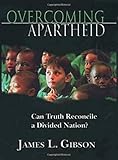
James L. Gibson. Overcoming Apartheid: Can Truth Reconcile a Divided Nation? New York: Russell Sage Foundation, 2004. xv + 467 pp. $47.50 (cloth), ISBN 978-0-87154-312-7.
Reviewed by Lyn Graybill (Sam Nunn School of International Affairs, Georgia Institute of Technology)
Published on H-SAfrica (March, 2006)
Does Truth Lead to Reconciliation?
In seeking to prove that truth has led to reconciliation in South Africa, James L. Gibson has chosen for himself an ambitious hypothesis to test. His study is a welcome contribution to the literature on truth commissions that, up to now, has been mainly qualitative rather than quantitative. This book represents the most comprehensive study of South African attitudes to date, and the sheer mass of data collected is a remarkable accomplishment.
This volume follows the much-acclaimed work by Gibson and Amanda Gouws, Overcoming Intolerance in South Africa: Experiments in Democratic Persuasion, in which he posed a set of questions in 1996 and 1997 to the various population groups in South Africa to gauge their beliefs, attitudes, and values.[1] This book repeats those questions in 2000 and 2001, making it possible to track changes in opinions over the last five years.
As he attempts to test empirically the hypothesis that truth led to reconciliation in South Africa, "truth" for Gibson means the truth as promulgated by the Truth and Reconciliation Commission. He views "reconciliation" as comprising four specific subsets: interracial reconciliation, political tolerance, support for a human rights culture, and legitimacy of government institutions.
I was somewhat disturbed by Gibson's conflating truth with the TRC's version of the truth. In most analyses of the TRC that assert the value of truth-telling processes in promoting reconciliation, the emphasis is on the efficacy of telling the truth (for the victim, on telling one's story; for the perpetrator, in confessing one's misdeeds). It is assumed by many scholars that telling one's story before a supportive audience leads to personal healing, and to reconciliation between individuals and ultimately the nation at large, though this process is often unanalyzed and accepted perhaps too readily as a given. Likewise, some analysts point to the cathartic value of hearing a perpetrator confess (tell the truth), or the value to a perpetrator to unburden his conscience and so be reconciled with the one harmed.
Gibson, however, is not interested in these aspects of truth-telling. He is concerned with one thing alone--the truth as espoused by the TRC, meaning the view that while apartheid was a crime against humanity, atrocities were committed by all sides, government and resistance, and that all such acts should be condemned. What Gibson is testing, therefore, is not whether truth-telling processes lead to reconciliation, but rather whether accepting a particular version of the truth about the past (a collective memory that asserts that all sides are to blame and have dirty hands) leads to reconciliation. For Gibson, this truth has led to reconciliation to the extent it has because "it is difficult indeed to reconcile with ultimate evil. It is less difficult to reconcile with more moderate evil, especially when one's own side is tainted as well. Moral relativism, I hypothesize, contributes to reconciliation" (p. 76). Because the TRC documented atrocities on all sides, many South Africans were able to acknowledge that the other side was also victimized. Gibson writes, "Sharing responsibility, blame, and victimhood evens the score ever so slightly, providing a basis for dialogue. When people are no longer dogmatically attached to a good-versus-evil view of the struggle, a space for reconciliation can be opened" (pp. 158-159). This is an important insight.
Gibson is not unaware of the alleged value of truth-telling to victim and perpetrator alike. In chapter 7, which he concedes is a "digression," he addresses the question of how to compensate victims for the inherent injustice of granting amnesty. Along with retributive justice (punishment), and distributive justice (compensation), he posits procedural justice (giving voice to victims), and restorative justice (apologies by perpetrators) as a way to mitigate the justice deficit.
Following the three introductory chapters that lay out the hypothesis, the "truth-reconciliation" hypothesis is tested in chapters 4, 5, 6, and 8. Each chapter takes up one of the four subsets of reconciliation. In every instance, Gibson investigates the hypothesis that "those South Africans who accept the truth as documented by the TRC are more likely to be reconciled" (pp. 7-8). A reconciled South Africa would be one which "eschews racial stereotyping"; "is tolerant of those with whom he disagrees"; accepts "the universal application of human rights protections to all South African(s)"; and "recognizes the legitimacy of South Africa's political institutions" (p. 17).
What are his findings? On racial reconciliation, the results are not encouraging: "If reconciliation requires interracial understanding, then a majority of South Africans of every race are not reconciled" (p. 122). Blacks were found to hold the least reconciled attitudes of all race groups. The causal link between truth and reconciliation is complex: among whites, accepting the TRC's version of truth leads to reconciliation but those already more reconciled are more likely to accept that truth. For blacks, truth does not lead to reconciliation; nor does reconciliation lead to truth acceptance (p. 156). Yet Gibson is not discouraged by the results, since "racial reconciliation in South Africa is perhaps more common than might be expected in light of the country's history of racism and racial separation and domination" (p. 131).
His findings on support for a human rights culture are equally disturbing. Gibson equates support for a human rights culture with respect for the rule of law, or legal universalism. Polling indicates that respect for the rule of law is not widespread. Again, racial differences exist, with blacks the least likely to accept the rule of law, and whites the most likely. What contribution did the TRC make in increasing respect for rule of law? Not much, says Gibson, who notes that attitudes in 2001 remained remarkably similar to those in 1996. However, those who did accept the truth about the past produced by the TRC were more likely to support the rule of law. At the very least, the TRC did not undermine respect for the rule of law.
A key component of reconciliation is tolerance of political enemies, the ability to put up with unpopular groups. Gibson finds that "in general, South Africans tend to feel quite negatively toward their political foes" (p. 219). Negative views of the ANC by whites are widespread, as are negative views of Afrikaners by blacks, mimicking the 1996 results. Again, blacks are the most intolerant, whites the most tolerant among race groups. Gibson bemoans the fact that "political tolerance is in relatively short supply in South Africa" (p. 234). Does truth acceptance lead to less animosity toward political groups? Gibson finds that among most South Africans, truth acceptance does not seem to play a major role in shaping toleration. But, putting a positive spin on the data, Gibson writes, "It is important to note that truth acceptance does not contribute to intolerance, even if its influence on tolerance is limited" (p. 251). Gibson theorizes that tolerance may possibly be achieved at advanced stages of reconciliation.
The fourth aspect of reconciliation, the legitimacy of political institutions, is the subject of chapter 8. In particular, Gibson looks at the willingness of South Africans to accept the national Parliament and Constitutional Court, the two institutions that are the backbone of the New South Africa. He finds that the Court has achieved only low to moderate legitimacy, and legitimacy has not increased over the last five years. Racial differences exist; blacks are more willing than whites to express support for both the Court and Parliament. Gibson concludes, "To the extent that political reconciliation requires that all South Africans express a basic loyalty to the primary institutions of democracy, then reconciliation has a long way to go" (p. 323). Unlike the other chapters, Gibson does not attempt to assess how truth acceptance contributes to accepting or not accepting these two institutions. With this subset of reconciliation, he does not test the truth-reconciliation hypothesis.
Is truth acceptance a predictor of reconciliation? Although the evidence suggests otherwise, Gibson ends on a positive note. While none of the racial groups are reconciled in terms of tolerance, all are "somewhat reconciled" in terms of institutional legitimacy. Reconciliation in terms of interracial attitudes and support for human rights falls somewhere in between. He argues that even if racial attitudes, political tolerance, support for a human rights culture, and loyalty to institutions do not fully exist, the fact that 44 percent of South Africans is at least somewhat reconciled bodes well for the future. South Africans' acceptance of a common view of the past (the one promulgated by the TRC) should be viewed as "perhaps the first tentative step toward reconciliation" (p. 129).
Gibson's study fails to prove a causal link between truth and reconciliation, and he concedes that the relationship needs further study. Nevertheless, his bold attempt to try to answer the question, "Does truth lead to reconciliation?" is welcome as an innovative approach. This book is a must read for transitional justice scholars, although the non-specialist will find the survey research theorizing too technical, and copious charts distracting. To aid the non-social scientist, each chapter ends with a concise summary of the findings and arguments in a "Concluding Comments" section which helps pull together the data and various arguments. Future qualitative researchers may find Overcoming Apartheid a useful jumping off point for their own research.
Note
[1]. James L. Gibson and Amanda Gouws, Overcoming Intolerance in South Africa: Experiments in Democratic Persuasion (New York: Cambridge University Press, 2003).
If there is additional discussion of this review, you may access it through the network, at: https://networks.h-net.org/h-safrica.
Citation:
Lyn Graybill. Review of Gibson, James L., Overcoming Apartheid: Can Truth Reconcile a Divided Nation?.
H-SAfrica, H-Net Reviews.
March, 2006.
URL: http://www.h-net.org/reviews/showrev.php?id=11599
Copyright © 2006 by H-Net, all rights reserved. H-Net permits the redistribution and reprinting of this work for nonprofit, educational purposes, with full and accurate attribution to the author, web location, date of publication, originating list, and H-Net: Humanities & Social Sciences Online. For any other proposed use, contact the Reviews editorial staff at hbooks@mail.h-net.org.

