



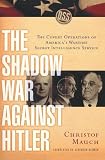
Christof Mauch. The Shadow War against Hitler: The Covert Operations of America's Wartime Secret Intelligence Service. New York: Columbia University Press, 2003. x + 352 pp. $21.00 (paper), ISBN 978-0-231-12045-6.
Reviewed by Patricia Kollander (Department of History, Florida Atlantic University)
Published on H-German (March, 2006)
America's First Central Intelligence Agency vs. Hitler
The Shadow War against Hitler is the translation of Christof Mauch's Schattenkrieg gegen Hitler. The project, which began as a study about the German resistance to Hitler, shifted focus when Mauch discovered that the head of U.S. intelligence knew a great deal more about the German resistance than was previously suspected. After studying several miles of documentation, Mauch produced a work that skillfully illuminates the history of the first central U.S. intelligence agency, the OSS, which was founded in order to compromise the power of Hitler's Germany during World War II.
Mauch reveals that the OSS was not a highly functional organization. As Mauch puts it, "The Office of Strategic Services operated as a kind of polyp whose tentacles became active in the most diverse range of fields, even if not always with the kind of coordination required" (p. 17). To make matters worse, it was "viewed with hostility by several government offices" (p. 18). Mauch suggests that the only glue that held the various agencies of the OSS together was a mutual desire to defeat Germany (p. 18).
Franklin Roosevelt appears not to have been terribly impressed by the OSS either. Mauch reveals that he and his predecessors wielded enormous power where intelligence was concerned. Since the time of George Washington, presidents had been authorized by Congress "to spy as part of the executive power" and were granted the "right to undocumented expenses ... for the purposes of espionage" (p. 10). Roosevelt used this special power with aplomb; he preferred to rely on his own instincts to handle strategic problems rather than on the OSS. Instead of using government intelligence agencies, he enlisted a journalist, John Franklin Carter, to run a small and secret intelligence organization that collected information on a diverse group of subjects ranging from the location of European oil reserves to a study of Hitler's psyche. Mauch points out that during the Casablanca Conference of 1943, FDR "did not seem to have all that much interest in his secret intelligence service as an authority on strategy or political consulting" (p. 73). Indeed, FDR made his decisions regarding the conquest of "Fortress Europe" without even consulting OSS head William Donovan.
Although the OSS was handicapped by its haphazard organization and by the fact that it was often ignored by the President, it did score important wartime successes. Its operations helped to shorten the war in Europe. More important, the OSS also underwent an important metamorphosis during the war that was key to its postwar survival--it overcame resistance to Donovan's belief that the United States could defeat its enemies by adopting their unsavory methods, such as "black" propaganda and covert operations. This shift in intelligence-gathering methodology in turn led to successful postwar missions--conducted by the successor agency to the OSS, the CIA--designed to keep as many European countries as possible away from the orbit of America's postwar enemy, the Soviet Union.
This exhaustively researched book tells a fascinating and important story; it is as much a history of the origins of the CIA as it is a history of secret operations against Hitler. It is ideally suited for advanced undergraduates and graduate students, as it assumes that readers have more than rudimentary knowledge about the history of World War II (the Katyn Massacre, for example, is mentioned on page 53 with no introductory explanation).
Since the publication of this book, millions of pages of wartime intelligence have been declassified through the Interagency Working Group. Scholars of the Second World War should look to Mauch's work to provide a template for analysis of this important subject.
If there is additional discussion of this review, you may access it through the network, at: https://networks.h-net.org/h-german.
Citation:
Patricia Kollander. Review of Mauch, Christof, The Shadow War against Hitler: The Covert Operations of America's Wartime Secret Intelligence Service.
H-German, H-Net Reviews.
March, 2006.
URL: http://www.h-net.org/reviews/showrev.php?id=11576
Copyright © 2006 by H-Net, all rights reserved. H-Net permits the redistribution and reprinting of this work for nonprofit, educational purposes, with full and accurate attribution to the author, web location, date of publication, originating list, and H-Net: Humanities & Social Sciences Online. For any other proposed use, contact the Reviews editorial staff at hbooks@mail.h-net.org.

