

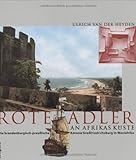
Ulrich van der Heyden. Rote Adler an Afrikas KÖ¼ste: Die brandenburgisch-preuÖŸische Kolonie GroÖŸfriedrichsburg in Westafrika. Berlin: Selignow, 2001. 105 pp. EUR 29.90 (cloth), ISBN 978-3-933889-04-1.
Reviewed by Michelle Moyd (Department of History, Cornell University)
Published on H-German (March, 2006)
Gaining an Imperial Foothold: Großfriedrichsburg and the Brandenburg-Africa Company on the Gold Coast, 1683-1724
In this slim and beautifully illustrated volume, Ulrich van der Heyden exposes another facet of Germany's colonial past, adding to the increasing numbers of works engaging with German colonial history in meaningful ways. Rote Adler traces the history of the late seventeenth-century development, implementation, and demise of plans by Elector Friedrich Wilhelm of Brandenburg to establish and maintain a presence on the West African coast in the region that is today Ghana.
Beginning in 1683, Friedrich Wilhelm commissioned the construction of a major fortress complex known as Großfriedrichsburg that stretched over some fifty kilometers of the Gold Coast (p. 34). This decision went hand in hand with the conception and acquisition of a small navy through the initiative of the Dutch merchant Benjamin Raule. This small fleet gave Friedrich Wilhelm the ability to project military power overseas and to thus begin participating in the international trading networks that had enriched other European nations in the preceding century. The trading company founded to promote Brandenburg's economic interests overseas, the Brandenburg-Africa Company, operated out of the Großfriedrichsburg location for nearly four decades, achieving its "high point" in 1686 (p. 38). The company never achieved the size or financial successes of its better-established European rivals along the coast, and indeed was plagued with financial problems and mismanagement throughout its history, but it was nonetheless thoroughly enmeshed in the international trading networks and power dynamics of the period. The fort was finally taken over by the Dutch in 1724 after Friedrich Wilhelm's uninterested son and successor Friedrich III ascended the throne. Then his grandson, Friedrich Wilhelm I of Prussia, sold the fort to the Dutch-West India Company for 6000 ducats in 1717.[1]
It would be another 160 years before Germany again occupied territory in Africa. But although formal German colonialism did not begin until the late nineteenth century, sound arguments can be made that the Brandenburg-Africa Company and its posts in West Africa were, at the very least, economic forerunners to the colonialism of the imperial period. Some will predictably argue that in historical terms the Brandenburg project in West Africa was inconsequential due to its brevity. But the fact that the Brandenburg-Africa Company profited from the Atlantic slave trade makes it worthy of consideration as part of the longer story of German colonial ambitions and the reverberations of those ambitions in Germany and elsewhere. Certainly colonial enthusiasts during the Kaiserreich viewed the Brandenburg project as part of their heritage (p. 9). By placing the history of the Brandenburg-Africa Company within the complex history of European expansion during this time, van der Heyden both reminds us of a neglected history and shows us why it should be more widely known in historiography.[2]
One of the strengths of the study is that it pays equal attention to both the African context within which the story of the Brandenburg-Africa Company unfolded, and the Brandenburg context that set it in motion. He acknowledges that source material on the lives of Africans around the fort is hard to come by (p. 38), but he shows us the available material, thus providing some insight into local social history. For example, van der Heyden insists that far from it being a case of Europeans simply arriving on the coast and dominating local economies and polities, European traders and soldiers often could only function in their coastal environs because of the good will of Africans who lived around the forts. These African coastal dwellers agreed to trade with and provision them (p. 61). Trading companies brought military force to bear, but the small numbers of troops, their inadequate resistance to tropical disease and climate and lack of familiarity with local languages and cultures made them vulnerable and detracted from their overall effectiveness. Thus companies like the Brandenburg-Africa Company were in a precarious and dependent position. Fierce competition between various European companies from France, Britain and the Netherlands posed its own threats to Brandenburg's interests and ability to maintain a presence on the Gold Coast over time.
Van der Heyden also gives us an intelligent reading of the myth and history of Jan Conny. Conny was a local African leader and agent or "middleman" who became known in German history as the "Black Prussian," the defender of Brandenburg-Prussia's interests against British and Dutch aggressors. Van der Heyden dispels the notion that Conny was merely a collaborator, arguing instead that he pursued his own economic interests in defending Großfriedrichsburg from seizure by the Dutch until 1724 (pp. 83-89). Although the Dutch had tried to take over the fort shortly after purchasing it from Friedrich III in 1717, Conny fought against them and defeated them in 1718. This action delayed Dutch plans to occupy the fort until 1724, and secured Conny's place in German lore as a loyal servant of Brandenburg. Yet according to van der Heyden, Conny's actions likely had far more to do with local legal conceptions of land rights, in which land could only be rented, not owned, by Europeans (p. 86). His "loyalty" to Prussia was thus a side effect of his own navigation of complex coastal politics.
The development of overseas trading interests affected Brandenburg and other German regions as well. Berlin suddenly became an important trading hub and the site of a new admiralty. Meanwhile Emden, the company headquarters, provided not just a harbor, but also transformed itself into a significant military garrison (p. 35). After 1683, this garrison housed three companies of marine infantry from which troops to man the West African forts were recruited. Van der Heyden thus shows how this attempt to establish a colonial presence in Africa was intricately interwoven with Brandenburg's military history during this period.
By far the best argued and most interesting section of the book is "The Great Elector as Slave Trader," in which the author outlines the extent of Friedrich Wilhelm's and Brandenburg's involvement in the Atlantic slave trade. Through the use of a few key surviving documents of the era, van der Heyden gives a detailed account of the extent of the Brandenburg-Africa Company's involvement in the Atlantic slave trade. He concludes that "the Brandenburg slave trade was--despite claims to the contrary--meaningful enough ... to be considered the 'foundation of the company'" (p. 52). Indeed, it was the "decisive reason for the founding of the company, and perhaps even the whole maritime and colonial undertaking generally" (p. 52). This section includes excerpts of contemporary texts by German observers that relate experiences of African captives victimized by the slave trade in vivid and harrowing detail. This innovative section makes clear that slavery has its place in Germany's history despite the relatively small numbers of people involved. Noting the grim descriptions of life on a German slave ship recorded by barber-surgeon Johann Peter Oettinger in his diary in 1693, van der Heyden concludes "Surgeon J. P. Oettinger's account comes from just one voyage! How many similar transports of unfortunate Africans might have been organized by the Brandenburgers?" By posing this question, van der Heyden suggests that the human costs of Germany's involvement in this trade were hardly inconsequential (p.55).
The volume is richly illustrated with excerpts of primary texts interspersed throughout, making it a more complex text than a cursory glance would reveal. The layout of the text is sometimes confusing, and while the inclusion of so many primary sources is commendable, they could be better explained or integrated into the general text. Similarly, plates sometimes seem randomly placed in the book, and are rarely explained beyond brief captions. Many of these could be fruitfully analyzed as pictorial texts themselves. Van der Heyden's language choices are also sometimes misguided, carrying over usage of terms like Häuptling (chief) and Stamm (tribe) with no elaboration of the problematic nature of such terminology.[3] In a discussion of the West African coastal region and its peoples, he remarks, "The Fanti are described in the colonial literature as 'true Negroes' [echte Neger]", but it is not clear what point he wants to make with this statement, or why it is necessary to repeat this colonial description. Given that this is a revised second edition (the first appeared in 1993), it is odd that van der Heyden did not take the opportunity to move on from such unconstructive terminology. These problems stand out all the more given van der Heyden's laudable efforts throughout the text to attribute agency to Africans, and to understand them as key participants in the Großfriedrichsburg story.
It is a shame that this book is only available in German, as perhaps it would be more useful to Ghanaians if it had been written in English.[4] Nevertheless, van der Heyden demonstrates his commitment to forging relationships between Germany and Ghana, and for reviving the memory of Großfriedrichsburg both in Germany and in West Africa. Rote Adler is a stimulating and constructive contribution to German history and West African history, and takes a positive step toward "transnational" history that tries to bridge the historiographic distance between Europe and other parts of the world.
Notes
[1]. In 1701, Elector Friedrich III of Brandenburg crowned himself Friedrich I of Prussia.
[2]. For further documentation of this early phase of German expansion overseas, see Horst Gründer, ed., "...da und dort ein junges Deutschland gründen". Rassismus, Kolonien und kolonialer Gedanke vom 16. bis zum 20. Jahrhundert (Munich: Deutscher Taschenbuch Verlag, 1999).
[3]. See recent H-Africa discussion of this theme for concerns within the Africanist scholarly community regarding the use of such terminology in English. See also Susan Arndt and Antje Hornscheidt, eds., Afrika und die deutsche Sprache. Ein kritisches Nachschlagewerk (Münster: Unrast, 2004).
[4]. But see http://www.gross-friedrichsburg.de/home.html for the associated website in English.
If there is additional discussion of this review, you may access it through the network, at: https://networks.h-net.org/h-german.
Citation:
Michelle Moyd. Review of van der Heyden, Ulrich, Rote Adler an Afrikas KÖ¼ste: Die brandenburgisch-preuÖŸische Kolonie GroÖŸfriedrichsburg in Westafrika.
H-German, H-Net Reviews.
March, 2006.
URL: http://www.h-net.org/reviews/showrev.php?id=11572
Copyright © 2006 by H-Net, all rights reserved. H-Net permits the redistribution and reprinting of this work for nonprofit, educational purposes, with full and accurate attribution to the author, web location, date of publication, originating list, and H-Net: Humanities & Social Sciences Online. For any other proposed use, contact the Reviews editorial staff at hbooks@mail.h-net.org.

