



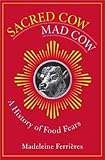
Madeleine FerriÖ¨res. Sacred Cow, Mad Cow: A History of Food Fears. New York: Columbia University Press, 2006. xiii + 329 pp. $29.50 (cloth), ISBN 978-0-231-13192-6.
Reviewed by Robin O'Sullivan (Department of American Studies, University of Texas at Austin)
Published on H-Environment (March, 2006)
The Politics of Meat and the Surveillance of Food
In times of scarcity, fear of hunger or shortage is the primary cause of food-related anxiety. In times of plenty, fear of unwholesome food predominates. Though contemporary eaters might assume that their fears about food quality are a recent phenomenon, spawned by the cornucopia of available edibles in sprawling mega-markets, perceptions of food risk have existed for centuries. Madeleine Ferrières, a professor of social history at the University of Avignon, describes various occurrences of food-related panic in Sacred Cow, Mad Cow: A History of Food Fears. Her engaging book illustrates that virtually all foods have been called into question between the Middle Ages and the twentieth century.
The increasing distance between consumers and the source of their sustenance has amplified food fears in the present-day era, but those who pause before taking a mouthful are following an extensive tradition of food surveillance. Before Pasteur, eaters had difficulty identifying the risks they saw in their food. A new discourse on food began to circulate when notions of microbes, salmonella, and vitamins came into general use. Today, food fears involve questions of pesticide in fruit, bovine growth hormone in milk, and, of course, mad cow disease from meat. Sacred Cow, Mad Cow is a useful reminder that humans have always been wary of the provisions offered to them.
Building on Mary Douglas's classic investigation of food taboos in Purity and Danger, Ferrières asserts that the fear of poisoning is a collective fear, shared socially.[1] By exploring how fears vary between countries and over time, Ferrières demonstrates that past fears are inscribed in particular ideologies and cultures. Drawing on medieval, Renaissance, and early modern primary sources, she combines the disciplines of science, law, history, and anthropology to analyze representations of risky food. She focuses on the cultural context of food fears, rather than their scientific validity. Religious, economic, medical, and social issues all played a role in nurturing incidents of food fright.
The first chapter begins in fourteenth-century Mirepoix, where the small town's lord, lawyers, professors of law, consuls, and butchers gathered to enact a regulation involving the sale of meat. They were anxious about unknown perils that might arise from meat consumption, and, according to the Mirepoix charter, their concern for public health was paramount. Mirepoix legislators took elaborate precautions with respect to eating meat, because they were obsessed with the potential danger of humans contracting animal diseases. Consequently, meat was placed under strict surveillance.
Chapter 2 elaborates on the political and legal consequences of medieval food fears. Meat was a "political foodstuff," evoking insistent standards regarding slaughter (p. 33). Regulations were meant to safeguard meat-eaters but also reflected the municipal need to increase taxes by keeping slaughtering within the city walls. The fiscal system, therefore, governed rules of slaughter. Ferrières notes that local laws may not have echoed popular opinion; using regulatory standards as sources entails the caveat that they are not simply translations of everyday behavior (p. 46).
Chapters 3 and 4 deal with the urban consumer of the ancien régime. Anxieties stemmed from the fact that "the urban consumer no longer knew what he ate and no longer ate the same things as his rural counterpart" (p. 49). Within the city, there were distinctions between the well-fed carnivores, who ate meat produced within a stringent network of inspections, and the "little people," who ate second-rate meat unencumbered by firm health laws. Doctors justified these segregated food standards, alleging that the stomach of the rich differed from the stomach of the poor. All consumers learned to protect themselves by using their five senses to select appealing odors and colors in the marketplace. Buyers took the essential precautions of eating the freshest food possible and always cooking it.
Chapter 5 discusses the "conquistador's neophobia" with respect to foodstuffs in the New World. Aversion to new things is a biological reflex, meant to prevent humans from ingesting toxic substances. Ferrières claims that timid "food habits caused a temporary slowdown in European expansion," preventing the conquistadores from cultivating new food sources (p. 83). The potato, for example, remained in culinary purgatory for nearly two centuries, in part because it was deemed by all groups except the Irish as food for pigs, not humans. Ferrières argues that neophobic attitudes toward the potato diminished gradually, until it became a familiar food to be eaten with peace of mind. However, it seems that it was not so much neophobia as misgivings about the "cultural capital" of potatoes that hindered their journey to the bourgeois dinner table. Roland Barthes's essays on prestigious "totem" foods and Pierre Bourdieu's observations on the connection between eating habits and social class would augment this section.[2]
Chapter 6 is about the "bread trials" that arose in the mid-sixteenth century, when consumption of animal protein declined, and consumption of bread increased in Europe. Chapter seven describes the quandary of doctors who sought to calm unfounded fears and raise awareness of unrecognized dangers. The doctors "used fear as a double-edged sword" (p. 152). Chapter 8 notes how pâtés prompted deep distrust, due to their mixed and disguised nature. For most foods, the market served as a health regulator, allowing only trusted foods to enter the city. Urban regulation served as a second filter. This system contributed to the imbalance between the quality of city food and that which remained in the country.
Chapters 9, 10, and 11 attend to the epizootics that caused two hundred million cattle deaths in Europe during the Enlightenment and prompted great fear of animal diseases being transferred to humans. In cities, the epizootic marked a time of stringent law and consumer advocacy. However, no danger was established with certainty, so Ferrières points out that "perhaps the only identifiable and avoidable danger was public fear" (p. 230).
Technological shifts in cooking, addressed in chapter 12, are prompted by changes in consumer taste. Copper cooking equipment developed in the modern period, and as media coverage of food risks increased, consumers became more complacent. Economic reasons, not health concerns, finally prompted the replacement of lead and copper with pottery, though consumers nonetheless benefited. Chapter 13 elaborates on the process of exiling slaughterhouses from provincial cities in the early nineteenth century. It was a slow procedure, Ferrières says, because "old habits and behavior cannot be changed by decrees" (p. 264). Industrialization helped calm food fears in the mid-nineteenth century. Chapters 14 and 15 expound upon the effects of nutrition and gastronomy on perceptions of food. Chemists promoted boiling, pasteurization, and sterilization to allay fears of impure milk. They also relayed their discoveries of calories, proteins, carbohydrates, and vitamins to the general public. In some cases, however, "knowledge did not necessarily lead to prevention" of ailments, such as English cattle disease (p. 293).
Chapter 16 takes up the industrial food revolution, which institutionalized an impersonal market. Consumers admired the miracles of refrigeration, mechanization, and shipping networks but were uneasy about products that traveled a long distance. Canned goods caused mixed feelings, though Americans were less neophobic than Europeans. When the shortening industry introduced butterine as a substitute for butter or margarine, its low price won over the working classes. By 1900, the middle classes no longer questioned the quantity and consistency of their food supply, so they directed their attention toward quality. "New nutrition" at the turn of the century promoted domestic modernism, natural products, and health foods. The first modern food crisis struck in 1906, when Upton Sinclair's The Jungle nauseated the whole world. According to Ferrières, the Pure Food and Drug Act inaugurated an era in which the twentieth-century eater left everything to intermediaries who would provide information, inspect the food, and take responsibility for judgments formerly served by each person's own senses (p. 323).
In her conclusion, Ferrières again discusses the temporal, social, and geographic variation among food fears. She avows that all perceptions of risk are connected to fear of shortages, the food circuit, and the status of food. Sacred Cow, Mad Cow is relevant to historians of food, medicine, law, folklore, and culture. Citing the greater accessibility of sources from the Mediterranean, Ferrières relies primarily on examples from Europe and the United States. The book could certainly be expanded to include cross-cultural comparisons with other food fears. Yet, it is meant to be anecdotal, rather than comprehensive, and the episodes Ferrières selects effectively demonstrate the interplay between cultural, political, and scientific factors in fostering perceptions of risk.
Notes
[1]. Mary Douglas, Purity and Danger (New York: Routledge & Kegan Paul, 1966).
[2]. Roland Barthes, Mythologies (New York: Hill and Wang, 1972), pp. 59-63. Pierre Bourdieu, Distinction: A Social Critique of the Judgment of Taste (Cambridge, Mass: Harvard University Press, 1984), pp. 178-199.
If there is additional discussion of this review, you may access it through the network, at: https://networks.h-net.org/h-environment.
Citation:
Robin O'Sullivan. Review of FerriÖ¨res, Madeleine, Sacred Cow, Mad Cow: A History of Food Fears.
H-Environment, H-Net Reviews.
March, 2006.
URL: http://www.h-net.org/reviews/showrev.php?id=11563
Copyright © 2006 by H-Net, all rights reserved. H-Net permits the redistribution and reprinting of this work for nonprofit, educational purposes, with full and accurate attribution to the author, web location, date of publication, originating list, and H-Net: Humanities & Social Sciences Online. For any other proposed use, contact the Reviews editorial staff at hbooks@mail.h-net.org.

