



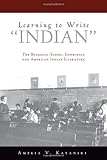
Amelia V. Katanski. Learning to Write "Indian": The Boarding-School Experience and American Indian Literature. Norman: University of Oklahoma Press, 2005. ix + 288 pp. $24.95 (cloth), ISBN 978-0-8061-3719-3.
Reviewed by David Carlson (Department of English, California State University, San Bernardino)
Published on H-AmIndian (March, 2006)
Rhetoric and Repertoire in the Shadow of the Band-Stand
In the introduction to Learning to Write "Indian", Amelia Katanski clearly reveals her sense of how best to answer the call for "de-colonizing methodologies" being made by many American Indian scholars (Devon Mihesuah, Robert Allen Warrior, Linda Tuhiwai Smith) in recent years. Throughout her book, Katanski seeks to draw heavily (but not exclusively) on the work of Indian writers to establish the critical framework through which the impact of boarding schools on Native American literature might be assessed. Diné writer Laura Tohe's 1999 poetry and prose collection No Parole Today provides Katanski with initial insight into the existence of a heterogeneous "student culture" that enabled students to negotiate the repressive colonialist pedagogies of the manual schools. Implicitly foregrounding the validity of the oral tradition and collective memory that informs Tohe's work, Katanski goes on to argue that the decades-old tradition of boarding school narratives by Indian writers provides us with clear insight into the dialectical process of self-definition that emerged from these institutions. Indian writers developed complex forms of self-expression, she maintains, by appropriating many of the same "representational tools of assimilation" that were designed to deny them a distinct tribal identity (p. 6). The title of her book refers explicitly to this rhetorical process, which Katanski also suggests can be examined through the theories of linguistic anthropologist Paul Kroskrity regarding what he refers to as "repertoires" of identity. The clearly stated goal of Learning to Write "Indian", then, is to recover a sense of both the agency and the creativity of Indian writers who came through the boarding school experience able to reinvent themselves, literarily, by drawing on such repertoires.
In chapters 1 and 2, Katanski looks at the anthropological assumptions underpinning the manual schools before focusing in detail on what she calls their "literacy curricula." Here, Richard Henry Pratt's Carlisle Indian Industrial School provides the paradigmatic example of assimilationist education. In her treatment of Carlisle, Katanski revisits somewhat familiar territory when discussing nineteenth-century evolutionary anthropology (drawn from Lewis Henry Morgan) and the "cultural replacement" model of education deployed by Pratt and his followers. She offers a more useful extension of our understanding, however, in her depiction of the school's techniques for controlling students' acts of self-representation. Katanski discusses the emergence of a range of boarding school "genres" (both written and photographic). Through these genres, she explains, "Representative Indians" were depicted by white teachers and administrators, and an idealized "Indian" voice that validated the ideal of "cultural replacement" was ventriloquized. In a persuasive Foucauldian analysis of the literary conventions of Carlisle's student newspaper, the Indian Helper, Katanski draws attention to the ways that the press functioned as a "rhetorical panopticon," actively policing student behavior through the figures of the constantly watchful "Man-on-the-Band-stand" (Pratt) and another regular columnist, "Mr See-All." Submissions by students to the Indian Helper, she further demonstrates, appeared only when those submissions reinforced the institution's views regarding identity transformation. Finally, Katanski discusses the emergence of the genre of the "returned student" story (serialized tales showing ex-Carlisle pupils struggling to cope with their "backward" relatives on the reservations). This genre reached its apogee with Indian Helper editor Mariana Burgess's appropriation and reimagination of the identities of two Carlisle students in composing her novel, Stiya: A Carlisle Indian Girl at Home (1891). Katanski opens and closes her treatment of the Carlisle curriculum by discussing Leslie Marmon Silko's reminiscences about her own family's possession of, and highly critical responses to, Burgess's novel. Framing chapters 1 and 2 in this manner allows Katanski, once again, to employ an Indian writer's perspective as the entry point into her own critical project. It also helps her to show how a colonialist genre came to provide specific inspiration for subsequent literary resistance.
In chapters 3 and 4, Katanski looks closely at a series of texts by three of the most prominent Indian writers of the Allotment-era--Francis La Flesche, Zitkala-Sa, and Charles Eastman. Compared with the earlier chapters, this part of Learning to Write "Indian" is uneven, however. Katanski's treatment of La Flesche's memoir The Middle Five (1900) succeeds in revealing a literary record of multiple models of affiliation and identity in a boarding school context. In her subsequent discussion of Le Flesche's ethnographic work and "reading" of his obituary photography, though, Katanski strains somewhat in her attempt to emphasize La Flesche's depiction of the "multivalent identities that he used to navigate through the personal and professional terrain of his life" (p. 111). Such a claim may indeed accurately reflect La Flesche's views and literary goals, but more supporting evidence would have been helpful. Following a similar pattern, Katanski's initial exploration of Zitkala-Sa's work persuasively reveals that writer's dialectical engagement with the "Indian" literature produced in the boarding schools. Repetitive treatments of Zitkala-Sa's autobiographical writings in chapter 4 detract from the power of this initial analysis, however. Katanski's reading of Eastman's Indian Boyhood (1902) in chapter 4 also breaks less new ground than one might have hoped. Indeed, it seems that Eastman's fairly strong engagement with the assimilationist discourse exemplified by the Carlisle curriculum makes him an awkward fit in the framework of this study. Perhaps sensing this, Katanski concedes that Eastman appears to be choosing one voice from a repertoire of possible identities and models of self, unlike the other authors she discusses, who write in a more multivocal manner.
In chapter 5 and the conclusion, Katanksi explores the ongoing literary reinvention of the boarding school experience in subsequent Native American writing. Her treatments of works by Luci Tapahonso, N. Scott Momaday, and Hanay Geiogamah exemplify the dynamic use which later generations of writers have made of the boarding school experience and its earlier literary depictions. Particularly intriguing is the way that Katanski explores the ways in which the Pan-Indianism paradoxically generated in the boarding schools transformed into a new form of what she calls "tribal cosmopolitanism." Learning to Write "Indian" concludes with the claim that an understanding of the history of boarding school genres can help readers today grasp an important intertextual thread in subsequent American Indian literature, one with ongoing significance for the articulation of Indian sovereignty and identity in the late stages of colonialism.
There is an extensive body of scholarship focusing on Indian boarding schools in the United States and the part they played within the overall framework of federal assimilation policy. The major innovation of Katanski's Learing to Write "Indian" is its move to examine the texts produced within (and in response to) these institutions as works of literature. Katanski also places greater emphasis than has often been the case on the adaptive rhetorical strategies of Indian students as they grappled with the oppressive educational curriculum developed by policymakers in the late nineteenth century. The result is a generally satisfying book that also provides an excellent introduction (certainly appropriate for undergraduate readers) to several important twentieth-century Indian writers.
If there is additional discussion of this review, you may access it through the network, at: https://networks.h-net.org/h-amindian.
Citation:
David Carlson. Review of Katanski, Amelia V., Learning to Write "Indian": The Boarding-School Experience and American Indian Literature.
H-AmIndian, H-Net Reviews.
March, 2006.
URL: http://www.h-net.org/reviews/showrev.php?id=11556
Copyright © 2006 by H-Net, all rights reserved. H-Net permits the redistribution and reprinting of this work for nonprofit, educational purposes, with full and accurate attribution to the author, web location, date of publication, originating list, and H-Net: Humanities & Social Sciences Online. For any other proposed use, contact the Reviews editorial staff at hbooks@mail.h-net.org.

