

Markus Völkel. Geschichtsschreibung: Eine Einführung in globaler Perspektive. Köln: Böhlau Verlag, 2006. 400 S. EUR 29.90 (cloth), ISBN 978-3-412-19605-9.
Reviewed by Christian Goeschel (Darwin College, University of Cambridge)
Published on H-German (March, 2006)
Feminism, Colonialism, and Nazism
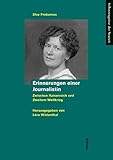
These are the edited memoirs of the journalist Else Frobenius (1875-1952), a feminist nationalist, whose career extended from Imperial Germany to the Third Reich. Scholars of the German women's movement and of German colonialism have already studied aspects of Frobenius's career. In this volume Lora Wildenthal, drawing upon her previous work on women in the German colonial movement, presents Frobenius's hitherto unpublished memoirs, "Der goldene Schlüssel: Erinnerungen aus meinem Leben." In a brief introduction, Wildenthal suggests that Frobenius's memoirs shed new light on the emergence of women as active citizens in Imperial, Weimar and National Socialist Germany. Frobenius's memoirs reveal how many women supported the Nazis early on. Written between late 1942 and October 1944 during the Allied bombings of Berlin, Frobenius's memoirs are characterized by a self-righteous tone, portraying Germans as victims of (among other things) Versailles and the Allied bombings. In her preface, for instance, Frobenius laments the destruction of her library and archives in an Allied air raid. As Wildenthal rightly points out, Frobenius does not refer at all to the persecution of Jews, although she had many Jewish colleagues when she wrote for the Deutsche Allgemeine Zeitung during the Weimar years.
Born in what is today Latvia, Frobenius grew up in a German pastor's family. Her German nationalism probably stemmed a great deal from a childhood spent in a Russian-dominated region with a sizeable, culturally separate German minority. Describing her failed first marriage to a Junker, Frobenius turns to a typically National Socialist depiction of the Bolshevik Revolution, which arrived in the Baltic states only in late 1918, after Germany's defeat. Bolshevik terror and the diseases that the Bolsheviks allegedly brought with them led to her father's death in April 1919, after which Frobenius's family moved to Germany. Frobenius describes her new life as a divorced woman in Berlin in 1908. Here she attended lectures at the university; she also met Erich Schmidt, a leading literary historian who introduced her to the Berlin press. She soon became a regular reporter for Berlin papers and was a major contributor to the new genre of women's newspaper sections. In this section of her memoirs, Frobenius also focuses on her political activities as a right-wing feminist and colonialist who lamented the loss of German territories in the East and the colonies. Like many Germans at the time, Frobenius was gravely offended by the Versailles Treaty and insisted, following President Wilson's Fourteen Points, that German minorities abroad must be given the right to self-determination. While she welcomed the granting of female suffrage in the Weimar constitution, Frobenius did not support the Weimar Republic. In 1933, the Frauenbund der Deutschen Kolonialgesellschaft was Nazified. Frobenius became a local functionary of the Nazi Reichskolonialbund in Berlin. Her memoirs end with her complaints about the destruction of Berlin.
These somewhat inconclusive memoirs are a contemporary account of why a feminist became a Nazi. A brief biographical sketch of Frobenius's life would have been helpful to make her memoirs intelligible to a non-specialist audience. Some more interpretation of these memoirs and comprehensive commentary locating Frobenius's life within a wider sociopolitical context would have been useful as well, especially for those unfamiliar with the German women's and colonial movements. This volume will be a useful source for scholars of the German women's movement, however, especially those seeking to understand fascism's popularity among women. This book is also a potential contribution to the study of fascism as a "cultural movement," as the late historian George Mosse demanded, in order to see "fascism as it saw itself and as its followers saw it, to attempt to understand the movement on its own terms."[1] These memoirs offer new insights into the life of an upper-middle-class professional woman and contribute to a cultural history that "centers above all upon the perceptions of men and women, and how these are shaped and enlisted in politics at a particular place and time."[2]
Note
[1]. George L. Mosse, The Fascist Revolution: Toward a General Theory of Fascism (New York: Howard Fertig, 1999), p. x.
[2]. Ibid., p. xi.
If there is additional discussion of this review, you may access it through the network, at: https://networks.h-net.org/h-german.
Citation:
Christian Goeschel. Review of Völkel, Markus, Geschichtsschreibung: Eine Einführung in globaler Perspektive.
H-German, H-Net Reviews.
March, 2006.
URL: http://www.h-net.org/reviews/showrev.php?id=11535
Copyright © 2006 by H-Net, all rights reserved. H-Net permits the redistribution and reprinting of this work for nonprofit, educational purposes, with full and accurate attribution to the author, web location, date of publication, originating list, and H-Net: Humanities & Social Sciences Online. For any other proposed use, contact the Reviews editorial staff at hbooks@mail.h-net.org.

