



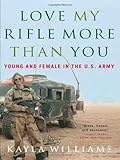
Kayla Williams, Michael E Staub. Love My Rifle More Than You: Young and Female in the US Army. New York: W.W. Norton & Company, 2005. 290 pp. $24.95 (cloth), ISBN 978-0-393-06098-0.
Reviewed by Noonie Fortin (Retired U.S. Army Reserve First Sergeant)
Published on H-Minerva (March, 2006)
Raw and Intense
Kayla Williams was an enlisted Arabic Linguist who deployed in February 2003 with the U.S. Army's 311th Military Intelligence Battalion attached to the 101st Airborne Division for the initial push into Iraq. As a retired enlisted woman, I was looking forward to the author discussing her wartime experience while in-country.
Williams was stationed throughout Baghdad, Mosul, Tal Afar, and a few other places. Her team worked long hours and also had to pull guard duty. The soldiers had some free time, sometimes too much. They met the locals in the various communities and made friends with some, until the military criticized their friendship. She had to assist with an interrogation and did not like what she was ordered to do, but all she said was that she was not going to be a part of any more interrogations. Although she knew what happened was wrong, she did not speak up about it until after the incident at Abu Ghraib. The author also expressed her feelings about the war and believes the war was all about oil.
Most of the content of the book seemed to be more about the sexual harassment that went on while she was in Iraq. She explained that she wrote this book "to let people know what it feels like to be a woman soldier in peace and in war" (p. 15). There were times when I thought that she should have expected some of the harassment, but then there were other times when I began to feel her pain. Although Military Intelligence is largely female, Williams usually worked alone with the Infantry soldiers for days and described the verbal harassment she received from many of the men.
Williams wrote that "Sometimes, even now, I wake up before dawn and forget I am not a slut.... The only other choice is bitch. If you're a woman and a soldier, those are the choices you get" (p. 13). Although she wrote about the harassment the entire time she was in-country she really did not say that she attempted to do anything about it. I thought she should have gone to someone and reported it but if she did, it was not brought out in this book.
One particular incident deserves mention. Williams's unit cleared a community and marked an area that had unexploded ordinance in it, but that did not stop the local people from going near the area. Her group had to leave to check somewhere else. A few days later they were back in the same area due to an explosion. "We find three locals on the ground, bleeding.... One guy ... worse off.... I reassure him in Arabic.... I'm holding the badly hurt guy's legs, covered in drying blood" (pp. 131-133). Williams may have been trying to show her unit was too understaffed to deal with this and other situations.
I wanted to read about life in Iraq for a young enlisted female soldier and while some of that was included, this book was mostly about verbal and sexual harassment. However, the author never really addressed the harassment she endured and it did not come across to me that she did anything about it. In addition, Williams described her experiences in the military but did not point out what other women experienced.
While I know that soldiers swear a lot, I was somewhat upset by the amount of foul language throughout her book. Thus, at first I was not impressed with the work. However, as the author brought out more about her wartime experiences, it did improve. Even though the author made it sound like most of her NCOs and officers were screw-ups, it did have its good points. It showed that sexist attitudes have not changed much over the years, how far women have come in their fields of expertise, and how strong-minded the women are today. They can be on the front lines.
Would I recommend this book? Yes! I think it is worth being read by everyone. Is it a good book? Not particularly, as the author wrote about several important points but did not seem to do anything to improve them. For example, she left me wondering why she did not complain about the interrogation in which she participated. And, since much of her text was about sexual harassment, I wonder why she did not complain about it to higher-ranking authorities. In this day and age I find it hard to believe that her rank held her back from saying something about these things to her superiors. However, this book can be used to show how attitudes still need to change within the military. I am glad to see that she has written a frank book about her time in-country. More enlisted women should do this!
If there is additional discussion of this review, you may access it through the network, at: https://networks.h-net.org/h-minerva.
Citation:
Noonie Fortin. Review of Williams, Kayla; Staub, Michael E, Love My Rifle More Than You: Young and Female in the US Army.
H-Minerva, H-Net Reviews.
March, 2006.
URL: http://www.h-net.org/reviews/showrev.php?id=11509
Copyright © 2006 by H-Net, all rights reserved. H-Net permits the redistribution and reprinting of this work for nonprofit, educational purposes, with full and accurate attribution to the author, web location, date of publication, originating list, and H-Net: Humanities & Social Sciences Online. For any other proposed use, contact the Reviews editorial staff at hbooks@mail.h-net.org.

