



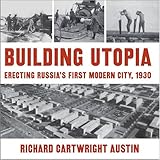
Richard Cartwright Austin. Building Utopia: Erecting Russia's First Modern City, 1930. Kent: Kent State University Press, 2004. 225 S. $45.00 (cloth), ISBN 978-0-87338-730-9.
Reviewed by Karl Qualls (Department of History, Dickinson College)
Published on H-Russia (March, 2006)
A Failed Promise
As the Soviet Union embarked on crash industrialization in the late 1920s and 1930s, leaders sought massive increases in production and a transformation in daily life. In Building Utopia, Richard Austin seeks to illuminate the process of erecting a new city and automobile factory just outside of Nizhnyi Novgorod (Gorky). Through the letters of his father, a low-level engineer and son of the president of Austin Company of Cleveland, Richard Austin intends to show an American's perspective on the emerging Soviet utopia. The Austin Company, known for its large-scale industrial plants, had secured a contract from the Soviet government to construct both the city and factories, and Allan Austin became the youngest engineer sent to Gorky to work on the project. His letters home, mostly to his parents, had been bound and preserved but had remained unnoticed until about a decade ago when author Richard Austin stumbled upon them.
Scholars of the Soviet Union will find little new and surprising here. The stories of harsh winters, food shortages, inefficient bureaucracy, unstable labor pools, insufficient quality and quantity of building products are ever-present in Austin's letters. But numerous other books on Soviet industrialization have made these points clear. The only novelty here is the perspective of an American capitalist and devout Methodist in Gorky. Allan Austin's letters home give us insight into American business practices and relations with various Soviet entities. Unfortunately, because Richard Austin chose to focus almost exclusively on the letters, we have little understanding of the Soviet perspective except for a few vaguely cited memos and newspaper accounts. In no way does this book reach the level of Stephen Kotkin's monograph on Magnitogorsk or John Scott's first-hand account of the same.[1]
In the long letters reproduced verbatim in this handsomely illustrated book, the most striking conclusion one will draw (but which the author does not) is that Allan Austin was distant from and ignorant of the society around him. Clearly, his inability to speak and read Russian made him only the most casual of observers. Without the aid of his translators, who changed frequently, he was unable to communicate with the Russians around him. Unlike John Scott, he seemed to have few meaningful conversations with his Russian counterparts on politics, art, economics, international affairs, or even industrial development. Thus, readers of his letters and this book gain few insights into daily life of the Russian workers on the construction site. Instead, they will find Allan Austin detailing his purchases at the market, complaining about construction delays, and praising his wife's lemon pie. Occasionally, when writing about the paucity of food and heat, Allan Austin reported to his father that he believed Russians probably had it worse. His lack of certainty in these anecdotes speaks volumes.
Author Richard Austin, a minister and not a historian, has written a book of likely interest to his family and to readers interested in American international business during the Depression, but readers of this list will find it more frustrating than useful. While it could serve as an interesting coffee table book (it appears to have developed out of a guide for an exhibit), its lack of scholarly rigor will put off most scholars and educators looking for a classroom text. For example, on the rare occasion that he cites archival material (and he admits to only one week of research in Gorky's regional archive!) he notes only the archive name with no indication of the fondy or dela. Even though the preface states that he had colleagues in Russia who gathered some information from the local archive and museum, the footnotes do not lead readers to those materials. Moreover, because Richard Austin, like his father, does not read Russian, he relied on translators. One can only wonder how accurate the translations are from the uncited material. If the poor translations that accompany photographs of banners and posters are any indication, then the accuracy of the account must be questioned. To cite just one example, the caption translation of "boevoi smotr revoliutsionnykh sil mirovogo proletariata" is rendered "Glorious Demonstration of Revolutionary Forces of the Young Proletariat"! (p. 34)
At other times the author is uncritical of his sources. Whether because Austin is not trained as a historian or because he is writing about his father, there is a distinct lack of context. When Allan Austin wrote that participants in the May Day celebrations were "solidly and actively behind their government" and were "the most representative and well-dressed" group he had seen, Richard Austin provides no context for this and shows no knowledge of the abundant scholarship on celebrations.[2] Of collectivization Richard Austin notes that "Stalin struggled to impose novel collective structures under direct party supervision. These efforts disorganized agriculture and decreased production" (p. 41). This understatement is compounded a page later when Austin states that Stalin's "Dizzy with Success" speech ordered a halt to collectivization. He fails to point out, however, that collectivization rapidly increased later that year. There is no use of the voluminous scholarship on those topics in either the notes or the bibliography. In fact, the bibliography contains only a handful of secondary sources on Russia (James Billington's Icon and the Axe (1966); Orlando Figes's A People's Tragedy, (1997); and Sidney Harcave's Russia: A History, 1953). The only pertinent source noted is Kurt Schultz's 1990 article on the construction of the auto factory in Gorky.[3]
Kent State's editors could have helped Austin in formulating this text. Rather than laying out the letters in chronological order, it might have helped to have a clear thesis and thematic organizing structure. Moreover, although many letters are reproduced in total, others are excerpted without an explanation of the omissions.
In short, if one wants an easy read through numerous letters of a young American in the Soviet Union, then Building Utopia might suffice. If someone is more interested in analyzing and interpreting the meaning of the letters and the person who wrote them, fortunately the research materials have been preserved at the Western Reserve Historical Society.
Notes
[1]. Stephen Kotkin, Magnetic Mountain: Stalinism as a Civilization (Berkeley: University of California Press, 1995); John Scott, Behind the Urals: An American Worker in Russia's City of Steel (Boston: Houghton Mifflin, 1942).
[2]. See, for example, Karen Petrone, Life Has Become More Joyous, Comrades: Celebrations in the Time of Stalin (Bloomington: Indiana University Press, 2000); and James von Geldern Bolshevik Festivals (Berkeley: University of California Press, 1993).
[3]. Kurt S. Schultz, "Building the 'Soviet Detroit': The Construction of the Nizhnii-Novgorod Automobile Factory, 1927-1932," Slavic Review 49 (Summer 1990): pp. 200-212.
If there is additional discussion of this review, you may access it through the network, at: https://networks.h-net.org/h-russia.
Citation:
Karl Qualls. Review of Austin, Richard Cartwright, Building Utopia: Erecting Russia's First Modern City, 1930.
H-Russia, H-Net Reviews.
March, 2006.
URL: http://www.h-net.org/reviews/showrev.php?id=11499
Copyright © 2006 by H-Net, all rights reserved. H-Net permits the redistribution and reprinting of this work for nonprofit, educational purposes, with full and accurate attribution to the author, web location, date of publication, originating list, and H-Net: Humanities & Social Sciences Online. For any other proposed use, contact the Reviews editorial staff at hbooks@mail.h-net.org.

