



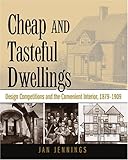
Jan Jennings. Cheap and Tasteful Dwellings: Design Competitions and the Convenient Interior, 1879-1909. Knoxville: University of Tennessee Press, 2005. xxxv + 313 pp. $48.00 (cloth), ISBN 978-1-57233-360-4.
Reviewed by Elizabeth Cromley (School of Architecture, Northeastern University)
Published on H-Urban (March, 2006)
Competing Designs for Convenient Houses
Jan Jennings has produced an imaginative study of the periodical Carpentry and Building (C&B), a magazine that held thirty years' of design competitions mainly for small, inexpensive houses between 1879 and 1909. The magazine saw itself as devoted to "practical building" rather than excessively artistic work, and wanted to get architect-designed projects to the general public in order to raise the general level of U.S. house-building. Builders, amateurs, and architects all entered these competitions and the winning designs were published in order to give all readers free access to them. C&B also encouraged readers to submit information on their practices and criticism of current architectural production in order to share practical information with others and raise standards in the world of building.
Using the information in this periodical, Jennings develops several strands of history. She is interested in the designs themselves and analyzes them to uncover contemporary definitions of comfort and convenience. She is also curious about the competitors and uses their biographies to construct a portrait of the emerging architectural profession, particularly how its members competed with or allied themselves with carpenters and builders. Jennings assesses the architectural education available in this time period--one in which the first architecture schools were emerging, but which also had numerous correspondence schools and self-help books that people could use to teach themselves drafting skills. Her inquiry into the material culture of design firms and the organization of professional offices is fascinating. She provides photographs of the interiors of offices and describes and illustrates the equipment that architects would expect to use including drafting tools and blue-print machines.
Publications for those in the building trades are also of interest to Jennings. She locates the C&B publication within a history of architectural publishing in the nineteenth and early twentieth centuries. First, builders' guides came on the market, instructing workmen on how to shape pieces of wood to make suitable columns or staircases, or enframe fireplaces. Style books made the current European styles available to American builders who were not able to educate their tastes through European travel. By the mid-century, pattern books addressed to would-be clients encouraged the middle and upper-middle class to hire architects and commission stylish abodes. By the later nineteenth century, publications offered plans and details that builders could use to execute houses, while other companies published catalogs of pre-cut building elements and even whole houses that could be purchased to assemble on the buyer's site.
Jennings analyzes the opposition inherent in the title "cheap and tasteful." Cheap could mean plain, forthright, basic ("good American" values), while tasteful suggested either frivolous, impractical, and arty(faults of fancy architects), or neat, temperate and attractive?"the qualities that C&B rewarded among the competition entries. The magazine praised middle-of the-road designs that were practical, but never stretched their stylistic tastes toward anything avant-garde.
One role of Carpentry and Building was to help codify interior living arrangements to make houses convenient no matter what the style of the exterior. A focus on interior arrangements was counter to architects' tendency to design beautiful facades and concern themselves with fashionable styles. Jennings traces architectural texts throughout the later eighteenth and nineteenth centuries, which treated exterior design as something separate from and more compelling than interior arrangements. But C&B's competitions, wanting to redress the balance and place more emphasis on convenience, encouraged builders to consult women who knew best what interior arrangements made for the most successful houses. The totality of the competition entries and the comments accompanying their publication added up to an "interior-centered philosophy" (p. 143) exposing design principles that assured a convenient, compact, economical house.
Looking closely at the floor plans of competition winners, Jennings decodes for the reader just what features were understood as producing convenience. Helpful adjacencies are praised--that is, kitchens should be right next to dining rooms, bedrooms shielded from the major entrances, nurseries near the kitchen so the mother could tend her children, and an owner's bedroom on the ground floor. Plans show the size and location of closets, which were all-important for the housekeeper who valued a tidy home. Some designers contributed furnishing plans to demonstrate exactly how a space could accommodate all the demands put upon it in a practical fashion. Jennings also analyzes the paths of movement through these house plans, showing the period's preference for a loop of circulation allowing occupants to traverse the house in a route of one or two circles. Finally she considers costs and the attempts of competition entrants to control projected construction budgets, required by competition rules that were often set for "a $1,000 house" or "a $3,000 house."
At the center of the book, Jennings includes a "Gallery" of twenty-four house elevations and plans from the span of the competition years. Informative about the stylistic and functional changes that occurred during the thirty-year time span of the competitions, these drawings will also make useful points of comparison for scholars working on other architects of this period. This set of designs supplements the several reprint editions of period pattern and plan books published over the years by Dover and the American Life Foundation, making house-design ideas of the period more accessible.[1]
The survey of Carpentry and Building's competition entries shows that over the thirty years, contributors achieved a "practical cottage" that combined convenience with the "pleasant features" of more expensive and stylish houses (p. 167). Decorative and utilitarian millwork, which was widely available from lumber mills in the later nineteenth century (and which Jennings has written about elsewhere), mediated between modestly decorated exteriors and fitted-out interiors with convenient shelves, cupboards, closets and other built-in furnishings.[2] So successful had this period's designers been in shifting the dialogue about modest house design from stylish exterior to convenience, Jennings concludes, that subsequent generations of home-seekers have simply taken convenience for granted.
Cheap and Tasteful Dwellings supplements other investigations into the history of the architecture profession. Dell Upton studied pattern books as a route to professional status, positing that they acted as advertisements for professional services in the years before the formation of formal professional organizations and credentials. Mary Woods published a recent book on how the first architecture firms were constituted and how architects formed professional associations and achieved state licensure to raise their status and secure their own professional territory.[3] Jennings's book amplifies these scholars' insights by providing a thorough look at one specific set of competitions. While her topic seems at first to be narrowly defined, the lens of Carpentry and Building allows a broader view of an American profession in the making. Her relatively brief study of correspondence schools adds a fresh and welcome dimension to existing monographs on architecture education that have focused on the architecture schools at MIT, Columbia, or Harvard.
Biographies of the competitors make up a lengthy appendix (pp. 209-265) and flesh out the individuals who participated in these competitions. Jennings has found information on numerous obscure designers, and on some who achieved fame and whose careers are still familiar. This represents an enormous effort of hunting down obscure facts in local newspapers and other hard-to-find records. Unfortunately the proof-reading of the text leaves much to be desired. The architect Harvey Wiley Corbett emerges as Farvey Wiley Corbert (211), and John Kingston lived in "Worchester" rather than Worcester (p. xxiv). While one is glad to have this compilation of biographies, the errors that have crept into the entries make one worry about their reliability. Elsewhere in the text the Touring Club Italiano becomes "of Italiano" (p. xxvi); the labels on the floor plans on page 34 are reversed so the second floor plan is labeled "1st floor plan;" and Yates County becomes "Country"(p. 48). One looks forward to a second printing of the book so these errors can be eliminated.
Notes
[1]. A. J. Bicknell, Bicknell's Victorian Buildings (New York: Dover, 1980); M. F. Cummings, Victorian Architectural Details: Two Pattern Books by Marcus Fayette Cummings and Charles Crosby Miller (Watkins Glen, New York: Athenaeum Library of Nineteenth-Century America/American Life Foundation and Study Institute, 1980); and R. W. Shoppell et. al., Turn of the Century Houses, Cottages and Villas: Floor Plans and Line Illustrations for 118 Homes from Shoppell's Catalogs (New York: Dover, 1984).
[2]. Jan Jennings and Herbert Gottfried, American Vernacular Interior Architecture, 1870-1940 (New York: Van Nostrand-Reinhold, 1988).
[3]. Dell Upton, "Pattern Books and Professionalism: Aspects of the Transformation of Domestic Architecture in America, 1800-1860," Winterthur Portfolio 19 (Summer-Autumn 1984), pp. 107-150; and Mary N. Woods, From Craft to Profession: The Practice of Architecture in Nineteenth-Century America (Berkeley: University of California Press, 1999).
Copyright (c) 2006 by H-Net, all rights reserved. H-Net permits the redistribution and reprinting of this work for nonprofit, educational purposes, with full and accurate attribution to the author, web location, date of publication, originating list, and H-Net: Humanities & Social Sciences Online. For other uses contact the Reviews editorial staff: hbooks@mail.h-net.msu.edu.
If there is additional discussion of this review, you may access it through the network, at: https://networks.h-net.org/h-urban.
Citation:
Elizabeth Cromley. Review of Jennings, Jan, Cheap and Tasteful Dwellings: Design Competitions and the Convenient Interior, 1879-1909.
H-Urban, H-Net Reviews.
March, 2006.
URL: http://www.h-net.org/reviews/showrev.php?id=11488
Copyright © 2006 by H-Net, all rights reserved. H-Net permits the redistribution and reprinting of this work for nonprofit, educational purposes, with full and accurate attribution to the author, web location, date of publication, originating list, and H-Net: Humanities & Social Sciences Online. For any other proposed use, contact the Reviews editorial staff at hbooks@mail.h-net.org.

