



James H. Mills. Cannabis Britannica: Empire, Trade and Prohibition. Oxford: Oxford University Press, 2003. xi + 239 pp.
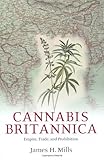
James H. Mills. Cannabis Britannica: Empire, Trade, and Prohibition 1800-1928. Oxford: Oxford University Press, 2003. 240 S. EUR 25.00 (leinen), ISBN 978-0-19-924938-1; $35.00 (paper), ISBN 978-0-19-927881-7.
Reviewed by Catherine Carstairs (History Department, University of Guelph)
Published on H-Albion (March, 2006)
Queen Victoria's Medicine?
Drug history is booming. There are new cultural and social histories of drug use, histories of the international drug conventions, as well as some intriguing books that examine drugs as global commodities and trace the connections between drugs, colonialism and empire. But so far, most of this work has focused on opium and, to a lesser degree, cocaine. James Mills's new book, Cannabis Britannica, fills the gap by focusing on marijuana. This wide-ranging book examines the use of hemp for cordage, for medicine, for intoxication and, finally, and perhaps most importantly, the place of hemp in the politics of empire.
From the sixteenth century onwards, the British navy required hemp for cordage. In 1563, Queen Elizabeth I decreed that all landowners with sixty acres or more had to grow hemp, and by the nineteenth century, the British government wanted to encourage hemp-growing in her colonial possessions as well. In India, frustrated colonial officials noted that hemp was grown for intoxication purposes instead, making its fibers unsuited for use as cordage. This did not stop the East India Company, and later colonial officials, from taxing it. Not surprisingly, smuggling was rife. Mills argues that because of the illicit trade, cannabis became associated with criminality in the minds of British officials.
Cannabis also became associated with insanity, especially in India. Annual reports from Indian asylums showed that marijuana was the leading cause of insanity. Mills argues that these statistics were inaccurate. The asylums in India had become a convenient way of dealing with vagrants and other undesirables. When someone was brought to the asylum, frequently by police, the superintendents filled out forms which required them to state the "cause" of the insanity. If someone smoked marijuana, this would frequently be put down as the cause, leading to the shocking statistics. Although cannabis was always a side-show to the more important anti-opium campaign, anti-drug crusaders jumped on the asylum statistics and spiced them with other tales of bhang leading to crime, wife-beating and suttee, to bolster their campaign in Parliament. In 1893, as the anti-opium campaign gathered steam, the British government created the Indian Hemp Drugs Commission. Mills argues that this was a diversionary tactic, done to create the impression of action on the part of the government.
The Commission had five "official" members--all of whom were British colonial officials--and three "non-official" members from the Indian elite. The Commission reported that hemp drugs were used medically, in religious rituals and for relaxation. The Commission concluded that the statistics on cannabis and insanity were inflated, that the stories about cannabis and crime were exaggerated, and that moderate consumption might even be beneficial. They recommended that a strict system of control should be put in place, and that there should be limits on how much any individual could possess. This, of course, would protect British taxation revenues! Interestingly, two of the Indian members dissented, with one saying that he thought that hemp drugs were in fact more harmful than the Commission suggested, while the other advocated prohibition over the long-term, and a register of hemp users in the short term.
In the meantime, doctors were experimenting with new medical uses for hemp drugs. Early in the nineteenth century, William Brooke O'Shaughnessy (best known as Director-General of Telegraphs in India, but also a well-published medical researcher), undertook a series of experiments on dogs and humans to determine the effects of cannabis and its usefulness as medicine. He advised that cannabis was a very valuable anti-convulsant, and useful for rabies, tetanus, cholera and delirium tremens. Other doctors recommended it for headaches, psychological problems and heavy menstrual bleeding. By the late-nineteenth century, British artists and rebels were smoking marijuana, as part of larger experiments with opium, cocaine and other drugs. And so, at the turn of the twentieth century, medical and recreational use of hemp drugs in Britain grew, while in India, regulations controlling hemp were only slowly put into place.
Cannabis prohibition in Britain itself would come about as a result of international drug treaties. The first of these, the Hague Anti-Opium Convention, was signed in 1912, and went into effect in 1919. Signatories, including Britain, agreed to control the manufacture and sale of opium and cocaine. Cannabis was not included. But in the early 1920s, a number of countries, especially Egypt, began agitating for the inclusion of Indian hemp. The British were not enthusiastic, but ironically, the Egyptian delegate who made a powerful, and successful, case against hemp drugs at the Second Opium Conference in 1924 relied heavily on a report by a British doctor who had been in charge of the Egyptian Lunacy Department when Egypt was a British protectorate. As Mills put it, "The many tentacles of the empire seem to have become entangled on the issue of cannabis" (p. 187).
Britain ratified the Geneva Opium Convention in 1925, placing control over the import, export and manufacture of cannabis. There had been some wartime panic about cannabis use in the armed forces, and the only opposition came from people who were concerned about the use of cannabis in corn plasters. In 1928, the Coca Leaves and Indian Hemp Regulations made it illegal to possess cannabis unless you were a medical professional or had a prescription. Mills ends his story here with the promise of a second volume that will take the history up to the present. Readers would have been better served by a single volume that covered the entire history. Mills relies heavily on long quotes from primary documents, needlessly lengthy prose and long digressions on marginally relevant topics. Do we really need six pages on how the drug was cultivated in India or four pages on the maneuverings of Sub-Committee F of the Second Opium Conference?
Throughout the book, Mills argues that knowing the history of marijuana can help us with policy-making for the present. He believes that the prohibition of marijuana was a mistake, and is sympathetic to the arguments for the medical use of marijuana. I agree; but he neglects the sources that talk about the harmful effects of nineteenth-century cannabis use. We know today that there are people who become very heavy users, to the detriment of their health and relationships (although alcohol is far more dangerous by any measure). There are reasons why people supported the banning of the drug, and this too may hold lessons for the present.
Finally, on a more positive note, by placing hemp in political, economic and medical context, Mills clears up many of the historical myths surrounding cannabis. By focusing on the international context, he is able to demolish the theory that it was the chemical company DuPont which lobbied for the criminalization of cannabis, because it was threatened by the potential commercial uses of hemp. He also says that there is no evidence for the popular myth that Queen Victoria used cannabis to relieve her menstrual cramps (p. 142). Every cannabis crusader who misuses history (and unfortunately it is quite common) should be forced to read this book!
If there is additional discussion of this review, you may access it through the network, at: https://networks.h-net.org/h-albion.
Citation:
Catherine Carstairs. Review of James H. Mills, Cannabis Britannica: Empire, Trade and Prohibition and
Mills, James H., Cannabis Britannica: Empire, Trade, and Prohibition 1800-1928.
H-Albion, H-Net Reviews.
March, 2006.
URL: http://www.h-net.org/reviews/showrev.php?id=11479
Copyright © 2006 by H-Net, all rights reserved. H-Net permits the redistribution and reprinting of this work for nonprofit, educational purposes, with full and accurate attribution to the author, web location, date of publication, originating list, and H-Net: Humanities & Social Sciences Online. For any other proposed use, contact the Reviews editorial staff at hbooks@mail.h-net.org.

