



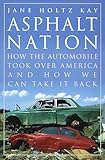
Jane Holtz Kay. Asphalt Nation: How the Automobile Took Over America and How We Can Take it Back. New York: Crown Publishers, 1997. xii + 418 pp. $27.50 (cloth), ISBN 978-0-517-58702-7.
Reviewed by Ulf Zimmermann (Department of Political Science and International Affairs, Kennesaw State University)
Published on H-PCAACA (July, 1997)
Perhaps the most important news Jane Holtz Kay, architecture and planning critic for The Nation, offers us is that the nation has indeed been so taken over by asphalt and automobiles that even their champions have found themselves too stuck on the asphalt in their automobiles to think it's fun any longer. This point was surely signalled when the Bush administration approved the Intermodal Surface Transportation Efficiency Act (ISTEA) which actually calls for a pedestrian/bicycle planner in every state.
This was in 1991 when Kay began her compendious coverage which diagnoses the asphaltic pathology that has put us in a "life lock"; then traces how we got there; and, finally, offers some palliatives. When we hear we spend 400 hours a year behind the wheel, most of us think of commuting. But in fact it's mostly errands, and--since those are done predominantly by women--we are not surprised that women's travel has quadrupled since 1983. Yet all of us are more auto-dependent. Nearly half our eating-out money is consumed behind the wheel for lack of time, but for lack of mobility our suburban children watch four times more T.V. as small-town children (and we're eight percent fatter for it than a generation ago). These suburban children are part of the eighty-million Americans who are kept from full participation in our society because they are too young, too old, too poor, or such to drive.
Cars have certainly become environmentally more correct, but in the same years we have doubled the miles we drive. And, while we know driving cars pollutes the air, most of us do not know that producing them pollutes it half again as much--a fact which gives new meaning to our new model madness. Then, too, after we pollute our highways home, we pollute our great suburban yards with a toxic armamentarium of gasoline-powered tools. For other side-costs one may consult A Fieldguide to Flattened Animals. (But there is hope: People have learned it's bad to pour antifreeze into the yard--so they put it down the toilet.)
There are other serious harms. We hear interminably about inner-city youth dying from drive-by shootings; we hear less that suburban youth die equally often from just plain driving. We have heard, too, about the road rage that leads to those periodic highway killings. Well, that's only natural: You get hot-headed sitting gridlocked on asphalt inhaling concentrated carbon monoxide which restricts the flow of oxygen to the brain.
And we are afflicted not just physically and psychologically; we are also economically addicted to automobiles: one-sixth of US employees are in auto-related enterprises; one-fifth of state budgets go to them; and seventy percent of state and local law enforcement activities are traffic-related. Good Americans worried about the trade deficit can contemplate the fact that three-fifths of it is accounted for by oil imports and two-thirds of the deficit with Japan alone is for cars and parts.
Kay's mid-section traces the development of auto domination. World War I demonstrated the strategic superiority of gasoline-powered mobility. The combination of automobile and oil interests that emerged quickly found another ally in the construction industry. The military connection forged these into an iron triangle at the national level thanks to an army captain named Dwight Eisenhower. He showed the country how desperately it needed good roads to protect itself and, after another world war, was able to create the biggest construction project ever (1991 was also the year of its completion) via the Interstate Highway and Defense Act of 1956.
Kay's last section suggests what can be done. We clearly need to rethink the excessive segregation into residential, commercial, and other land-uses produced by zoning (never mind the other forms of segregation zoning creates) that has made driving everywhere a necessity because of the disconnect between jobs and housing. To better connect housing and jobs we could use more mass transit, but to make that efficacious we need more compact development. To this end she rightly suggests we need incentives like tax breaks for people to live in denser, closer-in neighborhoods and disincentives like paying the "real" price for gasoline (as in other countries).
Full of such fine suggestions, of facts environmental and historical, and high hopes for the future, Asphalt Nation is a thoroughly informative--indeed, inspiring--read. Those little tourist buses plying many a city's streets enjoy great popularity and may be a sign of things to come; ISTEA is after all making funds available for alternative transportation modes. But absent a palpable crisis, we will not soon, I suspect, cease worshiping at the altar of automobility nor abandon our romance with the mythical open road.
This review is copyrighted (c) 1997 by H-Net and the Popular Culture and the American Culture Associations. It may be reproduced electronically for educational or scholarly use. The Associations reserve print rights and permissions. (Contact: P.C.Rollins at the following electronic address: Rollins@osuunx.ucc.okstate.edu)
If there is additional discussion of this review, you may access it through the network, at: https://networks.h-net.org/h-pcaaca.
Citation:
Ulf Zimmermann. Review of Kay, Jane Holtz, Asphalt Nation: How the Automobile Took Over America and How We Can Take it Back.
H-PCAACA, H-Net Reviews.
July, 1997.
URL: http://www.h-net.org/reviews/showrev.php?id=1142
Copyright © 1997 by H-Net and the Popular Culture and the American Culture Associations, all rights reserved. H-Net permits the redistribution and reprinting of this work for nonprofit, educational purposes, with full and accurate attribution to the author, web location, date of publication, originating list, and H-Net: Humanities & Social Sciences Online. For any other proposed use, contact P.C. Rollins at Rollins@osuunx.ucc.okstate.edu or the Reviews editorial staff at hbooks@mail.h-net.org.

