



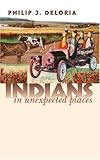
Philip J. Deloria. Indians in Unexpected Places. Lawrence: University Press of Kansas, 2004. xii + 300 pp. $24.95 (cloth), ISBN 978-0-7006-1344-1.
Reviewed by Jim Buss (Department of History, Purdue University)
Published on H-AmIndian (January, 2006)
Philip Deloria opens his book Indians in Unexpected Places by describing a mid-twentieth century photograph depicting an Indian woman, dressed in a beaded buckskin dress, sitting under a salon hair dryer. He sees the image as more than a juxtaposition of white expectations that stereotype Indians as primitive and the technologies associated with modernity. Instead, the author reads a centuries-long colonial project into the picture. Deloria uses this opportunity to open a discussion about how Native Americans often refused to fulfill the expectations of non-Indians and established their own notion of Indianness that "engaged the same forces of modernization that were making non-Indians reevaluate their own expectation of themselves and their society" (p. 6). He focuses on the late nineteenth and early twentieth centuries where he sees Americans trying to steady anxieties brought about by modernity and coexist with a large indigenous population. Deloria uses his skills as a cultural historian to investigate the artifacts of cultural production--Indian participation in athletic events, Indian purchases of automobiles, Indian performance in early film, and the adaptation of native music by whites--often overlooked by American Indian studies scholars as locations where Indians and non-Indians participated in a historical process that restructured the meaning and expectations of Indianness. Deloria explores these themes in five essays that will appeal to a wide audience, including American Indian studies scholars and those interested in American history at the turn of the twentieth century.
The first two chapters explore the historical context behind non-Indian expectations by examining the involvement of Indians in the production of cultural artifacts that helped reinforce the image of Indians as primitive people. Deloria explains that nineteenth-century Americans envisioned a segregated world where reservation boundaries separated Indians from non-Indians, primitive from modern, violence from harmony. He examines the manifestation of Indian violence on the silver screen and investigates the participation of native actors in the construction of images that reinforced the image of a historicized Indian. Deloria is quick to point out that while Indian actors fortified the stereotyped image of the violent Indian, they could also demonstrate to non-Indian audiences that Indians, as thespians, could participate in the modern world. However, non-Indians read Indian participation as a validation of misconstrued expectations, rather than evidence of Indian agency. Deloria reminds us that non-Indians closely linked authenticity and illusion, and for many "illusion came to matter more than authenticity" (p. 106).
The third chapter of Indians in Unexpected Places highlights Deloria's incredible talent of blending cultural history and American Indian studies. He combines rich personal stories, cultural analysis, and historical contextualization into a masterful essay on the role of sports and Native American identity. He begins the chapter by telling a touching story about how his grandfather, Vine Deloria Sr., near the end of his life pointed to his experience as a college football and baseball player as part of a self-identification process that held athletics, not Indianness or Christianity, at its foundation. Deloria explores the interconnection of class, race, and gender to draw some of the most revealing conclusions in this book as he examines a time when non-Indian expectations of native primitivism melded with issues of masculinity, Indian self-expectations, and access to higher education. The author explains that eventually age limitations on college athletes, the growing connection between sports and corporate culture, and a renewed indigenous movement toward autonomy pushed most native people out of collegiate and professional sports. But Indians, at least for a short time, negotiated the expectations of non-Indians in order to participate in a non-Indian world that almost certainly would have excluded them otherwise. This chapter is easily the most enlightening in the book and may be one of the better examples of how interdisciplinary work and non-traditional approaches can be successfully applied to American Indian studies. This chapter alone makes the book worth reading.
Chapter 4 explores the use of automobiles by reservation Indians and illustrates how Indians upended non-native expectations about the relationship between Indian primitivism and the consumption of modernity's products. This essay, more than any other, relies on the use of physical images and demonstrates Deloria's skilled use of cultural analysis in reading into the physical image of expectations of Indianness. He asks the reader not only to imagine Indians perched behind the wheels of immense, glimmering cars as normative practices on reservations, but to see Indians welcoming technology into the daily workings of native culture.
The final chapter examines how non-Indians translated the sounds of Native America into westernized music and used the recorded artifacts as the source for a new Americanized sound. Deloria examines both whites who chronicled Indian sounds and native performers who tried to bridge the world between Indianness and western music. He explores how Indians used non-Indian expectations alongside impressive talents associated with westernized music to draw white audiences. The chapter successfully extends Deloria's questions about the historical construction of Indianness and expands a discussion raised by the author in his previous work about Indians mimicking the expectations of non-Indians.[1]
In many ways Indians in Unexpected Places does what good scholarship should do, it raises more questions than it tries to answer and forces readers to ask critical questions about their own relationship with the subject matter. The author is successful in drawing the reader into his search for answers, although on occasion he leaves the reader begging for additional insights into events mentioned but not fully investigated. For example, Deloria misses an opportunity in the second chapter to include an extended analysis of Indian consumption with his discussion of Indian authenticity and the involvement of native people in the production of early movies. He tells us that Indians protested the violent image of Indians in film when they viewed the pictures on reservations or while visiting larger cities. Deloria cites a southern Californian agent who said that Indians often spent their "last cent on a moving picture" when they visited the city (pp. 90-94). If an image of one of these moments existed (and maybe it does), it might illustrate a group of early twentieth-century Indians sitting at a popular movie theater gazing at a silver screen where Indian thespians reenacted scenes of late-nineteenth-century Indian violence. Deloria spends a considerable amount of time dissecting the meaning of the image of Indians in the films, the role of the actors in reinforcing the expectations of non-Indians, and the protests of Indians against the images; but the reader begs a scholar with Deloria's talents to scrutinize the scene further and discuss the role of Indians as consumers of the cultural artifact. The early twentieth century marked a period where a growing consumer culture promised whites access to higher levels within a class hierarchy. Did non-Indian anxieties about Indian inclusion into American society prevent them from seeing native people as consumers in this example? How did Indian people negotiate non-Indian expectations about consumerism?
Deloria's book stands as a wonderful example of the possibilities that interdisciplinary cultural studies lends to American Indian studies and, hopefully, indicates an emerging trend in the profession.[2] The above critique is a subtle cry for more work like this and should not be read as dissatisfaction with a book that does much more than it promises. Indians in Unexpected Places will please those who believe academic scholarship should be challenging, insightful, and readable.
Notes
[1]. Philip Deloria, Playing Indian (New Haven: Yale University Press, 1998).
[2]. Previous work in American Indian studies that I believe demonstrates the promise of interdisciplinary scholarship includes Jill Lepore, The Name of War: King Philip's War and the Origins of American Identity (New York: Alfred A. Knopf, 1998); and Daniel Richter, Facing East from Indian Country: A Native History of Early America (Cambridge: Harvard University Press, 2001).
If there is additional discussion of this review, you may access it through the network, at: https://networks.h-net.org/h-amindian.
Citation:
Jim Buss. Review of Deloria, Philip J., Indians in Unexpected Places.
H-AmIndian, H-Net Reviews.
January, 2006.
URL: http://www.h-net.org/reviews/showrev.php?id=11373
Copyright © 2006 by H-Net, all rights reserved. H-Net permits the redistribution and reprinting of this work for nonprofit, educational purposes, with full and accurate attribution to the author, web location, date of publication, originating list, and H-Net: Humanities & Social Sciences Online. For any other proposed use, contact the Reviews editorial staff at hbooks@mail.h-net.org.

