



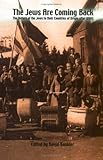
David Bankier, ed. The Jews Are Coming Back: The Return of the Jews to Their Countries of Origin after World War II. Jerusalem: Yad Vashem, 2005. 320 pp. $29.95 (paper), ISBN 978-1-57181-527-9.
Reviewed by Jay Howard Geller (Department of History, University of Tulsa)
Published on H-German (January, 2006)
Jews in Europe after the Six Million
In 1937, between nine and ten million Jews lived in Europe. Nine years later, fewer than four million remained. Hundreds of thousands of these Jews, survivors of the Nazi occupation and the Holocaust, wished to leave Europe forever. Many went to Israel, and others went to the United States, Australia, or other states that accepted immigrants. While these emigrants have received a notable amount of scholarly attention, considerably less has been written about the Jews who remained in continental Europe, including Holocaust survivors who chose to return to their former home countries. This volume, edited by David Bankier and published by Yad Vashem, which stems from a conference held in Jerusalem in 2001, seeks to rectify that gap in the scholarship.
In recent years, a number of edited volumes and monographs on postwar German Jewry have been published, but this volume elucidates the situation in some countries that have traditionally received less attention. Its fourteen essays survey events in Belgium, France, Hungary, Italy, the Netherlands, Poland, Romania, Slovakia, and the Soviet Union. Additionally, David Bankier points out, in a brief introduction, how unwelcome the Jews were in their home countries after 1945.
In the opening chapter, Pieter Lagrou sets the scene, portraying "the war Hitler won." By 1945, most of Europe's Jews were dead, the most enduring legacy of the Nazi occupation of Europe. Non-Jews were extremely uncomfortable about the return of their Jewish neighbors, both out of shame over their own comportment during the war years and out of fear that they might need to surrender formerly Jewish property. Indeed, restitution became a point of contention between Jewish returnees and their non-Jewish compatriots. Moreover, antisemitism did not cease with the demise of pro-Nazi regimes, and national chauvinists sought to exclude Jews from the national circle of remembrance--though they had been victimized as Jews and not as Danes, Frenchmen, Czechs, etc. As non-Jewish Europeans set about rebuilding their homelands and their national consensuses, very little compassion was left over for the returning Jewish survivors of the Holocaust. Additionally, most European countries were marked by ethnic homogeneity during the years 1946-50. As Bankier writes, "Post-war Europe was not a promising setting for the emergence of a multi-cultural, tolerant and cosmopolitan society" (p. 23). And yet, Jews returned.
Renee Poznanski addresses French apprehensions and Jewish expectations upon "the return." Vichy's discriminatory laws were popular among many Frenchmen and there was a disinclination to privilege the Jews after the war. On the other hand, returning Jews expected a complete restoration of their rights as residents and citizens of democratic France. Ultimately, Poznanski claims, official recognition of the Jews' unique persecution did not occur and Jewish demands for such recognition abated in face of calls for national unity. Patrick Weil illustrates the debates that raged in Free French circles over how to handle the thousands of foreign Jews naturalized in prewar France and denaturalized by the Vichy regime. While the war continued, officials in liberated French territory, including North Africa, resisted renaturalization, but a more liberal approach prevailed by 1945.
Frank Caestecker argues that Belgian authorities were deeply reluctant to single out the Jews after the years of Nazi-dictated discrimination. Surviving Jews were, at best, merely "Israelites," distinguished solely by religion. However, this radical universalism meant that legislation uniquely referencing the Jews was not forthcoming, and Jews, persecuted as Jews, did not receive special assistance. Dienke Hondius notes a similar phenomenon in the Netherlands. Moreover, latent antisemitism was still prevalent in the Netherlands and Jewish survivors felt isolated. Conny Kristel characterizes the social revolution that took place within the postwar Dutch Jewish community. Its prewar elites had been discredited through their involvement with the Jewish Council and younger Zionists assumed leadership positions. However, the predominance of the Zionists led to a prevailing pessimism about continued Jewish life in the Netherlands.
Mario Toscano describes the restitution of Jewish property, the restoration of civil rights to Jews in Italy, and the regeneration of the Italian Jewish community. In achieving the latter two goals, in particular, the anti-fascist Resistance and the Risorgimento of the nineteenth century served as a model for a post-fascist consensus, and Jews frequently allowed their own identity as victims to be subsumed into this new consensus. Manuela Consonni explores writings on the Italian concentration camp experience and notes how frequently writers sought to situate their experiences within a universalistic narrative, de-emphasizing their Jewishness. Fear of being seen as the other led these writers to situate their experiences within the larger collective memory.
As Yaacov Ro'i points out, in the Soviet Union officials erected obstacles that made the formation of legally recognized Jewish communities difficult and were loath to endorse the commemoration of Jewish victimization in particular. The regime was almost paranoid in its concern about anything that might have been construed as "Jewish national activity," and existing communities struggled to preserve traditions and rituals. Joanna Michlic examines the manner in which postwar Polish intellectuals perceived the fate of the Jews during the Holocaust. She notes that many non-communist Polish intellectuals did engage in a critical self-examination of Polish society. They recognized the truth of Polish antisemitism before and during the war and found their compatriots lacking.
Jean Ancel examines the fate of Romanian Jews after the war. Despite the wishes of government officials, Jews to returned to Romania from Transnistrian deportation. Facing negligible restitution, legal statelessness, rampant popular antisemitism, and famine, Romanian Jews embraced emigration to Palestine as a solution, but Zionist authorities considered such large numbers of poor, elderly refugees to be a burden. While less than one-quarter of Slovak Jewry survived the war, as Yehoshua Buechler points, returnees faced a deeply entrenched antisemitic bureaucracy. Nonetheless, a renaissance of Jewish religious and cultural life was met by popular antisemitic violence with the tacit approval of the Slovak leaders.
Two contributions consider postwar Hungarian Jewry. Kinga Frojimovics compares the reconstruction efforts mounted by the World Jewish Congress and the American Joint Distribution Committee (AJDC). While the former worked for restitution of property and rights, the latter worked to reintegrate Jews into local social and economic life. The AJDC was particularly successful, and the majority of Hungarian Jewish survivors remained in Hungary, which came to be seen as a poor decision after the Stalinization of the country. Laszlo Karsai demonstrates that prominent right-wing Hungarians, linking Jews and Communists, feared a so-called Jewish revenge after the war, and that fear often dictated their comportment towards the Jews.
The fact that The Jews Are Coming Back was compiled from assembled conference papers does cause some shortcomings. The chapters are quite uneven in length and in quality, and the contributions by Poznanski, Caestecker, Hondius, Toscano, Ro'i, Buechler, and Frojimovics stand out as highlights of the volume. Additionally, the papers reflect the authors' own interests and research agendas rather than providing a comprehensive overview of the topic. Indeed, the book contains some noticeable absences. Any study designed to elucidate the fate of the Jews in postwar Europe comprehensively should address Jews in Germany and Austria. The Czech lands are not the subject of any chapter, nor is Greece, which included the storied Jewish community of Thessaloniki. And the sole chapter that deals with Poland focuses on non-Jewish attitudes towards Jews rather than the reconstruction of the Jewish community itself.
Additionally, the editor and publisher have provided only an index of names and places, which is considerably less helpful than a comprehensive index (even though readers of German-language scholarship are, no doubt, accustomed to the ubiquitous Personen- und Ortsregister). The Jews Are Coming Back has seven photographs, in addition to the cover photograph. While these are nice additions to the volume, their choice seems ill-conceived. Three depict Jews in Greece, in Austria, or en route to Poland--Jewish communities not covered in the book. An additional internal illustration and the cover photo depict Jewish displaced persons in Germany demonstrating for emigration to Palestine--the very antithesis of the book's stated subject. The Jews Are Coming Back is about Jews staying in Europe, not leaving Europe.
While this book is an interesting addition to the scholarship, its utility will be limited by its narrow scope. Focusing primarily on smaller countries and featuring niche topics, it will appeal primarily to the specialist on twentieth-century European Jewry rather than a reader generally interested in European or Jewish history. However, several of its chapters would make useful reading for undergraduates in a course on modern European Jewish history.
If there is additional discussion of this review, you may access it through the network, at: https://networks.h-net.org/h-german.
Citation:
Jay Howard Geller. Review of Bankier, David, ed., The Jews Are Coming Back: The Return of the Jews to Their Countries of Origin after World War II.
H-German, H-Net Reviews.
January, 2006.
URL: http://www.h-net.org/reviews/showrev.php?id=11343
Copyright © 2006 by H-Net, all rights reserved. H-Net permits the redistribution and reprinting of this work for nonprofit, educational purposes, with full and accurate attribution to the author, web location, date of publication, originating list, and H-Net: Humanities & Social Sciences Online. For any other proposed use, contact the Reviews editorial staff at hbooks@mail.h-net.org.

