



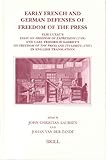
John Christian Laursen, Johan van der Zande, eds. Early French and German Defenses of Freedom of the Press: Elie Luzac's "Essay on the Freedom of Expression" (1749) and Carl Friedrich Bahrdt's "On Freedom of the Press and Its Limits" (1787). Boston: Brill, 2003. 176 pp. $85.00 (cloth), ISBN 978-90-04-13017-3.
Reviewed by Kimberly Garmoe (Department of History, University of California, Los Angeles)
Published on H-German (December, 2005)
Towards a Cosmopolitan History of the Freedom of the Press
Chris Laursen and Johan van der Zande's Early Defenses of Freedom of the Press is a welcome expansion of the boundaries of the history of free expression. This volume presents two translations, Elie Luzac's "Essay on the Freedom of Expression," originally published in 1749, and here translated by John Paul McDonald, and Carl Friedrich Bahrdt's 1787 "On the Freedom of the Press and Its Limits," translated by Laursen and van der Zande. These primary sources and their introductions challenge the traditional Anglo-American historiography of early free press arguments, detaching it from the history of a single system of politics and opening it to more cosmopolitan lineages.
Luzac's "Essay" is the earliest book length call for free expression in Europe, and the first to claim free expression as a human right within the structure of natural law. Luzac's "Essay" is introduced by Wyger R.E. Velema, the author of an excellent monograph on Luzac, Enlightenment and Conservatism in the Dutch Republic.[1] In a concise twenty-five pages, Velema contextualizes the position taken on free expression by this Huguenot, printer, lawyer, and Dutch correspondent in the republic of letters in what was his second foray into the free expression fray. The first having been his 1747 edition of La Mettrie's Le Homme Machine, which cost him the condemnation of the Walloon Consistory of Leiden as well as the loss of his stock, and forced from him an insincere promise to cause no more trouble. It was here, in his preface to La Mettrie's work, that Luzac first staked out his arguments for the freedom of the press: truth is discovered through the free and public exchange of ideas; the benefits of a free discussion, especially on the difficult issues of religion, outweighed the possible disadvantages; secrecy and privilege are used to benefit special interests; the suppression of free expression is usually against the common good.
The "Essay on Freedom of Expression," which Luzac published anonymously in 1749, is ably translated from the French by John Paul McDonald. Luzac's "Essay" differs from his previous preface in the depth and scope with which he addresses the question of freedom of opinion. The "Essay" is a discussion of what limits, if any, ought to be set on the freedom of expression, and by whom. The determination pivoted on the distinction between good ideas worthy of inclusion and harmful ideas deserving exclusion. Luzac concludes that "no ideas are harmful except by the abuse which one does to them, and that public interest demands that their expression be free and unlimited" (p. 56). His discursive approach insists that each member of the polity has the right to present the truth, as it is evident to that individual, for the bad ideas will be exposed as such through reasoned discussion. Although Luzac concedes significant ground in the broad realm of interest in which the state is free to censor expression, he warns against its abuse: "[L]et it then be frankly admitted (and this admission will decide between the upright and the indicted) that if one wishes to take away from others freedom of expression, it can only be for a motive of tyranny, of laziness or of fear of being convicted of bad faith or of ignorance" (p. 87).
As Velema, Laursen, and van der Zande indicate, Luzac's argument is not without its flaws. The confidence of his claims rests on his idealization of the republic of letters. Luzac excludes "novels, lampoons, and other productions of that sort," limiting this discussion to the more 'serious' works" (p. 43). The approach is high-minded, and an intentional salvo against the alleged abuses of the press by Grub Street and its international analogues. Luzac retained his aversion to the popular press until the end of his life, even after the Dutch Patriot movement had translated and embraced his "Essay" in the 1780s. Luzac railed against these propagandists as, "newspaper writers who turn their liberty to relate the news into the impertinence of publishing everything that surfaces in their raging and sick brains, are a disgrace to nature and the pests of society. They may with justice be regarded as the scum of the earth" (p. 32).
Although its impact was not immediate, Luzac's "Essay" is a watershed in the history of freedom of the press in its illustration of the centrality of communication to the self and society, as testament to the Enlightenment search for truth and its ramifications on social hierarchy and social control, and very significantly, because of the location of inalienable rights, such as that to self expression, within the human condition. The attachment of free expression to the human condition became increasingly common, and increasingly common-sense, in the course of the eighteenth century.
Carl Friedrich Bahrdt's 1787 "On Freedom of the Press and Its Limits," was the work of an immensely popular Aufklärer, who is now generally neglected by historians, but who exerted significant influence on the German Enlightenment. His personal life was scandalous, his professional life was tumultuous, and his literary life, as witnessed by more than 130 publications, was prolific. Bahrdt was at best a derivative thinker, but his writings framed some of the most radical problematics of the late Enlightenment.
Laursen and van der Zande have provided the first complete translation of this work into English, a partial translation in having already appeared in James Schmidt's What is Enlightenment? Eighteenth-Century Answers and Twentieth Century Questions.[2] The editors introduce Bahrdt's work with a discussion of eighteenth-century political philosophy, in its broader continental trends and specifically German permutations. The introduction draws from the very few works published in German and English on Bahrdt, as well as from some of contemporary authors who influenced his thinking. The Bahrdt depicted in this introduction was a well-read satirist and Aufklärer, current with the best of the Enlightenment thinkers, and responsive to the creative energies of the time. This is a generous reading of a man whose curriculum vitae begins with a theological degree and ends in a tavern, one who consistently ignored the advice and warnings of those who wished to protect him from himself, as well as from his many other enemies. Nevertheless, Laursen and van der Zande provide an important service by presenting C. F. Bahrdt to an English-speaking public for the first time since Sten Gunnar Flygt's problematic The Notorious Dr. Bahrdt.[3]
The debate over free expression was considerable before Bahrdt's contribution, and Bahrdt, ever the sieve, synthesized many of these strains of thought, and impressed upon them his own unique form. Although Bahrdt is placed in the German natural law tradition, it is clear that he was no apologist for absolutist rule; he grounded basic human rights, among them the right to free expression, in human nature itself, thus guaranteeing their duration. His turn to human rights is best understood within the immediate context of ideas already in circulation in Germany, especially as expressed within the "What is Enlightenment" debate, initiated in Berlin Monthly in 1784, of which Kant's essay was judged the best of many.[4] Bahrdt's conceptualization of freedom of expression connected reason, communication, and sociability as processes of Enlightenment. While reason is the activity of individuals, the process of sound reason and its consequences are intensely social. Bahrdt's idea of Enlightenment, "that one strives toward the most perfect possible knowledge and toward the highest possible level of certainty" (p. 113), is a process of truth seeking based on experience, judging discoveries against what one knows of the world, comparing accumulated knowledge to the works of others, and the publication of conclusions for the investigation of others. Bahrdt's placement of the right to free expression within the individual was an important, although not unprecedented, transformation of the natural law tradition. Arguing that "whoever tells me that he does not forbid thought when he prohibits speech, mocks me just as much as he who allows me to heat my room in the winter, but does not permit me to close the doors and windows," Bahrdt makes free expression into one of the faculties of humanity, and consequently a universal human right; moral, inalienable, and unmitigated (p. 128). He argues, "the right can be taken from nobody without tyranny, without invasion of God's sovereignty, no more than the right to live, to breathe, to reproduce, and so forth, for being able to use one's reason and to possess one's vital energy is, one like the other, a good that God has bestowed upon us" (p. 135). The only permissible limitations on this right are on its mode of use, legitimate only on an individual basis, as consequences of particular instances of use rather than categorical exclusions.
Bahrdt offers a weaker argument, an echo of the Spinozist position, in which the power becomes right, in particular that the power to rule is the right to rule. Laursen and Van Der Zande point out that the weakness of this argument lies in the problematic distinction between might and right. Bahrdt consistently argued that the power to act was evidence of having the right to act. However, he did not concede this point when it came to a prince's right to censor; here a prince had the power, but not the right (p. 99).
Priced at $85.00, this collection will be inaccessible for many individuals, although it clearly belongs in research institutions, libraries, and on reserved reading shelves for classroom use. This volume will be especially welcome in seminars discussing the evolution of human rights. The expansion of freedom of expression beyond a narrow Anglo-American context is a timely historiographical addition. New challenges to free speech are raised from a variety of corporate, political and cultural quarters. Larsen and Van der Zande offer a prescient reminder that freedom of expression and freedom of conscience have a cosmopolitan history in human rights, and are not merely cultural conventions of a few countries and peoples. By locating the lineage of free expression across history, Laursen and Van der Zande provide for it a stronger defense from the assaults of cultural relativism, political accident and ideological convenience.
Notes
[1]. Wyger R.E. Velema, Enlightenment and Conservatism in the Dutch Republic (Assen and Maastricht: Van Gorcum, 1993).
[2]. James Schmidt, What is Enlightenment? Eighteenth-Century Answers and Twentieth Century Questions (University of California Press: Berkeley, 1996), pp. 97-113.
[3]. Sten Gunnar Flygt, The Notorious Dr. Bahrdt (Nashville: Vanderbilt, 1963).
[4]. Laursen and Van Der Zande provide the context and lineages of the "Was ist Aufklärung?" debate on pages 93-98, but for the definitive collection of primary sources and discussion see Schmidt, What is Enlightenment, pp. 1-15, and passim.
If there is additional discussion of this review, you may access it through the network, at: https://networks.h-net.org/h-german.
Citation:
Kimberly Garmoe. Review of Laursen, John Christian; Zande, Johan van der, eds., Early French and German Defenses of Freedom of the Press: Elie Luzac's "Essay on the Freedom of Expression" (1749) and Carl Friedrich Bahrdt's "On Freedom of the Press and Its Limits" (1787).
H-German, H-Net Reviews.
December, 2005.
URL: http://www.h-net.org/reviews/showrev.php?id=11274
Copyright © 2005 by H-Net, all rights reserved. H-Net permits the redistribution and reprinting of this work for nonprofit, educational purposes, with full and accurate attribution to the author, web location, date of publication, originating list, and H-Net: Humanities & Social Sciences Online. For any other proposed use, contact the Reviews editorial staff at hbooks@mail.h-net.org.

