



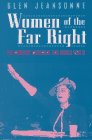
Glen Jeansonne. Women of the Far Right: The Mothers' Movement and World War II. Chicago: University of Chicago Press, 1996. xix + 264 pp. $32.50 (cloth), ISBN 978-0-226-39587-6; $22.00 (paper), ISBN 978-0-226-39589-0.
Reviewed by Howard Lune (New York University)
Published on H-PCAACA (July, 1997)
Motherworld/Fatherland
Scholars of collective action and social movements have long been aware of two lacunae in the literature: the participation of women in collective action (other than the women's movements), and the study of movements of the far right. Various theories have provided partial explanations, from the left-leaning sympathies of the investigators, to the general lack of interest in women in history, to the relative inaccessibility of right-leaning organizations to investigators. If only for this reason, Women of the Far Right is an important research project worthy of inclusion on many syllabi. Fortunately, it is also a fascinating story, meticulously researched and extremely well written. Jeansonne's study incorporates just over 20 leaders of about 15 mothers' organizations, and their affiliates. While some organizations claimed only a few dozen members, most had hundreds of participants and thousands of subscribers and supporters. Millions of women around the country supported some parts of the mothers campaigns. And what were these causes that had so many of the nation's women up in arms? Primarily, they were anti-Communist, anti-Semitic, anti-Roosevelt, and anti-U.S. participation in World War II. They were hostile to Britain and often openly supportive of Hitler and Nazism. They were hostile to refugees, and successfully prevented a bill that would have provided refuge in the U.S. for 20,000 German Jewish children, whom the mothers characterized as "'thousands of motherless, embittered, persecuted children of undesirable foreigners'" who "'could never become loyal Americans'" (p. 144).
The mothers traced all economic, social, and political ills to an international communist conspiracy led by Jews, who had manipulated Hitler and Chamberlain, and faked the holocaust. Thousands of prominent Americans, infiltrating all government branches, newspapers and educational institutions, were willing servants to the cause, according to the movement's leading researcher, Elizabeth Dilling. "The chief devil in the communist conspiracy, however, was the New Deal" (p. 21), which became the 'Jew Deal' in their literature. Most of the mothers' causes returned inevitably to Roosevelt's plans to sell out the country to communism and set himself up as a dictator, and the mothers participated actively in efforts to run candidates against him and to oppose all of his domestic and foreign initiatives. Most of these efforts were unsuccessful, but their ranks continued to increase.
It is crucial to recognize that the movement's growth did not occur without significant outside help. Among other agencies that supported and were served by the mothers' efforts were the German-American Bund, the K.K.K., Charles Lindbergh, Christian Crusaders for Americanism, the right-wing Christian movements of Father Coughlin and Gerald K. Smith, the newspapers of William Randolph Hearst, occasional, direct financial support from the German government and political support from members of Congress. American mothers, concerned about losing their sons to foreign wars, provided a wholesome face for anti-Roosevelt corporate interests, Nazi sympathizers in the US, and a variety of anti-Semitic groups throughout the country, each of whom selectively reproduced the mothers' literature, and provided them with additional "data" for their campaigns. The collective effort very nearly constituted an international conspiracy of its own.
Like any widespread movement, the mothers were torn by disagreements at both the ideological and the logistic level. Many of the mothers' groups had begun with relatively moderate positions, eventually losing control of their organizations to the extreme right elements. Indeed, one of the strategies pushed by leading mothers' organizers was that militant women activists should join moderate organizations and "take them over from within" (p. 87). Yet, for most of the groups, the tide turned after Pearl Harbor, when many of the movement participants reversed their opposition to US involvement in the war. And while many mothers denied, or even approved of, Hitler's genocidal policy towards Jews, Gypsies, and other scapegoat enemies in Germany, mounting public evidence of the Holocaust further eroded the movement's support.
Jeansonne spends much of the book arguing that the mothers' movement was more significant than you would think, especially since you probably didn't know that it existed. Ironically, in his concluding chapter he backs off from this position, asserting that the lasting impact of the movement should not be exaggerated. A literal reading supports this position. The movement's leaders fell out of the public eye, most of the groups disbanded, the New Deal proceeded despite their efforts, the US entered the second world war, women were brought into the labor force in support of the war effort, and the U.N. remains intact. But this does not mean that the movement failed to achieve its underlying objectives. The activists of this story, working from far outside of the American mainstream, mobilized the country around the notions of extreme nationalism, extreme anti-communism, anti-Semitism, and xenophobia. The post-war period which Jeansonne defines as their waning saw the start of McCarthyism, ideological purges on a grand scale, new immigration restrictions, and the beginnings of a forty year cold war that lacked none of the paranoia of its antecedents in the mothers' anti-communism. Jeansonne also claims that the true measure of the mothers' modern relative irrelevance lies in the virtual removal of overt anti-Semitism from the language of the contemporary right. Yet he himself has demonstrated that `Jew,' or `communist' became the invective of choice for nearly everything that the mothers did not like. If we were to substitute the terms `homosexual,' `liberal,' or even `politically correct' in a few of the speeches found in this book, one could easily bring them back into circulation today. This book makes me nervous, as it should, and even the author's own reassuring conclusion does not assuage this feeling. Perhaps the most frightening aspect of the story was that I found myself, for the first time in my life, relieved to see how little direct impact collective action had on the workings of the State.
This review is copyrighted (c) 1997 by H-Net and the Popular Culture and the American Culture Associations. It may be reproduced electronically for educational or scholarly use. The Associations reserve print rights and permissions. (Contact: P.C.Rollins at the following electronic address: Rollins@osuunx.ucc.okstate.edu)
If there is additional discussion of this review, you may access it through the network, at: https://networks.h-net.org/h-pcaaca.
Citation:
Howard Lune. Review of Jeansonne, Glen, Women of the Far Right: The Mothers' Movement and World War II.
H-PCAACA, H-Net Reviews.
July, 1997.
URL: http://www.h-net.org/reviews/showrev.php?id=1117
Copyright © 1997 by H-Net and the Popular Culture and the American Culture Associations, all rights reserved. H-Net permits the redistribution and reprinting of this work for nonprofit, educational purposes, with full and accurate attribution to the author, web location, date of publication, originating list, and H-Net: Humanities & Social Sciences Online. For any other proposed use, contact P.C. Rollins at Rollins@osuunx.ucc.okstate.edu or the Reviews editorial staff at hbooks@mail.h-net.org.

