



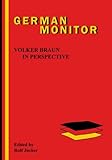
Rolf Jucker, ed. Volker Braun in Perspective. New York: Rodopi, 2004. v + 273 pp. $52.50 (broschiert), ISBN 978-90-420-0859-5; $105.00 (gebunden), ISBN 978-90-420-0869-4.
Reviewed by Rachel Halverson (Department of Foreign Languages and Cultures, Washington State University)
Published on H-German (September, 2005)
Volker Braun Up Close and Personal
This is a celebratory issue of the German Monitor, its publication in 2004 coinciding with Volker Braun's sixty-fifth birthday and with the twenty-fifth anniversary of the first issue of the GDR Monitor in Summer, 1979. As I have come to expect from this journal, Volker Braun in Perspective presents a comprehensive high quality collection of articles, in this case on Volker Braun and his publications in a variety of genres. Editor Rolf Jucker, who himself has been working intensively with Braun's oeuvre for ten years, clearly states the volume's focus in his introduction: "Ich hoffe, daß dieser Band erreicht, wozu er gedacht war: als Anschauungsmaterial für die Breite und Vielfalt der interpretarorischen Ansätze, zu denen Brauns Werk die BeiträgerInnen ermuntert hat, und als Anstoß, sich erneut dem Werk dieses wichtigen Autors zuzuwenden" (pp. xvi-xvii). The international cast of contributors from Canada, Germany, Great Britain, Ireland, Italy, Japan, Switzerland and the United States Jucker has assembled underscores his editorial goal to show: "die Vielfalt der interpretatorischen Perspektiven, die gewinnbringend an dieses Werk angelegt werden können" (p. ix). To make such thematically varied contributions accessible to readers, Jucker has organized the articles in five categories: the first, "Überblicksartikel," contains articles dealing with multiple genres or translation issues; the remaining four follow Braun's genre structure found in his Texten in zeitlicher Folge, i.e. "Prosa," "Lyric," "Theater," and "Schriften." The articles are in German or English, and each is prefaced by a paragraph-length abstract in English, a useful orientation feature for English-speaking readers.
The first section is disproportionately the largest, containing eight of the volume's seventeen articles. That being said, the articles give a rounded picture of Braun's influence and the range of interpretative potential his work offers literary scholars. In her "Der Text als geologische Formation. 'Archäologisches Schreiben' als poetologisches Programm im Werk Volker Brauns," Karin Bothe approaches her analysis of Braun's Leipzig Poetik-Vorlesung (1989) and his poems "Hanß Georg Braun u.a." (1971), "Landwüst" (1971), "Durchgearbeitete Landschaft" (1971), "Material V: Burghammer" (1990), and "Andres Wachtlied" (1999), and his essay "Dem Geyer gleich. Goethe und Kafka in der Natur" (1999) like an archaeological dig. Exposing each text's meaning layer by layer, Bothe brings connections between Braun's texts and Goethe's "Ilmenau," "Harzreise im Winter," and "Hochgebirg" from Faust II, Hölderlin's "Mein Eigentum," and Fühmann's essay "Schieferbrechen und Schreiben" to the surface and establishes a clear line of textual development: "Der Tagebau ist quer durch Volker Brauns gesamtes Schreiben und Werk von besonderer Bedeutung. Es ist die Spur eines 'Lebentextes', an dem er arbeitet ..." (p. 19).
Dieter Schlenstedt examines the recurring phrase "Salute, Barbaren" in Braun's dramas, lyric, and prose. Based on a statement Braun made in an interview with Thomas Irmer, Schlenstedt interprets this phrase to mean "Seid gegrüßt, Leute von draußen" (p. 37) and maintains that with this greeting Braun is speaking to foreigners coming to Germany and the issues in German society in response to this trend. The next two articles, Gilbert Badia's "Zur Rezeption von Volker Brauns Werken in Frankreich" and Alain Lance's "'Ein Freund, ein guter Freund, Das ist das schönste, was es gibt auf der Welt'," detail the reception of Braun's work in France and the authors' personal relationship to Braun as translators of his Die Kipper (1979) into French. Both articles have a highly personal tone and capture the passion Badia and Lance share for Braun's texts and their career-long mission to facilitate the access of the French-speaking world to this East German author. The special relationship between Braun and Franz Fühmann is the subject of Dennis Tate's contribution to the volume. Tate reads Braun's short text "21., 22. August 1984" as an homage to Fühmann, and in his reading of "Drei nackte Männer" (1974) and Hinze-Kunze-Roman (1985), Tate demonstrates that "the final tribute which he (Braun) made to Fühmann was in standing up to the ideological pressures to tone down his criticisms or make any significant modifications to his text during the long battle between 1981 and 1985 to get it published" (p. 84). Paul Peters's "Mysteriöse Übergänge. Anmerkungen zu einem Motiv bei Volker Braun" examines Braun's treatment of two transitions (life to death; text to life) in a diverse selection of Braun's writings, while Yasuko Asaoka examines the frequent occurrence of border words and images in Braun's poetry, short stories, novella, essay and dramas published after the fall of the Wall between 1990 and 2001. She demonstrates how Braun now addresses the new "borders" that have been drawn between East German and West German now that the physical border has been removed, as well as borders that exist between rich and poor countries around the globe at the end of the twentieth century. Rolf Jucker's "Aspekte gesellschaftskritischer Literatur seit 1989. Einige Bemerkungen mit Bezug auf zwei Gedichte von Volker Braun" is the final article in this section. In the first half of his article, Jucker argues that political literature is not necessarily bad literature as is often assumed, and in the second half he analyzes two poems from Braun's latest lyric collection Tumulus to articulate Braun's statements on globalization. Although the analytical, textual, and theoretical breadth of this first section may appear random and diffuse at first glance, it arms readers with sufficient knowledge of Braun and his diverse publications to contextualize the four short genre-specific sections which make up the remainder of this issue.
The next section, "Prosa," consists of two articles: Wilfried Grauert's "Nach der Natur leben. Zivilizationskritik in Volker Brauns Der Wendehals" and Anna Chiarloni's "Das Wirklichgewollte. Eine Interpretation." Both continue the interpretative thread Jucker establishes in his immediately preceding article, i.e,. the significance of Braun's texts should not be limited to the German-speaking world, but rather read for their statements on globalization. In his analysis of Braun's Der Wendehals (1995), Grauert's interest in the text lies in its stereophonic narrative structure (ICH and ER), its intertextuality with Diderot's Rameaus Neffe, and its connections to Braun's own Bodenloser Satz (1988) and collection of short stories Das Wirklichgewollte (2000). Grauert thus expands Braun's portrayal of the Wende beyond German unification: "Er (Braun) verschiebt es auf eine andere Ebene und denkt es grundsätzlich anders, nämlich als Wende zu einer anderen, humanen, ökologisch und sozial orientierten Zivilisation" (p. 139). Chiarloni's close reading of Braun's "Das Wirklichgewollte," the first of three short stories published in a volume of the same name, is concerned with his treatment of global migration. With respect to the short story's depiction of Albanian refugees to Italy, she concludes: "Braun beschreibt einen Zustand fundamentaler Fremdheit, bei dem seine Kunst als ganz feiner Gradmesser fungiert, für den sie aber kein direktes Heilmittel sein kann" (p. 166).
The three articles featured in the third section, "Lyrik," shift the focus from Braun's global message to the development of poetic themes and connections within his poetry and between his poems and those of others. Klaus Schuhmann's analysis of Braun's "Lagerfeld," the cornerstone poem in the collection Tumulus (1999), demonstrates the transection of earlier themes, such as workers alienated from their jobs and robbed of their possessions (Die vier Werkzeugmacher [1996]), Roman history (Tumulus [1999] and Limes. Marc Aurel [2002]), and law und justice (Der Staub von Brandenburg [1999]). In his "'Worte und Knochen'--Überlegungen zu Volker Brauns Gedicht 'Andres Wachtlied,'" Peter Geist analyzes Braun's "Andres Wachtlied" with respect to texts by Büchner and Goethe, and to earlier texts by Braun himself. Geist's analysis reveals constants in Braun's work: "die Sehnsucht nach Leben, Freude, Sinnlichkeit, Genuss nicht der Macht, sondern der Gleichheit im Austausch von Gedanken, Bestätigungen, Körperflüssigkeiten und Berührungen ..." (p. 192). In the final article in the section, Ruth J. Owen examines Braun's treatment of time in five poems published between 1964 and 1996: "Könnt ich die Augenblicke leben," "Die Austern," "Der Mittag," "Das Nachleben," and "Der Reißwolf." She ascertains the following shift in his focus: "The poem as production of the present, at a peak in time, gives way to a poem facing foreshortened time: the imperative is not to effect motion but to mark the dissolving self, albeit by a motionless reproduction" (p. 206).
Braun's dramatic works are the basis of analysis in the fourth section. Moray McGowan's article "'Machen wir uns auf in das Land hinein.' Volker Braun's Übergangsgesellschaft: 'Übergangstheater,' 'übergangenes Theater,' 'Metatheater'?," as made clear in its very descriptive title, showcases a three-phase examination of Braun's 1982 drama Übergangsgesellschaft. Similarly to the other literary scholars contributing to this volume, McGowan sees the play as being about far more than the GDR or even the "Wende": "It is also part of Volker Braun's own lifelong artistic 'Übergang,' his resistance to the social determinations which turn free individuals into the 'Strichmännchen der Planung'" (p. 222). Götz Wienold's "Volker Braun, Böhmen am Meer: Gedruckte Fassungen und einige Lesarten" is an expansion of an earlier article by the author on Braun's Böhmen am Meer published in 2001 in Dokkyoo Daigaku Doitsugakukenkyuu--Dokkyo-Universität Germanistische Forschungsbeiträge. For the first article, Wienold worked with the 1992 Suhrkamp edition of the drama, only later to discover that the 1993 version which appeared in Texte in Zeitlicher Folge (Mitteldeutscher Verlag) was significantly different. Wienold's comparison of the two versions of the drama reveal substantial differences in characters and number of scenes. Wienold concludes that Böhmen am Meer may be read as a coded text to answer the question: "Was wird dann aus den Sozialisten, die es doch gab und noch gibt?" (p. 234).
In the final section, "Schriften," Gerd Labroisse examines Braun's acceptance speech for the Georg-Büchner-Preis given in 2000, while Carol Anne Costabile-Heming studies his speech "Himmelhoch, zutode" delivered in 2001 as part of the city of Dresden's series "Zur Sache Deutschland." In the former, Labroisse opens his examination of Braun's speech by pointing to Braun's earlier essay "Büchners Briefe" (1977), which Braun himself noted as a kind of preparatory work for his speech in 2000. The connection between Braun and Büchner is immediately clear; both authors see themselves as students of social upheaval, for Büchner the French Revolution and for Braun the October Revolution. Returning to Büchner in 2000, Braun is now a student of the failed East German socialism and quotes from Büchner's Dantons Tod, Lenz, and Leonce and Lena in his speech to define the parallels and differences in the upheavals both Büchner and Braun have experienced. In her "'Zur Sache Deutschland.' Volker Braun Takes Stock," Carol Anne Costabile-Heming turns our attention to "Braun's assessment of his life and work as reflected in his speech 'Himmelhoch, zutode'" (p. 260). Braun structures this speech around three historic events: the bombing of Dresden and the end of WWII, the Prague uprising in 1968, and the peaceful revolution and unification of Germany in 1989/1990. He then reflects on his personal connections to them and fantasizes about other possible outcomes. Costabile-Heming concludes that Braun has not resigned to the fate life has served him but rather continues to be a voice to be listened to as Germany plays an increasingly greater role on the world stage.
Volker Braun in Perspective is a carefully edited issue of The German Monitor. From the diversity evident in the individual contributions emerges a portrait of an author who survived the oppression of East Germany to find a new voice in a unified Germany. When read in its entirety, Volker Braun in Perspective can serve the neophyte as a solid introduction to Volker Braun's extensive oeuvre, while the veteran Braun scholar can pick and choose key contributions to round out his or her knowledge of the author and specific texts.
If there is additional discussion of this review, you may access it through the network, at: https://networks.h-net.org/h-german.
Citation:
Rachel Halverson. Review of Jucker, Rolf, ed., Volker Braun in Perspective.
H-German, H-Net Reviews.
September, 2005.
URL: http://www.h-net.org/reviews/showrev.php?id=11135
Copyright © 2005 by H-Net, all rights reserved. H-Net permits the redistribution and reprinting of this work for nonprofit, educational purposes, with full and accurate attribution to the author, web location, date of publication, originating list, and H-Net: Humanities & Social Sciences Online. For any other proposed use, contact the Reviews editorial staff at hbooks@mail.h-net.org.

