

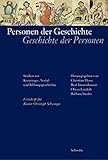
Christian Hesse, Immenhauser, Beat. Personen der Geschichte - Geschichte der Personen: Studien zur Kreuzzugs-, Sozial- und Bildungsgeschichte. Festschrift für Rainer C. Schwinges. Basel: Schwabe Verlag, 2003. 500 S. EUR 40.50 (leinen), ISBN 978-3-7965-1974-1.
Reviewed by Marc Lerner (Humanities Consortium, University of California, Los Angeles)
Published on H-German (November, 2004)
Migratory Personal Histories
The prosopographical method has been used to great effectiveness in family history, social history and the institutional history of such entities as universities or learned societies. Supporters of this method claim that the study of individual lives, not just the study of "great men," produces important leaps of understanding. The collection of essays entitled Personen der Geschichte-Geschichte der Personen directly confronts this tension between what the editors name the "persons of history" and the "history of individuals" (p. xi). The prosopographical method has been used in order to gain a collective sense of how networks of communication were built or how ordinary individual lives were led. Guy P. Marchal, in his contribution to this collection, even makes an explicit link with the study of everyday experience (Alltagserfahrungen) (p. 44).
At the same time, the volume demonstrates that the grand tradition of the Festschrift is alive and well in Switzerland. The editors of this volume in honor of Rainer Christoph Schwinges, holder of the chair for Medieval History at the University of Bern, dedicated themselves to exploring differing aspects of Schwinges's research agenda and its implications. However, the simultaneously beneficial and problematic result is that the quality and quantity of Schwinges's varied interests force a massive volume of twenty-six contributions that range from a discussion of a twelfth-century treaty between Christians and Muslims to an examination of the Swiss who lived in nineteenth-century Rome.
This volume is organized thematically and not chronologically. The contributions are formally divided into four sections: Bern and its surrounding areas; cities and citizens; universities and students; and Christians and non-Christians. However, many more themes culled from Schwinges's research interests run throughout the volume, crossing these four categories and clearly putting late medieval and early modern Switzerland into its proper context as part of Germanophone central Europe. Issues of mobility and migration, urbanization, citizenship (especially the acceptance of new citizens), tolerance, the role of universities and intellectuals as well as changing understandings of the concept of a just war in medieval and early modern Europe are all addressed.
Roland Gerber's essay, "Das Ringen um die Macht," opens the volume with an analysis of the changing networks of power at the end of the thirteenth century in Bern. His goal is to discover which groups led Bern and exercised power (p. 6). In the late thirteenth century Bern experienced a virtual constitutional crisis and a leadership transition. In 1288 Rudolf I (Habsburg) had twice attempted to take the city of Bern and his son successfully inflicted a defeat on Bernese troops in 1289. This defeat initiated a power struggle between two elements of the Bern elite, the nobility and notables who were blamed for the military defeat and an emerging class of merchants and artisans who sought full membership in the community. This Bernese constitutional crisis dealt with the fundamental definition of the Buerger and what privileges such status entailed. It was not until 1294, in the aftermath of a pogrom against the Jewish moneylenders of the city, that constitutional revision defused the situation by expanding the political leadership (p. 15). The Buerger opposition was integrated into the small council and a council of 200 was newly elected. Although no bloody struggle accompanied the reform, the late thirteenth century saw a significant transition in terms of the elite of Bern when artisans and guilds gained a voice in the governing councils of Bern.
The second section of the volume deals with questions of urbanization and citizenship. Kristina Isacson and Bruno Koch shed light on these issues by examining migration and mobility in late medieval Zurich. Their fascinating joint contribution, "Losziehen und Los ziehen," compares the geographic and social origins of Zurich lottery participants and new citizens of the city. The authors emphasize the mobility of Europeans in the late middle ages. Migrants traveled for temporary visits and permanent relocations for reasons as varied as trade, markets, pilgrimages, study, work, war, the taking of healing waters and visiting relatives as well as for entertainment possibilities such as festivals and lotteries (p. 127). In 1504 Zurich hosted a shooting festival financed, at least partially, by a subscription lottery. Around 24,000 people from Zurich and beyond participated in the lottery, buying tickets for themselves, family members, as a possible charitable contribution for their church or even in the name of a lucky weapon or favorite pet (p. 128). Isacson and Koch look at the snapshot provided by these names and compare the migration patterns of the 1504 lottery participants with the longue duree list of new citizens recorded by the city administrators of Zurich from 1351 to 1545. This comparison allows them to re-examine the relationship between the city and hinterland. They argue that migrants, whether temporary or permanent, traveled greater distances than previously recognized. Isacson and Koch challenge a center-periphery perspective in which the central area exploited the resources of the hinterland in a single-sided relationship. Instead they demonstrate that Zurich absorbed new citizens and temporary visitors from distant, equivalent-sized cities within and beyond the Swiss Confederation as well as the smaller dependent villages of the surrounding countryside. In fact, almost half of these migrants came from these other cities and they demonstrate that the further the distance traveled the more likely the point of origin was another city (p. 149).
Peter Blickle in "Pfarrkirchenbuerger?" also takes up issues of citizenship and the formation of communities, continuing themes of his own research on early modern communes as well as Schwinges's interest in new citizens. At first Blickle distinguishes between two categories of citizens in late medieval towns: Buerger and Pfalbuerger, those who managed their farms outside the city, but enjoyed citizenship rights (Buergerrecht) in the city and probably spent part of the year in the city as well (p. 153). However, Blickle suggests that we consider a new group of Buerger whose privileges stemmed from their attachment to a parish: the "Pfarrkirchenbuerger" (p. 154). Blickle claims that by the fifteenth century an urbanization process had tremendously increased the number of towns and cities in Germanophone Europe and that this process led to a spread of citizenship privileges. Although he only begins to generalize from a specific case in Memmingen, Blickle suggests that further investigation of the fate of this possible new category of Burger will help explain the late medieval/early modern relationship between town and land. Blickle acknowledges that much research needs to be done on this topic, but raises the possibility that this intermediate category of Buerger may provide further links between urban and rural movements for greater popular freedom (pp. 162-164).
The third section of this collection deals with the changing nature of students and their studies in German and European Universities. This is the section that deals most explicitly with the Bildungsgeschichte of the book's subtitle. Peter Moraw's "Deutsche und europaeische Gelehrte im lateinischen Mittelalter" offers a good introduction to this section on the institutional history of European universities as well as a history of intellectuals in their social context. Many of these contributions to the volume build on Rainer Schwinges's earlier work, which emphasized that universities were not isolated institutions but part of a broader social context (p. 285). Ludwig Schmugge points to thirteenth-century monks who desire to study outside the cloistered monastical arena as a catalyst for change (p. 257). A clash persisted between the intellectual worlds of the university and the church, and if clerics wanted to study theology in a university setting they required their abbot's or bishop's permission, which was not always readily forthcoming. As universities grew, tensions increased. Schmugge points to "town and gown" frictions, while Christian Hesse points to disciplinary tensions. At the end of the fifteenth century, new disciplines beyond theology expanded due to an increasing number of lay students concerned with the professionalization of such fields as law and medicine (p. 276). Secular rather than church law came to dominate university life as local administrators and office holders sought degrees (pp. 283-284).
One contribution in this third section that ties together many aspects of the entire volume is Beat Immenhauser's essay "St. Gallen und der Universitaetsbesuch um 1500." The author uses the pool of university students coming from the city of St. Gallen to make generalized claims about migration and mobility in this period. Immenhauser defends St. Gallen as a worthwhile case study for student mobility because the town, compared to others in the Swiss Confederation, had the largest percentage of its population who attended university (p. 286). According to his research, the migration patterns were much more widespread than he expected to find in this earlier period. A surprising number of St. Gallen residents went to study in distant universities. These results only emphasize the extent of the long distance communication networks that existed in the late medieval and early modern periods. This research, of course, dovetails nicely with what we learned from Kristina Isacson and Bruno Koch about migration patterns in Zurich during the same period (chapter 8).
The fourth section on Christians and non-Christians addresses questions of religious toleration, networks between Christians and non-Christians as well as the impact of Christian theological thought on important questions of the day such as the concept of a "just war." Just war and its corollary of resistance theory justifying rebellion was not only important for Swiss developments, though it was a central debate all the way to the founding of the modern Swiss federal state in 1848, but these concepts impacted notions of popular sovereignty, liberty and international law.
The discussion links to Oliver Landolt's earlier contribution, "Wider christenlich ordnung und kriegsbruch," in which he looks at war as an ethical problem in the late medieval period and traces the concept of war crimes. Medieval conceptions of a just war refer back to Augustine's writings. However, Heinz Herzig argues that Augustine was only transforming and transmitting Cicero's theories about the concept of bellum iustum. Augustine introduced a moral and theological element to the discussion, whereas Cicero focused on the security needs of the state. Just causes of war for Cicero include self-defense, revenge and coming to the aid of a Confederate (p. 395). Pedro Zwahlen also makes an interesting contribution to a broader understanding of international law with his essay about a twelfth-century treaty between Christians and Muslims. Zwahlen argues that international law existed before the birth of the modern state system by demonstrating the practice of two legal traditions with religiously defined communities working together as early as the twelfth century.
In addition to the essays discussed above, the volume includes contributions by Hans Braun, Barbara Studer, Werner Meyer, Arnold and Doris Esch, Hans-Joerg Gilomen, Bela Marani-Moravova, Urs Martin Zahnd, Carl Pfaff, Juerg Schmutz, Rainer A. Mueller, Walter Rueegg, Hans-Dietrich Kahl, Hans-Joachim Schmidt, Andreas Meyer and Katherina Simon-Muscheid. Despite some excellent articles there are some drawbacks to this collection. The difficulties inherent in this volume are similar to all but the rarest of volumes of collected essays, especially Festschriften. The editors gathered a large number of essays, many of which are useful and include a tremendous amount of information, but that does not necessarily make a coherent volume, especially without a longer thematic introduction or conclusion. If a complaint can be made about too much of a good thing then there is too great a multiplicity of themes and goals. The book attempts to join seven or eight major themes, which impinges on its general interest as a complete work. That said, there is certainly something for everybody among the individual contributions. Although perhaps not intended or suited for a student starting out in a new field, specialists should find useful leads to future research in a variety of medieval and early modern sub-fields. If the main goal of a Festschrift is to honor its recipient, this volume is a great compliment to Rainer Schwinges and reflects his meaningful impact on so many aspects of his discipline.
If there is additional discussion of this review, you may access it through the network, at: https://networks.h-net.org/h-german.
Citation:
Marc Lerner. Review of Hesse, Christian; Immenhauser; Beat, Personen der Geschichte - Geschichte der Personen: Studien zur Kreuzzugs-, Sozial- und Bildungsgeschichte. Festschrift für Rainer C. Schwinges.
H-German, H-Net Reviews.
November, 2004.
URL: http://www.h-net.org/reviews/showrev.php?id=11088
Copyright © 2004 by H-Net, all rights reserved. H-Net permits the redistribution and reprinting of this work for nonprofit, educational purposes, with full and accurate attribution to the author, web location, date of publication, originating list, and H-Net: Humanities & Social Sciences Online. For any other proposed use, contact the Reviews editorial staff at hbooks@mail.h-net.org.

