



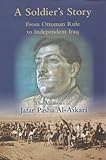
William Facey, Najdat Fathi Safwat, eds. A Soldier's Story, From Ottoman Rule to Independent Iraq, The Memoirs of Jafar Pasha Al-Askeri (1885-1936). London: Arabian Publishing, 2003. xxvi + 294 pp. $39.95 (cloth), ISBN 978-0-9544792-0-6.
Reviewed by Edward Erickson (International Research Associates)
Published on H-Turk (December, 2005)
A Memorable Iraqi Soldier and Diplomat
The memoirs of Jafar Al-Askeri come to us by way of his family and their efforts to give voice to the history of this larger-than-life man. Jafar Pasha (or Cafar as he is known in Turkish publications), an Arab from Mosul, began his career as an officer in the Ottoman Army. After an active career in the Balkan Wars, he was captured by the British in 1916 in Libya during the First World War. Jafar then joined the Arab Revolt and participated in the campaigns in Palestine against the Turks. An active member of a group of politically minded Arab officers, Jafar went on after the war to a career in the government of the newly formed state of Iraq and served as the minister of defense and ambassador to Great Britain. He was assassinated in 1936 at the age of 51. The title is somewhat deceptive because Jafar's memoirs run from 1897 to 1919, however, the story resumes thereafter as a biography.
Of interest to military historians are the experiences of Jafar Al-Askeri as a regular army officer fighting in an irregular (or guerrilla) warfare environment against the British in Libya. In this campaign the Ottomans sent leaders, money, and weapons to the Sanusi tribesmen in 1915-1916, and outside of the British official history there is nothing in English concerning the Ottoman perspective of this campaign. Jafar describes the difficulty of trying to wage war on a shoestring while simultaneously trying to maintain politically correct bonds with the tribesmen. Informed readers will note that Jafar's professionalism and energy conflict with the commonly held notion that most Ottoman army officers tended toward lethargy and indolence, and in this regard, present a refreshing and overdue corrective. Jafar was wounded and captured at the Battle of Aqaqir in late February 1916.
Later as a POW in Cairo, his allegiances shifted to the growing Arab nationalist cause and, after a failed escape attempt, he joined his enemies and began to work with the Arab Bureau. Jafar dismissed his treason as the result of learning of the death of some of his Arab friends at the hands of the Young Turks or CUP. His exposition of this plows new ground in bringing to light an understanding of how a serving Ottoman army officer could simultaneously fight for a decaying empire while belonging to a subversive society dedicated to its destruction. He went on to become a leader in the Arab Revolt and participated in the attacks on the Turkish railways in Palestine and Syria. After the war, Jafar briefly served as military governor in Aleppo in 1919 and, like many of his fellow nationalists, was greatly disappointed with the peace settlements and the associated mandate system.
Four of the appendices were also written by Jafar. The first deals with the Arab awakening and contains interesting commentary on the Ahd (Covenant) movement and details Jafar's direct involvement in its nationalist workings. Jafar's other appendices outline political, economic, and social progress in Iraq in the 1920s and 30s. These are quite valuable to readers interested in the formation of the Iraqi state and highlight Jafar's skills as an organizer. The remaining appendices concern Jafar himself and were written by Churchill and several other British observers. Churchill observed that Jafar was probably the only participant of the Great War who was awarded both the German Iron Cross (while fighting for the Ottomans) and a British Companionship of St. Michael and St. George (while fighting with the allies). There is also an impressive array of very clear previously unpublished photographs that illustrate Jafar's remarkable life and associations.
This is a physically handsome and impressive book. The editing of these memoirs is uniformly excellent with particular attention paid to very detailed footnotes. Consequently, at no point in the narrative does the reader wonder who a person was, or in what context Jafar was writing. The English translation of the memoirs appears to be uniformly excellent as well, with the exception of the Arabic transliteration of conventional western historical spellings of Ottoman names. For example Djavid (Cavit) Pasha is referred to as Ahmad Jawid, Mahmut Sevket Pasha as Mahmoud Shawkat, and Nazim Pasha as Nadhim Pasha. While the editor clarifies each name in the footnotes, it caused this reader to break his train of thought often and think "I wonder if he meant Nazim Pasha?"
The memoirs of Jafar Al-Askeri are a pleasure to read and contain many interesting observations and anecdotes about his times and the personalities that drove the history of the making of the modern Middle East. These memoirs complement and balance those memoirs from this period that are traditionally available to the English-speaking world (such as Gertrude Bell, W. S. Churchill, T. E. Lawrence, Rafael DeNogales, and Cemal Pasha). This book will appeal to both the specialist and to the casual reader interested in the people and events of the late Ottoman and early mandate periods. It is especially timely given our contemporary interest in the political and military aspects of Iraqi history, and we might pause to reflect that Jafar's life was cut short in a violent coup d'état. Serious scholars, as well as non-specialists, will want to add Jafar's memoirs to their libraries.
If there is additional discussion of this review, you may access it through the network, at: https://networks.h-net.org/h-turk.
Citation:
Edward Erickson. Review of Facey, William; Safwat, Najdat Fathi, eds., A Soldier's Story, From Ottoman Rule to Independent Iraq, The Memoirs of Jafar Pasha Al-Askeri (1885-1936).
H-Turk, H-Net Reviews.
December, 2005.
URL: http://www.h-net.org/reviews/showrev.php?id=11012
Copyright © 2005 by H-Net, all rights reserved. H-Net permits the redistribution and reprinting of this work for nonprofit, educational purposes, with full and accurate attribution to the author, web location, date of publication, originating list, and H-Net: Humanities & Social Sciences Online. For any other proposed use, contact the Reviews editorial staff at hbooks@mail.h-net.org.

