



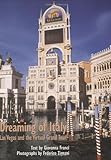
Giovanna Franci. Dreaming of Italy: Las Vegas and the Virtual Grand Tour. Reno: University of Nevada Press, 2005. 157 pp. $24.95 (paper), ISBN 978-0-87417-610-0.
Reviewed by Eugene Moehring (Department of History, University of Nevada, Las Vegas)
Published on H-Urban (November, 2005)
Old World Splendor on the Las Vegas Strip
Giovanna Franci offers a provocative interpretation of Las Vegas's appeal in this colorful work featuring numerous photographs of buildings, statues, and other objects alongside their authentic inspirations in Italy. Federico Zignani's expert photography complements his mother's text. Franci begins by reviewing the various phases that Las Vegas has undergone from a city dedicated to gambling to a modern venue of dramatically themed resorts dedicated to mass tourism. She traces the evolution of Las Vegas from its 1940s western phase epitomized by El Rancho Vegas and Hotel Last Frontier and the clubs downtown, to the "sleek supper-club architecture" of the Flamingo, Desert Inn, and Sands, before addressing the mega-resort trend of recent decades (p. 26). Her book is firmly set in the literature of postmodern architecture and Las Vegas history. Indeed, she moves the field of inquiry popularized by Robert Venturi, Denise Scott Brown, and Steven Izenour in the 1970s, and extended by Alan Hess, Frances Anderton, and John Chase in the 1990s, in a new direction partially inspired by Manfred Pfister's edited work on the "Italies" of British travelers.[1]
Franci uses the European Grand Tour as a model for explaining a particular phase in the Strip's development: the emergence of Italian-themed resorts. Specifically, she relates modern Las Vegas tourism to the Grand Tour experience that flourished between the sixteenth and nineteenth centuries when elite families sent their offspring to the great European cities and the scenic countryside to experience history firsthand by viewing the ruins of imperial Rome, plying the majestic canals of Venice, and exploring other historic points on the continent. Franci attributes much of Las Vegas's recent popularity to the success of Caesars Palace, Paris-Las Vegas, Luxor, Bellagio, The Venetian, and other resorts in exploiting the desire of tourists at all income levels to experience a virtual Grand Tour by providing them with gleaming, if not totally accurate, replicas of classic Old World venues. The author supports her argument by citing a variety of cross-disciplinary sources that cover everything from the distinction between a fake and a copy to the most recent work on tourism, emphasizing the modern traveler's need to engage in travel that is based on "experience" rather than "movement" (p. 51). The book's real strength lies in its insightful analysis of how the architecture and interior design at Caesars Palace, Bellagio, and The Venetian resemble, but do not completely replicate, the ruins of Rome, the hill towns mirrored in Lake Como, and the romantic marriage of water and cityscape that is Venice. The imaginative ideas and creations of The Venetian's designer Rem Koolhaus, Bellagio architect Jon Jerde, and other artists come alive in Franci's text and are juxtaposed nicely with Hillel Schwartz's views regarding "the culture of the copy."[2]
While the book is set in the postmodern context of recent scholarship on Las Vegas, the emphasis remains largely on the three Italian-themed resorts. For the most part, Franci avoids many of the sweeping generalizations about Las Vegas that pervade recent scholarship on the subject. Occasionally, she prefaces an idea with a questionable assumption such as: "In our era devoid of illusions," (p. 54); or declares that "The standardized cities of the world are recycled" in Las Vegas (p. 33); or supports Hal Rothman's dubious contention that Las Vegas "has become the place where the twenty-first century begins."[3] Fortunately, however, statements like these are few and far between. One can accept the author's notion that Las Vegas "is becoming a repository for a new idea of culture and art that belongs to a phase successive to modernism" (p. 33) as long as it is limited to the idea that some resorts build "urban copies" as a means of appealing to modern tourists (p. 87). Franci does not try to extend her thesis beyond the architecture and artistic objects found in some Strip resorts to generalize about Las Vegas society or the metropolitan area as a whole, nor does she exaggerate the city's influence upon the nation and the world.
Franci's Grand Tour is a useful model for partially explaining the popularity of Caesars, Bellagio, The Venetian, and even Excalibur, Luxor, and New York-New York, although other considerations also need to be explored. Indeed, for many globe-trotting tourists, Las Vegas is merely another destination in a lifelong series of periodic trips that will surely include Rome, Venice, Florence, and Paris as well as San Francisco, Hong Kong, Tokyo, and perhaps Luxor, Machu Picchu, and other places. For these sophisticated travelers, it would be an exaggeration to say that Caesars Palace, The Venetian, or Bellagio provide anything like the experience of actually going to Rome or Lake Como. For the average American visitor, their Las Vegas trip may provide a virtual Grand Tour, but, for the most part, it is a relatively brief experience. For some young people, Las Vegas is the place they see on the E Channel, it is where The Palms and the Hard Rock are located, and all the nightclubs and non-stop action they dream about at home. For the average family coming to Las Vegas on their vacation, the Strip also delivers the WOW-factor they cannot get at home. Of course, The Venetian, Bellagio, and Caesars Palace, in particular, offer spectacular architecture that tourists will gaze at for some time, but in fact they will spend much more time having fun--gambling, nightclubbing, sunbathing, show-going, flocking to special attractions, and browsing the designer shops one can only find in places like New York, London, Rome, and Rodeo Drive. If there is a virtual Grand Tour dimension to a tourist's visit to Vegas, it is only a small part of the trip when compared to their eighteenth-century counterparts on a vintage Grand Tour of Europe.
These concerns aside, Dreaming of Italy offers an intriguing view of how some resort-makers have extended the boundaries of Las Vegas's nearly seventy-year infatuation with themed casinos and resorts by using spectacle architecture to lure even more tourists to America's gambling mecca.
Notes
[1]. Robert Venturi, Denise Scott Brown, Steven Izenour, Learning from Las Vegas: The Forgotten Symbolism of Architectural Form (Cambridge: The MIT Press, 1977); Alan Hess, Viva Las Vegas: After Hours Architecture (San Francisco: Chronicle Books, 1993); Manfred Pfister, ed., The Fatal Gift of Beauty: The Italies of British Travellers (Amsterdam: Rodopi, 1996).
[2]. Hillel Schwartz, The Culture of the Copy: Striking Likenesses, Unreasonable Facsimiles (New York: Zone Books, 1996).
[3]. Hal K. Rothman, Neon Metropolis: How Las Vegas Started the Twenty-First Century (London: Routledge, 2002), p. xxvi.
If there is additional discussion of this review, you may access it through the network, at: https://networks.h-net.org/h-urban.
Citation:
Eugene Moehring. Review of Franci, Giovanna, Dreaming of Italy: Las Vegas and the Virtual Grand Tour.
H-Urban, H-Net Reviews.
November, 2005.
URL: http://www.h-net.org/reviews/showrev.php?id=10940
Copyright © 2005 by H-Net, all rights reserved. H-Net permits the redistribution and reprinting of this work for nonprofit, educational purposes, with full and accurate attribution to the author, web location, date of publication, originating list, and H-Net: Humanities & Social Sciences Online. For any other proposed use, contact the Reviews editorial staff at hbooks@mail.h-net.org.

