



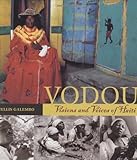
Phyllis Galembo. Vodou: Visions and Voices of Haiti. Berkeley: Ten Speed Press, 2005. 144 pages. $24.95 (paper), ISBN 978-1-58008-676-9.
Reviewed by Grete Viddal (Department of African and African American Studies, Harvard University.)
Published on H-AfrArts (October, 2005)
Photographic Exploration of Haitian Religion Back by Popular Demand
Phyllis Galembo's Vodou: Visions and Voices of Haiti, a collection of photographs first published in 1998, has been re-issued by publisher Ten Speed Press. With over eighty color photos, Vodou is a savory feast for the eyes. Included are portraits of religious practitioners, images of divine art objects, and pictures of sacred spaces. The 2005 edition's new cover captures attention with a portrait of a mambo, or Vodou priestess, in striking red ritual attire anchored by monochromatic images of faces of the faithful during Vodou events.
With a long-standing interest in masquerade and costuming, Galembo manifests a sense of theatricality in her work. She uses flash techniques to emphasize the hues of her subject's garments and surroundings, making the environment "pop" with intense color. Galembo's subjects are positioned with attire and accoutrements they have carefully chosen for the occasion. Their ease, dignity, and poise are palpable, suggesting that Galembo establishes genuine and effective rapport with her subjects.
An introductory chapter by ethnomusicologist Gerdès Fleurant (author of Dancing Spirits: Rhythms and Rituals of Haitian Vodun, the Rada Rite, 1996) offers a succinct overview of the history and practice of Vodou. Further essays and commentary are interspersed throughout the book, providing readers with an introduction to Haitian religion by prominent scholars such as Harold Courlander, Donald Cosentino, Maya Deren, Marilyn Houlberg, Lannëc Hurbon, Zora Neale Hurston, Elizabeth McAlister, Karen McCarthy Brown, and Alfred Métraux. Also included are narratives and remarks by performance artists, cultural activists, and practitioners such as New York-based musician Azouke Sanon, and Mimerose and Theodore Beaubrun, founders of Haitian rasin or roots band Boukman Eksperyans.
Galembo's photo documentary of Haitian Vodou at the end of the twentieth century is more than a handsome coffee-table book. Ethnographers and researchers will want this remarkable assembly of images in their collection. Vodou: Visions and Voices of Haiti also serves as a captivating introduction to Vodou for the interested public or aficionados of religious or folk arts. Additionally, it is an appropriate vehicle for faculty teaching undergraduate Afro-Atlantic religion courses seeking to add visual information to their theoretical discussions.
If there is additional discussion of this review, you may access it through the network, at: https://networks.h-net.org/h-afrarts.
Citation:
Grete Viddal. Review of Galembo, Phyllis, Vodou: Visions and Voices of Haiti.
H-AfrArts, H-Net Reviews.
October, 2005.
URL: http://www.h-net.org/reviews/showrev.php?id=10903
Copyright © 2005 by H-Net, all rights reserved. H-Net permits the redistribution and reprinting of this work for nonprofit, educational purposes, with full and accurate attribution to the author, web location, date of publication, originating list, and H-Net: Humanities & Social Sciences Online. For any other proposed use, contact the Reviews editorial staff at hbooks@mail.h-net.org.

