



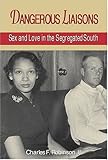
Charles F. Robinson, II. Dangerous Liaisons: Sex and Love in the Segregated South. Fayetteville: University of Arkansas Press, 2003. xv + 196 pp. $29.95 (cloth), ISBN 978-1-55728-755-7.
Reviewed by Joan Johnson (Department of History, Northeastern Illinois University)
Published on H-South (September, 2005)
Sex, Love, and Marriage across the Color Line
Charles Robinson II perceptively begins his book on interracial relationships in the American South with the observation that "the rhetoric of the white South about interracial sex differed significantly from its actions with regards to prevention" (p. xiii). His book is a brief but thorough analysis of the Southern reaction to interracial romances from the end of the Civil War through the 1920s.
Robinson sets up six themes that guide his analysis throughout the book. First, that interracial intimacy and relationships, which implied social equality, were more strictly punished and regulated than interracial sex alone. Second, that anti-miscegenation laws "existed as tools to support both a white patriarchal structure, and a race-based caste system" (p. xiv), and therefore Southern whites punished black men who crossed the color line more often than white men who did the same. Third, that interracial couples concealed their relationships through two primary means: claiming the relationship was informal, or that they were in fact close in color, whether that be black, white, or even Latino or Native American. Fourth, that whenever blacks seemed to be gaining political or economic power, whites played the race card, raising the specter of interracial relationships. Fifth, that African Americans commonly condemned laws punishing such relationships but at the same time disapproved of interracial marriage because they thought that it threatened black solidarity and that white reactions to such relationships endangered African Americans. And sixth, that laws regarding interracial marriage resulted not only in criminal prosecution, but also in economic impact, when divorce, custody, inheritance, and other legal issues were affected. While several of these themes have been employed by other historians, Robinson's most interesting contribution comes from the third and fifth themes, in which he points out the strategies couples used to conceal their relationships and shifts the attention away from whites in power and instead looks at how African Americans regarded interracial marriage. He aptly reminds us that Jim Crow laws "could not always control ... more private actions nor the dictates of the heart" (p. xv).
Robinson begins with a very brief summary of the development of laws punishing interracial sex and marriage from the colonial period to the Civil War. He traces the development of slavery and the need to regulate interracial sex in order to enforce racial hierarchy and to prevent mulatto children from escaping the fate of slavery. He also notes that Thomas Jefferson had proposed that white women who gave birth to mulatto children be banished from the state, which, given his relationship with his slave, Sally Hemmings, suggests that Jefferson was concerned with controlling white women rather than with the propriety of interracial sex in general. Robinson also follows anti-miscegenation law into the nineteenth century, arguing that court cases show that the Southern states were most interested in punishing free black men and poor white women, particularly in cases where the relationship was too well established to be purely sexual. Here he follows the example of Martha Hodes and other historians who have found some level of tolerance for interracial relationships, with punishment usually resulting only when some other factor (such as divorce, rape, inheritance, slave status, etc.) brought attention to the couple.[1]
Robinson found that the growth of black political power in some states during Reconstruction meant that those states either ended or ignored anti-miscegenation laws, while other states where blacks held fewer offices tightened their control and moved to enforce such statutes more stringently. This makes an interesting comparison to Hodes, who points to Reconstruction as a time when the Ku Klux Klan punished those guilty of interracial romances as a means of effecting control over the newly freed slaves. Robinson instead dates a decrease in tolerance to the era of Redemption, when the Southern states more uniformly enacted strict anti-miscegenation laws. White Southerners, he argues, were becoming increasingly nervous about maintaining white supremacy in a world without slavery. Yet, because federal intervention was still a possibility, states did not enforce such statutes as strictly as they would by the 1890s.
Robinson begins his chapter on the 1890s with the story of an interracial couple who were not arrested for violating anti-miscegenation law in Texas until after they had spent twenty-two years together. The couple was brought to the attention of the judicial system because Katie Bell testified about herself and her husband in a civil case of unknown origins, a fact about which Robinson makes little comment. Robinson shows that Southern states now began to enforce anti-miscegenation laws more strictly and to punish those found guilty of violation more harshly. He briefly argues that this led to the likelihood that black men involved in relationships with white women who accused them of rape would now almost certainly be lynched. Although other historians, including Hodes, Lisa Lindquist Dorr, and Diane Sommerville, have recently debated the frequency of black men's vulnerability to violence following rape charges both before and after the Civil War, because his focus is on romance, love, and marriage, rather than on rape (or accusations of rape), Robinson's book does not speak to this debate.[2]
This strict enforcement of anti-miscegenation law continued with little change in the next three decades. Robinson argues that progressive reformers, for example, by banning black prostitutes from living in certain sections of New Orleans, tried to strengthen white supremacy and limit interracial contact. In part influenced by eugenics, reformers in the 1920s continued this trend, and states like Virginia and Georgia redefined whiteness and blackness by preventing whites from marrying anyone with any African-American heritage at all (the one drop rule). Throughout these chapters, Robinson effectively shows how interracial couples strategized to avoid prosecution, both through denying the nature of their relationship under the guise of less established relations, and through claiming "color closeness," often claiming Indian or Spanish rather than African heritage.
Although Robinson dedicates a separate chapter to analyzing black reactions to interracial relationships, black voices are evident throughout the book, especially through the voices of actors in court cases. Through their willingness to go to court to defend themselves, these individuals prove that their own relationships could be the most powerful force influencing ordinary African Americans. Robinson also cites the protests lodged by black politicians, ministers, and other leaders against anti-miscegenation laws, in many instances because they feared that black men would be punished while white men who abused black women were not. Yet at the same, blacks also displayed hostility to interracial marriages such as Frederick Douglass' second marriage to a white woman, because they feared that whites would use the relationships against them, and because they resisted the notion that white skin was more desirable than black skin.
Recently a number of books on interracial relationships have been published. Dangerous Liaisons differs from other treatments of interracial intimacy because of its regional and chronological focus on the South from the Civil War to the 1920s, and its attention to the strategies that interracial couples used to avoid prosecution.[3] This legal history is appropriate for undergraduate classes as Robinson writes with clarity rather than legal jargon. Furthermore, his attention to how the laws were enforced (or not) and their purpose is important. White Southern lawmakers, Robinson makes clear, attempted to erase the possibility of romance and marriage across the color line because of the possibility of social equality that such a relationship suggested rather than because they were offended by interracial sex. This slender book is a very useful exploration of interracial intimacy in the post Civil War South.
Notes
[1]. Martha Hodes, White Women, Black Men: Illicit Sex in the Nineteenth-Century South (New Haven: Yale University Press, 1997); and Joshua Rothman, Notorious in the Neighborhood: Sex and Families across the Color Line in Virginia, 1787-1861 (Chapel Hill: University of North Carolina Press, 2003).
[2]. Lisa Lindquist Dorr, White Women, Rape, and the Power of Race in Virginia, 1900-1960 (Chapel Hill: University of North Carolina Press, 2004); Hodes, White Women, Black Men; and Diane Miller Sommerville, Rape and Race in the Nineteenth-Century South (Chapel Hill: University of North Carolina Press, 2004).
[3]. See notes above; Rachel F. Moran, Interracial Intimacy: The Regulation of Race and Romance (Chicago: University of Chicago Press, 2001); Peter Wallenstein, Tell the Court I Love My Wife: Race, Marriage, and Law: an American History (New York: Palgrave MacMillan, 2002); and Renee Romano, Race Mixing: Black-White Marriage in Postwar America (Cambridge, Mass.: Harvard University Press, 2003).
If there is additional discussion of this review, you may access it through the network, at: https://networks.h-net.org/h-south.
Citation:
Joan Johnson. Review of Robinson, Charles F., II, Dangerous Liaisons: Sex and Love in the Segregated South.
H-South, H-Net Reviews.
September, 2005.
URL: http://www.h-net.org/reviews/showrev.php?id=10869
Copyright © 2005 by H-Net, all rights reserved. H-Net permits the redistribution and reprinting of this work for nonprofit, educational purposes, with full and accurate attribution to the author, web location, date of publication, originating list, and H-Net: Humanities & Social Sciences Online. For any other proposed use, contact the Reviews editorial staff at hbooks@mail.h-net.org.

