



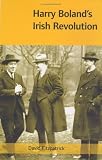
David Fitzpatrick. Harry Boland's Irish Revolution. Cork: Cork University Press, 2003. xi + 450 pp. EUR 39.00 (cloth), ISBN 978-1-85918-222-2; $24.95 (paper), ISBN 978-1-85918-386-1.
Charles W. Magill, ed. From Dublin Castle to Stormont: The Memoirs of Andrew Philip Magill, 1913-1925. Cork: Cork University Press, 2003. vi + 93 pp. EUR 10.00 (paper), ISBN 978-1-85918-344-1.
Reviewed by Kevin Matthews (Department of History and Art History, George Mason University, Fairfax, Virginia)
Published on H-Albion (August, 2005)
Two Tales of Ireland
During a recent visit to the Middle East, U.S. Secretary of State Condoleezza Rice made clear that the Bush administration's support for democracy has limits. Some organizations, some political parties are beyond the pale. So, in Egypt, for example, while Rice was willing to talk to secular opponents of Hosni Mubarak she would have nothing to do with the Muslim Brotherhood. This is despite the fact that most experts agree that in any genuinely free election the Brotherhood would replace Mubarak's regime.
The story is much the same in Iraq. Shortly after Rice's trip, Secretary of Defense Donald Rumsfeld acknowledged that U.S. officials have had contacts with some Iraqi insurgents. The operative word here is "some." In effect, Rumsfeld, like Rice, has claimed that they have the option of choosing their negotiating partners. If this is the Bush administration's idea of a "roadmap to peace," to borrow one of its favored slogans, it is likely a roadmap to nowhere. Sooner or later, Rice and Rumsfeld or their successors will, in the words of one long dead British politician, "shake hands with murder." Successive governments in London had to learn that lesson several times over in Africa and Asia. But they learned it first in Ireland.
This lesson also echoes in both David Fitzpatrick's new biography of Harry Boland and in the memoirs of Andrew Philip Magill, a civil servant who worked for the last British administration in Ireland as well as for the first government in the partitioned six counties of Northern Ireland. Both men were Irish, but their feelings about their country's relationship with its larger neighbor and about the use of violence in politics could not have been further apart.
The more slender of these two books is drawn from a 120,000-word typescript composed by Magill toward the end of his life and includes an introduction that sets the memoirs in context. Some readers will be taken aback by his strident comments; Magill was very much a man of his times. Fitzpatrick's far larger study of Boland is based on a wealth of primary sources, not least his subject's own, invaluable diary. There is no bibliography, unfortunately, and there are a few minor errors here and there. Germany and its allies during World War I, for instance, were known as the Central Powers, not the "Axis Powers" (p. 35). However, such missteps are rare.
There is, though, a tendency in Irish biography to place the subject, the men at any rate, into one of two categories. As Tom Garvin once pointed out to the BBC, Irish political heroes are held either to be sexually abstinent, "political priests if you like," or they are "heroically fertile." Fitzpatrick avoids either of these pitfalls, only to fall into a third. This is the portrayal of the happy-go-lucky, cheeky-chappie always "full of life and vitality" (p. 45). A biographer cannot help it if these are the recollections of his subject's contemporaries. Even so, this seems to be a phenomenon that occurs in Irish political biography more than anywhere else and, after a time, the stories begin to wear a bit thin.
While Boland may not have been born with a smile on his face and a song in his heart, his republicanism was almost genetic. Both his father and uncle were members of the Irish Republican Brotherhood, the secret society committed to the violent overthrow of British rule in Ireland and the creation of an independent republic. According to family lore, his mother was a descendant of a "James Woods" who took part in "The '98," the 1798 rising inspired by the French Revolution. As a young man, Boland was caught up in the revival of Gaelic culture, becoming an active member of the Gaelic Athletic Association--though not, curiously, of the Gaelic League, which promoted use of the Irish language. While still a teenager he was inducted into the IRB.
Like Boland, Magill was born in Dublin. But there any similarities end. The descendant of Scottish Presbyterians who originally had settled in seventeenth-century Ulster, Magill worked his way up through Britain's Irish civil service while, at the same time, earning a degree in history and political science from Trinity College. Even though Magill, like other Trinity students, was required to learn Greek, he found it "strange" that this, "the leading university in Ireland" offered no courses in Irish history or culture (p. 6).
The two worlds represented by these men clashed over Home Rule, the promise of self-government for Ireland first made by Liberal Party leader William Gladstone in 1885. Although strictly limited (Home Rule was roughly akin to state government in the United States or provincial government in Canada), it was twice blocked by British Conservatives and their Irish Unionist allies centered in the northeastern province of Ulster. Only in 1912 was the Irish Parliamentary Party at last poised to redeem the pledge from a Liberal government headed by H.H. Asquith.
The pre-war Home Rule Crisis erupted just as Magill reached the pinnacle of his career. In 1913, he was appointed private secretary to Augustine Birrell, then head of the Irish Office. Like other Irish chief secretaries, Birrell was also a member of the British Cabinet and a member of Parliament. This meant that, although he was responsible for Ireland's day-to-day governing, Birrell, and Magill along with him, spent most of his time in London. None of this background is to be found in Magill's memoir. However, he does provide a glimpse of life in the British Parliament at a time when a mere handful of unarmed police officers protected the House of Commons. These officers seemed to know not just the MPs; they could at the same time differentiate the "army of private secretaries and officials" from "unauthorized" visitors--and they "never made a mistake" (p. 20). Contrast that with the armed guards and the security cordon that now surrounds Westminster, and Magill's world seems a thousand years away instead of less than a hundred. In his portrait of Birrell there is affection as well as respect, but also exasperation with a man whose "heart was not in his political work" and who "took his duties very lightly" (pp. 40-41). In other words, Birrell was not the sort of politician who should have been in charge of Ireland as it slid toward civil war.
If any one man was responsible for taking Ireland to the brink of that catastrophe, it was Sir Edward Carson, whom Magill calls "the heart and soul of the opposition" to Home Rule (p. 23). Determined to prevent even this limited form of self-government, Carson and his followers created a private army, the Ulster Volunteers, and threatened rebellion if Home Rule was put on the Statute Book. Their example was not lost on Home Rule supporters who responded with the creation of their own force, the Irish Volunteers. Much as they despised Home Rule for not going far enough, members of the IRB like Boland quickly infiltrated the Volunteers seeing it as a vehicle for an eventual republican revolution.
While most Irish Volunteers, like their counterparts in Ulster, joined the British Army at the beginning of World War I, a nationalist rump refused to sign up. Instead they mounted what came to be known as the Easter Rising of 1916 which, as it emerges in Fitzpatrick's account, was not so much a tragedy as a very uncomical farce. This book does nothing to enhance the reputation of the Rising's leaders, which is just as well. As for Boland, an often contradictory not to say confusing picture emerges of the part he played in the rebellion (pp. 38-43). After capturing a British Army drill instructor on the north side of Dublin, Boland and his fellow Volunteers were ordered to assist the already beleaguered main force concentrated at the General Post Office. To get there, according to one account, Boland "cheekily traveled across the battlefield by cab," his prisoner at his side (p. 41). The stunt almost cost him his life. Later, his former prisoner was able to pick out Boland as one of his captors. Unlike most rebels who were interned after their surrender at the end of Easter week, Boland was court-martialed. He was spared the firing squad only because, as Fitzpatrick puts it, while he had taken part in the rebellion, he had done so "without emerging unmistakably as a leader." Ironically, the fact that Boland had been court-martialed and yet survived assisted his "revolutionary promotion" (pp. 44-45).
Magill, who was also on the north side of Dublin when the Rising began, has left behind a highly colored, not to say colorful account of that week. Instead of stories of rebel heroics, Magill recalled the terror experienced by Dubliners, both nationalist and Unionist, who had to depend on word-of-mouth stories for news of what was going on in their city. "The most extraordinary thing," he later wrote, "was the way in which all the laborers and working men in the district welcomed the troops, and the savage way in which they denounced the rebels." Magill blamed the later, sudden shift in public opinion on the "damned English sense of fair play" (p. 31). Had the British Army summarily executed the insurrection's ringleaders, instead of doing so over several weeks, he was sure that the rebels soon would have been forgotten. True or not, the Easter Rising created a divide in Ireland between those who viewed the men as martyrs and those, like Magill, who could never forgive this stab in the back at time when Britain was fighting for its survival on the Western Front (p. 32).
By the time Boland was released from prison in June 1917, the independence movement generally and the IRB specifically were again up and running, and it is here that Fitzpatrick runs into trouble. The overarching aim of his work is to place Boland in the first rank of Ireland's republican leaders. So, throughout this book the reader is told that Boland was "indispensable in every organization or enterprise which engaged his interest" (p. vii); that he was "one of the foremost spokesman for a great popular movement" (p. 37); that he was "a key member of the inner revolutionary circle" (p. 223).
Fitzpatrick's problem is that Boland keeps letting him down. While it would be unfair to fault Boland for all of the mishaps that occurred during his career, it is impossible to ignore the fact that he was so wrong so many times about so many of the important issues that confronted Ireland's independence movement. Aside from that, for a "secret society man" (p. 326) whose work depended on the ability to keep quiet, Boland could be astonishingly "indiscreet" with those outside that inner revolutionary circle (pp. 232, 238). More importantly, after his release from prison, the last five years of Boland's life were played out in the shadow of two other men and their competition to control Irish republicanism. Although Boland ultimately allied himself with Eamon de Valera, it is Michael Collins, his "closest friend and chief antagonist" (p. 8), who dominates this book. Hard as he tries, whenever Fitzpatrick puts Boland at center stage he can never quite keep him in the spotlight.
It was only natural that Boland initially was pulled into Collins's orbit. While all three men had taken part in the Easter Rising, both Collins and Boland were also members of the IRB. De Valera was not. While Fitzpatrick implausibly credits Boland with being responsible for Collins's induction into the IRB, it is true that for many their "friendship became a symbol of republican brotherhood in practice" (pp. 34, 92). The IRB represented to Boland, perhaps even more than to Collins, "the mystical unity of initiated brethren"--a bond that could never be broken (p. 249). More broadly, the survivors of the Easter Rising were, Boland later told the New York Times, carrying on their country's tradition where "the fight for freedom is handed down in Ireland as if by apostolic succession" (p. 263).
Leave aside the uniquely Irish religious overtones, and Boland's formulation is little different from Lenin's idea of a "revolutionary vanguard." "The proper function of the brethren," Fitzpatrick writes when explaining Boland's outlook, "was not to subjugate the people, but to organize and educate them until they qualified for full citizenship of the Republic" (p. 327). Yet this notion is fundamentally anti-democratic. For what if, after all that organizing and educating, the people came to conclusions that fundamentally differed from those of the "brethren"? What then? Boland never confronted those questions, and that is the ultimate tragedy of his life.
As well as rebuilding the IRB, both Collins and Boland also threw themselves into winning parliamentary by-elections for the candidates of Sinn Fein, the republican political party. When British authorities arrested most Sinn Fein leaders during the so-called May Plot of 1918, Collins and Boland went "on the run." They would remain outside the law for the next three years.
The Anglo-Irish War of 1919-1921 was a harbinger of many of the "wars of national liberation" that were to erupt throughout the rest of the twentieth century. Not only that, but the British government's reaction to this challenge--first, denial that there was a problem; then, ill-considered measures to quell the violence; the institution of "reforms" that pleased no one; the search for "moderates" with whom to negotiate; strenuous denials that the government would ever deal with "murder-gangs" (today, read: terrorists); and, eventually, negotiations with the leaders of these very same groups--also prefigured the ways in which most of these wars would be fought and, eventually, settled. To men like Magill, the war plunged Ireland into "an orgy of assassination and violence which was worse in many ways than the Great War" (p. 76). The man most responsible for the success of that campaign was Collins, who, for all practical purposes, directed the operations of the Irish Volunteers, soon known as the Irish Republican Army or, more simply, the IRA.
Collins remained in Ireland throughout the war. Boland and de Valera, on the other hand, spent most of this time in the United States. Their mission was to gain official recognition of the Irish republic and, at the same time, "reassert 'home' control" over Irish-American organizations that funneled both money and weapons to the republican cause (p. 120). In both instances, they failed. For this, de Valera largely was responsible, especially for the way in which his dictatorial manner alienated the leaders of Clan na Gael, the movement's principle American link. Yet even after de Valera's return to Dublin, Boland, far from patching up relations with the Clan, widened the rift even further by setting up a rival organization.
Boland showed equally poor judgment when, at a rally at New York's Madison Square Gardens in January 1921, he delivered what became known as his "race vendetta" speech. Boland, now the Irish republic's "ambassador" to the United States, called on Irish men and women "all over the world to take up the fight" against Great Britain. Addressing himself specifically to Irish-Americans, he declared: "If I had my way, I would tell them to rise up and tear down everything British in America." Fitzpatrick's characterization of the speech as "predictably counter-productive" is an understatement (p. 194). Far from rousing Irish-Americans to action, Boland's intemperate call to arms produced a backlash. The New York Times, among others, denounced what it called "Bolandism," while American liberals backed away from their support of the Irish cause. The speech also brought Boland to the attention of J. Edgar Hoover, soon be head of the FBI (p. 195).
Boland's return to Ireland in August 1921, a month after the truce ending the Anglo-Irish War, did nothing to restore his reputation, which "had been damaged by repeated setbacks and miscalculations" in America (p. 224). On the contrary, despite Boland's expectation that he would accompany Collins to London for the negotiations that led to Ireland's independence, he was instead sent back to the United States. This meant that he spent the crucial months of October-December 1921 literally an ocean away from the scene of action. "Once again", Fitzpatrick observes, "the vital decision would be taken by Collins," leaving Boland to defend the agreement to already suspicious supporters in the Irish-American community (p. 255).
At the same time, both men were caught up in a personal crisis they no longer could avoid. Shortly before going "on the run" Boland and Collins met Kitty Kiernan, a young woman with whom they both fell in love. The triangle that developed between the three was at the center of Neil Jordan's 1996 film, "Michael Collins," with the spectacularly miscast Julia Roberts playing the love interest of Liam Neeson's Collins and Aidan Quinn's Boland. Here, Fitzpatrick takes several gratuitous swipes at Boland's rival, the "characteristically fork-tongue[d] Collins" (p. 226). But if anyone comes out of this three-sided relationship not looking very good, it is Kiernan. As Fitzpatrick points out, her "letters indicate that the contest was unequal from the start" (p. 253). The ever attentive Boland "seemed tame and dependable by comparison with the elusive Collins" (p. 254). Kiernan's refusal to make a clean break with Boland seemed designed to remind Collins that an "alternative" prospect was at hand if he was unwilling to marry her (p. 304). Even the prospect of a trip to the States could not entice Kiernan to join Boland, and his letters--by turns confident, demanding, pleading--are almost painful to read (pp. 249-254).
Despite Boland's assurance that however "our Triangle may work out," he and Collins "shall be always friends" (p. 237), it is hard to believe that this romantic duel was not a factor in their eventual estrangement. The more immediate cause of the disintegrating friendship, however, was the Anglo-Irish Treaty. Embittered Unionists like Magill condemned the agreement for giving Sinn Fein and the IRA "everything for which they had asked, and a great deal more than would have satisfied them" (p. 64). That was hardly the case. The coalition government led by David Lloyd George had spent the better part of two years vowing never to give into the demands of IRA "extremists." Instead, Lloyd George along with his Conservative and Liberal colleagues finally enacted a Home Rule Bill--albeit at the price of partitioning six counties of Ulster from the rest of Ireland. But by then Home Rule had passed its "sell-by" date. There was no one, not in the south anyway, who was any longer willing to accept Home Rule as a solution.
Much as they wished to end the Anglo-Irish War, the one thing that Lloyd George and his colleagues would never accept was a separate Irish republic. The Irish Free State agreed to by Collins, Arthur Griffith, and the other Sinn Fein negotiators was instead a dominion: Ireland was independent--like Canada, Australia, New Zealand, and South Africa - but it was still linked to Britain through an oath of allegiance to the crown. Boland and other Treaty opponents focused their attacks solely on this part of the agreement--"there's nothing else, nothing but the oath," he told erstwhile friends in the IRB (p. 275). Although Fitzpatrick does not deal with the matter directly, Boland's words confirm that the Treaty split had nothing to do with the partition of Ulster and the creation of the Protestant- and Unionist-dominated state of Northern Ireland.
For southern Unionists like Magill, the Treaty was also a nightmare. Nothing, he wrote, "would induce me to remain under the men responsible for murdering so many of my colleagues" (p. 61). Magill and his family moved north, where he helped establish the Belfast government. The rest of his memoir is devoted to this phase of his career, a wholly partisan account of the pogroms and murders that occurred while men like Magill too often looked the other way. In these pages it is possible to discern the origins of the conflict that finally erupted in Northern Ireland in 1969. Strangely, Magill sensed that partition would not solve his country's ethnic conflict and that the most the British had "obtained was temporary liberation from the eternal Irish question" (p. 64).
More immediately, de Valera's opposition to the Treaty all but guaranteed a civil war in the south. When the shooting finally erupted in June 1922, Fitzpatrick writes that it "brought much needed relief to opponents of the Treaty, like Harry, whose republican principles had been compromised through the search for a settlement" (p. 306). In fact Boland, as well as de Valera, had abandoned their "republican principles" before the Treaty was even negotiated. Although some in the independence movement would settle for nothing less than a republic, de Valera had long since realized that this goal was unattainable. Instead he proposed what he called "external association," a form of independence that differed little from dominion status except that the British connection was implicit rather than explicit. Boland had even entertained the idea of a "dual monarchy" (p. 231): the creation of two independent governments, one Irish the other British, linked by the same king as head of state. The difference between this arrangement and the one achieved by the Treaty was that the British king would have been formally crowned in Dublin as an Irish "king." Whatever the merits of this idea, it certainly was not "republican."
Boland quickly abandoned this proposal when it ran into opposition (pp. 231-232). But the question remains: If he could have lived with a dual monarchy, why did he become such a bitter opponent of the Treaty? Fitzpatrick, perhaps, comes closest to the answer when he writes that as Boland's "two closest mentors became the chief protagonists in the bitter dispute over approval of the agreement, Harry's alignment was affected not only by his admiration for de Valera's intellect and Collins's organizational genius, but by the grievances which had tainted both relationships" (p. 256).
Put another way, the battle over the Treaty was as personal as it was political. Boland's own diary refutes the allegation that de Valera "owned his soul" (p. 10) and that he opposed the agreement simply out of loyalty to "the Chief." But Fitzpatrick is far less convincing when he argues that Boland's opposition to the Treaty had nothing to do with his "romantic rivalry with Collins" (p. 262). In fact, during the debate on the agreement's ratification by Ireland's parliament, Dail Eireann, Boland's eleventh-hour interventions were laced with increasingly bitter recriminations, most of them directed at his former friend (pp. 266-267).
Boland's last decisive act in Irish politics, negotiating the abortive de Valera-Collins Pact, could do nothing to avert an armed struggle, and after voters sharply rebuffed the anti-Treatyites in June, civil war was all but inevitable. Throughout these last months of his life, Boland continually miscalculated the mood the country and the course of events. He predicted that the Dail would never ratify the Treaty (p. 259). It did. He was confident that the IRB would back the Treaty's opponents. "Once again," Fitzpatrick concedes, "Harry's optimism proved groundless" (p. 285). He was sure that half the members of the Free State Army were "disaffected" and would never fight the anti-Treaty members of the IRA (p. 301). They did. He was certain that the Treaty's opponents could not lose the civil war (p. 316). They were routed--though not before devastating much of the country and leaving a legacy of bitterness to last generations.
Boland's death and subsequent "canonization" by other anti-Treatyites contributed to that bitterness. Shot in a struggle with Free State soldiers attempting to arrest him, his death was soon blamed on Collins, though, as Fitzpatrick points out, there is no evidence to support the accusation. Within a month, Collins himself was killed in an ambush not far from his home in County Cork. Both men are buried in Dublin's Glasnevin Cemetery, as is Kitty Kiernan. So, too, is de Valera, although five decades passed before he went to his reward. Magill, who had a better claim than most to being called a "Dubliner," never saw his city again once he fled to Ulster.
In a letter written to Magill a decade after the Irish Civil War, his old chief Birrell ruminated on the troubled relationship between their two countries. "We English will never understand the Irish," Birrell concluded, "and the sooner we part company the better. It is a thousand pities that the two islands are so near one another" (p. 47). Altering geography is, of course, beyond the power of any man. But Birrell and his colleagues had not been entirely helpless. Had they faced down the Ulster Unionists during the Home Rule Crisis, they could have settled the Irish Question with moderates when they had the chance. Instead, it fell to their successors to negotiate in conditions far less favorable and with the far more militant Sinn Fein and IRA. The lesson is instructive to any politician confronting nationalist movements, but only if he--or she--is prepared to heed it.
If there is additional discussion of this review, you may access it through the network, at: https://networks.h-net.org/h-albion.
Citation:
Kevin Matthews. Review of Fitzpatrick, David, Harry Boland's Irish Revolution and
Magill, Charles W., ed., From Dublin Castle to Stormont: The Memoirs of Andrew Philip Magill, 1913-1925.
H-Albion, H-Net Reviews.
August, 2005.
URL: http://www.h-net.org/reviews/showrev.php?id=10830
Copyright © 2005 by H-Net, all rights reserved. H-Net permits the redistribution and reprinting of this work for nonprofit, educational purposes, with full and accurate attribution to the author, web location, date of publication, originating list, and H-Net: Humanities & Social Sciences Online. For any other proposed use, contact the Reviews editorial staff at hbooks@mail.h-net.org.

