



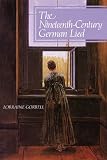
Lorraine Gorrell. The Nineteenth-Century German Lied. Portland: Amadeus Press, 1993. 398 pp. $39.95 (cloth), ISBN 978-0-931340-59-8.
Reviewed by Margaret E. Menninger (Department of History, Texas State University-San Marcos)
Published on H-German (August, 2005)
For Singers with Tremendous Artistry but No Voice
In one of her stunningly accurate satires of classical vocal music, from which this review derived its title, Anna Russell warned that the German lied must be approached with "reverence," despite the fact that much of the repertoire could be seen as "excruciatingly dull" (a fact that should not be discussed lest one be thought a musical philistine).[1] Of course Russell doesn't really mean it; the German lied is in fact breathtaking in musical and textual variety. Moreover, its consumption and performance in the home as well as the concert stage points to the fundamentally central role music played in nineteenth-century German society. This assertion is well substantiated by musicologists; Charles Rosen's work The Romantic Generation places strong emphasis on the song as one of the principal means of musical expression in the first half of the nineteenth century and Carl Dahlhaus is no less respectful.[2]
Lorraine Gorrell's The Nineteenth-Century German Lied celebrates this art form in a work primarily aimed at the singer or listener. Gorrell's book has four introductory chapters which serve as an overview and context for a closer examination of the songs of particular composers in the later part of the book. She begins with a discussion of the relationship between the text and the melody of a lied, a relationship much discussed by the composers themselves. For example, while many successful poems, and even great ones also made good texts for songs, other rather more "mediocre" poems (in the words of Robert Schumann--Anna Russell would have called them "soggy") still made wonderful lieder (p. 21). Gorrell follows this with a chapter on the political context of German history of the long nineteenth century. Here the emphasis is on the origins of romantic nationalism and its poetical expression in such works as Clemens Brentano's Des Knaben Wunderhorn, one of the textual sources for some of the best lieder. Gorrell also briefly discusses the Sturm und Drang poets, the brothers Grimm, and finally the twin giants Schiller and Goethe. Rather than a literary or political history, Gorrell keeps her discussion and examples rooted in specific songs.
Discussion of poetry and history is followed by two chapters dealing more with context. Gorrell devotes a chapter to the origin and development of the piano, briefly covering its construction but paying more attention to the ways new performers and composers were able to exploit the instrument's range of sounds and tones. The final chapter in this first part of the book summarizes the move of the lied from the salon to the stage. Since many of the lied's composers were also exceptional pianists, they were often the first to perform their own works often both playing and singing. Schubert's famous Schubertiads are only one example of this (Gorrell notes that Schubert, a former Vienna choir boy, was willing to sing his songs to his intimate friends, but generally only played piano during more public performances). Brahms also sang first performances of his works, although his voice did not measure up to his keyboard abilities (pp. 81-82).
The bulk of Gorrell's work features chapters on individual composers of German lieder. She includes the usual suspects; Ludwig van Beethoven, Franz Schubert, Robert Schumann, Johannes Brahms, Hugo Wolf, and Gustav Mahler. More interestingly, Gorrell pays attention to women composers of the lied and their rather precarious place in nineteenth-century society. Fanny Mendelssohn Hensel is the subject of one chapter and other minor female composers such as Luise Reichardt (1779-1825) and Josefine Lang (1815-1850) are introduced along with extensive examples of their compositions. Clara Wieck Schumann's important career as a pianist (and as wife of Robert) also occupies a central position in the discussion of the lied over several chapters. Less well known male song-writers such as Louis Spohr and Robert Franz are also analyzed. Gorrell finishes her work with several appendices including a chronology, performance editions of songs by less well-known composers and a series of suggested groupings of lieder for performance.
The strength and heart of The Nineteenth-Century Lied lies in the analysis of individual songs. For example, in her chapter on Schumann and particularly his song cycle Dichterliebe, which use poems of Heinrich Heine, Gorrell elegantly shows how the emotional curve of the poems are enhanced and punctuated by the music and how the songs melodically relate and echo each other from beginning to end. In the same chapter, Gorrell takes a stab at the problem of how a soprano today might approach texts with a decidedly subservient image of women or indeed if some songs are meant to be sung only by men or by women. Certainly these discussions will be of use to singers approaching these works for the first time.
However, what is puzzling and ultimately a bit disappointing about the book is the lack of depth to the analysis. In the above example of the question of how to sing sexist lyrics or sing a song as a man when the narrative voice is female, Gorrell's discussion doesn't really do more than scratch the surface. There is little in the way of advice or even summary of musicological findings. This rather sketchy approach is also noticeable in the introductory chapters, particularly those dealing with the historical context. The connection between songs and historical events is awkward and simplistic. For example, Gorrell's historical context for the post-unification is a three-page discussion covering mostly Nietzsche's and Wagner's relationship to German nationalism. Much could be said here, but is not. What does come across instead is a quick and glib end of history with Hitler and the Gestapo lurking around the corner.
Gorrell also misses an opportunity to firmly situate the German lied in the social history of the nineteenth century. The chapter on the piano says almost nothing about how the instrument functioned in the German home or how its existence fueled a growing market for sheet music. Amateur singers are also curiously absent from this story. Moreover, while the book is nicely illustrated with images of the composers and a marvelous selection of paintings by Caspar David Friedrich, the connection between these illustrations and either the text of the songs or their composers is left to the reader's imagination.
In sum, then, The Nineteenth-Century Lied, while perhaps useful to the singer, will do little more than whet the appetite of readers hungry for a more contextual approach. A devoted listener will find more detail in this work than can be found in liner notes, but not necessarily enough to feel truly satisfied, and a social or cultural historian looking for a closer relationship with the social practice of music in the nineteenth-century will be disappointed.
Notes
[1]. Anna Russell, The Anna Russell Album, compact disc, Sony Music, MDK 47252, copyright 1972 Sony Music Entertainment Inc.
[2]. Charles Rosen, The Romantic Tradition (Cambridge: Harvard University Press, 1995); and Carl Dahlhaus, Nineteenth-Century Music. translated by J. Bradford Robinson (Berkeley: University of California Press, 1989).
If there is additional discussion of this review, you may access it through the network, at: https://networks.h-net.org/h-german.
Citation:
Margaret E. Menninger. Review of Gorrell, Lorraine, The Nineteenth-Century German Lied.
H-German, H-Net Reviews.
August, 2005.
URL: http://www.h-net.org/reviews/showrev.php?id=10823
Copyright © 2005 by H-Net, all rights reserved. H-Net permits the redistribution and reprinting of this work for nonprofit, educational purposes, with full and accurate attribution to the author, web location, date of publication, originating list, and H-Net: Humanities & Social Sciences Online. For any other proposed use, contact the Reviews editorial staff at hbooks@mail.h-net.org.

