



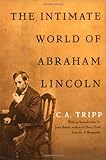
C. A. Tripp. The Intimate World of Abraham Lincoln. New York: Free Press, 2005. xxxvi + 343 pp. $27.00 (cloth), ISBN 978-0-7432-6639-0.
Reviewed by Edward Blum (Freelance Editor)
Published on H-CivWar (August, 2005)
Was Abraham Lincoln Bisexual?
Abraham Lincoln is the source of endless fascination for historians, politicians, Civil War buffs, and a host of others. For some of his early biographers and contemporaries, his assassination on Good Friday in April 1865 raised him to legendary status, as he was frequently portrayed as a martyr for the reunification of the nation. Throughout the twentieth century, he has been presented alternately as an adroit political organizer and a weak military leader, a champion of anti-slavery and a moral coward on racial issues, a faithful Christian and a crude infidel. Since the early 1990s, Lincoln's sexuality has become a new topic of discussion. Many have wanted to know not only the specifics of Lincoln's sexual persuasion, but also the impact his allegedly sexual encounters with men had on his presidency and his personality.
In The Intimate World of Abraham Lincoln acclaimed sex researcher and psychologist C. A. Tripp answers boldly. Using many of Alfred Kinsey's landmark findings on male sexuality from the 1940s and 1950s, Tripp claims that Lincoln was predominately homosexual and incidentally heterosexual, meaning that Lincoln felt strongly attracted to men, yet was also able to have sexual relationships with women. Furthermore, Lincoln's bisexuality influenced his personal relationships with men and women, his conduct during the war, and his view of religion. Unfortunately, although Tripp asks provocative questions, he offers few compelling answers. While he marshals a great deal of evidence to show that Lincoln was much closer to men than women, Tripp's attempts to connect Lincoln's sexual preferences with the rest of his character are confusing, poorly elucidated, and circumstantial at best.
Tripp bases his appraisal of Lincoln's sexuality on a number of factors. First, there are several known incidents in which Lincoln shared a bed with another man, most famously with Joshua Speed for more than four years. Most historians have explained away the Speed example as a common occurrence in antebellum America, especially since beds and warmth were in short supply. But Tripp's evidence that Lincoln also opened his bed in the White House to Captain D. V. Derickson when Mary Todd Lincoln was away is compelling. Why would Lincoln sleep with another man after he had ascended to the presidency and no longer lived on the frontier? The traditional answers, which assume Lincoln's heterosexuality, do little to explain it. Surely the President could have found Derickson a bed of his own, or found himself a warmer place to reside if needed. Of course, it is probably impossible to know if Derickson and Lincoln, or Speed and Lincoln, had sexual intimacy. Tripp is right, however, to look askance at American historians who want to downplay these occurrences. What went on between the sheets is anybody's guess, but Tripp cannot be faulted for thinking that sexual activity was quite likely.
To further make the case for Lincoln's bisexuality, Tripp focuses on Lincoln's supposed early puberty, a short story that he allegedly wrote that details a marriage between two men, and Lincoln's difficulties in dealing with women. None of this evidence is as illuminating as Lincoln's bed sharing, though, when it comes to providing evidence for his bisexuality. Yet these examples do offer a new window into understanding Lincoln. Tripp's focus on when Lincoln hit puberty demonstrates very little. The evidence, an account from Lincoln's friend that he was tall at an early age, is shaky. And Alfred Kinsey's correlations between puberty and sexuality from evidence in the mid-twentieth century tell us little about sexual norms and feelings in the nineteenth century, unless of course one believes that sexual trends transcend time, space, and context. "The Chronicles of Reuben," the tale Lincoln probably wrote as a young man, is far more telling. It is a fascinating satirical poem, in which a community celebrates several springtime marriages. In a twist at the end, however, the author references another set of marriages quite unlike the others. Two men, "biley" and "naty" wed, and the narrative ends with them attempting to have a baby. Thankfully Tripp included the story in an appendix. Students of sexuality and frontier life in the nineteenth century will find it quite striking. I am not convinced that it stands as evidence of Lincoln's bisexuality, but if he did author the story, then there was something going on in Lincoln's mind that demands further attention. Finally, Tripp's claim that Lincoln's difficulty when interacting with "eligible" women indicates bisexuality is highly questionable. Many men--both in the contemporary world and in nineteenth-century America--were able to be heterosexual and also be troubled around women. Shyness is not necessarily a sign of homosexuality.
While he provides a great deal of new insight on Lincoln's bed sharing, his encounters with women, and his early life, Tripp pushes too far when attempting to link Lincoln's sexuality with his religious beliefs and notions of morality and ethics. To suggest, as Tripp does, that Lincoln's sexual unorthodoxy encouraged his religious unorthodoxy is an amazing leap. Referring to Lincoln's youth and his reading of the Bible, Tripp turns speculation into fact and runs with it. "But since Lincoln had already arrived on his own at the powerful pleasure of orgasm, loved it, and found that the sky did not fall, one can be sure that like most precocious youngsters he was in no mood to give it all up for bookish or Bible reasons" (p. 189). Any possible connection between Lincoln's faith and his sexuality is shrouded in mystery, in part because Lincoln articulated a variety of claims about religion and in part because the exact nature of his sexuality is unclear. In short, since neither Lincoln's faith nor his sexual preferences were apparent, then it seems unlikely that any definite association between the two can be made--except perhaps that Lincoln kept most of his deeply held convictions and opinions to himself.
Readers will benefit substantially by the materials added to The Intimate World of Abraham Lincoln by the Free Press. In the introduction, Jean Baker introduces Tripp and the book superbly, while Michael Burlingame, Michael Chesson, and Alice Fennessey supply thoughtful critiques of the work and Tripp in an afterword. Fennessey, a trained psychologist, attests to Tripp's passion for Lincoln studies and to sexuality studies, while Chesson, a historian, suggests that Tripp's research provides a number of important questions about nineteenth-century intimacy and emotion. Historians interested in Lincoln's marriage to Mary Todd will find Burlingame's essay interesting in comparison with Baker's introduction and Tripp's assessment of the couple's relationship. Both Burlingame and Baker hold firm to points they have made previously, with Burlingame and Tripp denouncing Mary Todd as a thief and domestic abuser and Baker defending Mary Todd once again. Those hankering for more on Lincoln's personal life will also find the website for the book helpful as well, for it contains a number of additions to the endnotes.[1]
For classroom purposes, I cannot see how this book would improve any courses in nineteenth-century America, the Civil War, or even Lincoln studies. The evidence is too fragmentary, and Tripp lacks the appropriate nuance to handle such matters. Tripp's conclusive statements about inconclusive matters may confuse or mislead most undergraduates, while this book will not aid graduate students studying for comprehensive exams. Those interested in any and all aspects of Lincoln's life, however, will find Tripp's work interesting. Most, I imagine, will probably find it as excruciating to read as I did. To be sure, if he had lived, Tripp would have streamlined and clarified much of the prose. In a time of such public animosity toward same-sex civil unions, though, Tripp's questions are important to ask and to address without blushing or pretending that heterosexuality is the universal way of life.
Note
[1]. See www.theintimateworldofabrahamlincoln.com.
If there is additional discussion of this review, you may access it through the network, at: https://networks.h-net.org/h-civwar.
Citation:
Edward Blum. Review of Tripp, C. A., The Intimate World of Abraham Lincoln.
H-CivWar, H-Net Reviews.
August, 2005.
URL: http://www.h-net.org/reviews/showrev.php?id=10810
Copyright © 2005 by H-Net, all rights reserved. H-Net permits the redistribution and reprinting of this work for nonprofit, educational purposes, with full and accurate attribution to the author, web location, date of publication, originating list, and H-Net: Humanities & Social Sciences Online. For any other proposed use, contact the Reviews editorial staff at hbooks@mail.h-net.org.

