



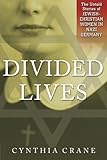
Cynthia Crane. Divided Lives: The Untold Stories of Jewish-Christian Women in Nazi Germany. New York: Palgrave Macmillan, 2000. xi + 341 pp. $17.95 (paper), ISBN 978-1-4039-6155-6.
Reviewed by Matthew D. Hockenos (Department of History, Skidmore College)
Published on H-German (July, 2005)
The Limits of Personal Narratives
On the back cover of Cynthia Crane's book, Divided Lives: The Untold Stories of Jewish-Christian Women in Nazi Germany, Nobel Peace Prize laureate and Holocaust survivor Elie Wiesel praises Crane's decision to quote at length from interviews she conducted with Jewish-Christian women who lived through the Nazi era. Wiesel says (apparently in a letter to Crane), "I believe in personal testimonies as you do--they have no equal in their weight of truth and memory." For historians such as myself, however, the extensive use of personal narratives signals a missed opportunity for deeper analysis and interpretive insights. Although "the truth" may always be elusive, historians tend to believe that they can get closer to it by questioning and analyzing their sources than they can by simply publishing primary documents or transcribing interviews verbatim. The recovery of lost voices is important and makes fascinating reading, but the analysis of these voices is a necessary and productive second step.
Crane, to be fair, was not trained as a historian--she is an English professor at the University of Cincinnati--and Divided Lives consists of more than published interviews with Jewish-Christian women. Her book is divided into three parts; the first two, "The Spirit" and "The Law" are relatively brief--forty pages all told. Crane introduces the reader to the subject matter with autobiographical information that explains her personal interest in the topic of Jewish-Christian women in twentieth-century Germany. Her grandmother, an Austrian Lutheran, married her grandfather, Felix Cohn, a German doctor of Jewish descent. Cohn served on the western front in the First World War and earned two Iron Crosses for his bravery. According to Nazi racial laws, described in the second part of Crane's book, her grandparents' marriage was an illegal mixed marriage and the children of this marriage, including Crane's father, were labeled "Mischlinge." Although Jews and persons of Jewish descent in mixed marriages during the Nazi era were somewhat better off than Jews who were not in mixed marriages, the Nazis treated them and their children as Jews. Fortunately, Felix Cohn and his family escaped persecution by emigrating to the United States. Cohn came first in 1938; his wife and children, including Crane's father, Carl, left Hamburg in early 1939 to join him. Like many migrs of his generation, Carl Cohn changed his last name in the 1950s to avoid anti-Semitic discrimination in the United States. Carl Cohn became Carl Crane.
Cynthia Crane's interest in the personal narratives of women in or daughters of mixed marriages stems from reading her grandmother's historical memoir, which discussed her life, hardships, and philosophy in the years from 1915 to 1939 in Austria and Hamburg. In 1994 Crane was awarded a Fulbright grant to travel to Hamburg to conduct research on her family and to expand on and contextualize her grandmother's memoir. Once in Germany, however, Crane was disappointed by what she found in the archives and decided to seek out women who experienced the Third Reich in this anomalous position. Crane writes, "In the archives, I was not only burdened with language barriers but also with gender barriers. It was telling that I found hardly any information on women at all, and I wanted to know why. Because life outside the archives had to be more invigorating, I decided to interview surviving Mischlinge" (p. 13). In addition to their experiences during the Nazi era, Crane was curious why these women stayed in Germany after 1945 and what their experiences were in post-Holocaust Germany.
The third part of Divided Lives, 300 pages long, consists of transcripts of interviews with ten Jewish-Christian women as well as a brief introduction to each interview by Crane. These women, most of them born in the 1920s, experienced the Nazi era as young women in their teens and twenties. The children of parents in what the Nazis defined as mixed marriages, these women tended to be from middle or upper class families from Hamburg, like Crane's own family. Most of them were baptized or identified as Christian and had little contact with Jews in Germany, although a couple of the women actively sought out contact with Jews. Only two might be considered public figures: one is an author who has written about her Jewish-Christian experience; the other is a theologian concerned with reconciliation between Jews and Christians.
The interviews are both fascinating and frustrating. Many of the women are speaking about their experiences for the first time and understandably contradict themselves or fail to tell their story in an entirely comprehensible way. Although Crane edited the transcripts because of their length, it is not clear why some of the material made it to publication--some passages read like stream-of-consciousness rambling. At the same time the reader is sympathetic to the fact that women in their 70s and 80s might drift off topic when trying to explain horrific events that took place nearly fifty or sixty years ago. As Ruth Yost, the daughter of a mixed marriage who was raped by Russian soldiers at the end of the war, explained to Crane, "It is always good that one doesn't remember events so exactly, so horrible things can't be remembered" (p. 122). Nevertheless Crane should have been more rigorous when editing the peripheral material. She, in fact, acknowledges the trouble she had with this process. In the introductory remarks to her interview with Ruth Wilmschen, Crane reports, "Ruth had written notes on a small legal pad in order to follow her life in as orderly a fashion as possible; yet her conversation was the longest and most scattered of all the women. By the time I found the core of Ruth's experiences during the Third Reich gleaned from so much excessive almost child-like talk, I wondered if she had unconsciously tried to muddle the narration of her life. It seemed the more she tried to make sense of what she was saying, the more digressive and unpredictable she became in her conversation" (p. 135). Unfortunately, this lack of clarity came through in some of the material Crane shared with the book's readers.
The short introductions Crane wrote for each interview (approximately three to four pages long) are also of mixed value. In these introductions Crane provides both background information about the interviewees and analyzes (all too briefly) certain aspects of the interview. We learn about the state of the room in which each interview took place and how each of the women was dressed. In one case Crane makes note of Holocaust books on display and in another that a menorah sat on the coffee table. At times helpful and insightful, the observations and analysis are just as often unhelpful and facile. For instance, she writes, "I was conscious of her jewelry the entire interview: the pearl circle pin, green-colored pearls, black onyx ring, green coral bracelet, and a large watch. Her house with its cherry furniture and four Oriental rugs, like herself, exuded expensive taste" (pp. 201-202). Or "Books lay everywhere; one by Anna Freud and others by various psychologists suggested to me that Ursula was and is searching for answers" (p. 297).
In spite of these drawbacks the interviews offer a wealth of information on the consequences of the Nazi racial policy directed at so-called Mischlinge and men and women in mixed marriages. Ingeborg Hecht, the daughter of a Jewish father and Protestant mother, told Crane, "I have always had the vision of my father having to suffocate like a rat just because very primitive people ordered it. This horrible picture appears night and day" (p. 61). The Nazis murdered her father in Auschwitz but Hecht was never deported to a camp herself. After the war Hecht was so traumatized that she did not leave her home between 1957 and 1983. Only after she had written about her experiences did she feel strong enough to venture outside. Nevertheless she did not leave Germany and told Crane she would have become homesick had she emigrated to the United States. "The Germans and the Nazis," Hecht said in her interview, "were not synonyms for me" (p. 59).
Crane's book has as its most dramatic asset the frank and unvarnished testimony of a unique group of women who survived Nazi Germany. They bring alive both the terror-filled nightmare of life in Nazi Germany for "Mischlinge" and their parents and the difficult postwar process of coping with these memories in Germany. But the very richness of this testimony is at the same time its burden because it calls out for insightful interpretation to better understand its historical significance.
If there is additional discussion of this review, you may access it through the network, at: https://networks.h-net.org/h-german.
Citation:
Matthew D. Hockenos. Review of Crane, Cynthia, Divided Lives: The Untold Stories of Jewish-Christian Women in Nazi Germany.
H-German, H-Net Reviews.
July, 2005.
URL: http://www.h-net.org/reviews/showrev.php?id=10754
Copyright © 2005 by H-Net, all rights reserved. H-Net permits the redistribution and reprinting of this work for nonprofit, educational purposes, with full and accurate attribution to the author, web location, date of publication, originating list, and H-Net: Humanities & Social Sciences Online. For any other proposed use, contact the Reviews editorial staff at hbooks@mail.h-net.org.

