



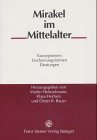
Martin Heinzelmann, Klaus Herbers, Dieter R. Bauer. Mirakel im Mittelalter: Konzeptionen - Erscheinungsformen - Deutungen. Stuttgart: Franz Steiner Verlag, 2002. 492 S. (broschiert), ISBN 978-3-515-08061-3.
Reviewed by Karen Stoeber (Department of History and Welsh History, Aberystwyth University)
Published on H-German (July, 2005)
The issues of miracles and miracle-working saints have been crucial in shaping our perceptions of the medieval world view. The editors of the present volume go so far as to pose the question whether miracles and the Middle Ages might not indeed be regarded as altogether inseparable entities. To approach this question, as well as assess a range of other related questions, is the overarching purpose of Mirakel im Mittelalter.
The eighteen chapters (sixteen of which are written in German, two in French) that comprise this volume are the proceedings of a conference held at Weingarten in Germany in April 2000, and as such represent the views of some of the leading European scholars in the field. The focus of the work is on the miracle in the Middle Ages, the many manifestations thereof, their meanings and interpretations, as well as their place in historiography, and the ways in which changes over time have impacted upon developments in the field. Chronologically, the essays range from late antiquity to the second half of the sixteenth century, with considerable emphasis on the earlier to high Middle Ages, while geographically the focus is on Western Christendom, with some bias towards Germany. The collection is accompanied by a comprehensive introduction by the editors, which sets out the aims of this volume and outlines some of their main concerns and purposes. Three main identified "problem areas" have here been emphasized by the editors. The first of these relates to the problem of theological and intellectual conceptions, the second "problem area" addresses the many possibilities of definition and specification of the type, function, contexts, and interpretations of miracles and miracle stories, and finally, some attention has to be paid to the issue of chronological and regional developments within individual miracle stories. Within these three broader sections, the contributions themselves discuss a very wide range of issues surrounding the miracle debate. Some of these will be considered here.
In his chapter on the function of the miracle in the historiography of late Antiquity and the early Middle Ages, Martin Heinzelmann suggests the need to clarify the definition of both Mirakel and Historiographie. In this context he stresses the importance of considering miracles as phenomena which are relevant in the Christian as well as in pagan traditions, while concluding that within the historiography of late antiquity and early medieval western Christendom, miracles may assume definite functions that are connected with the social or religious concepts of the respective historiography. The discussion regarding an overlap between hagiography and historiography is reiterated by Karin Fuchs in her contribution, which considers the analysis of miracle tales in medieval historiography versus the practical application thereof, as exemplified in the work of the eleventh-century monk Guibert de Nogent. Lutz E. von Padberg in his discussion of the role of the miracle tale in the early medieval sermon uses the example of Anglo-Saxon missionaries in the eighth century in order to stress the contribution of miracle stories to conversion. Miracle reports can thus be seen to play a central part in the conversion process, as, indeed, they did in the political and dogmatic efforts of establishing official authorization for the cult of a potential saint, as Patrick Henriet's study of the miracles of Isidore of Seville and Uta Kleine's chapter on Engelbert von Koeln illustrate.
Barbara Heller-Schuh stresses the developments in the tradition of miracle stories and the increasing evidence for "distance miracles" and the adoration of saints' images from the later Middle Ages into the early modern period. Hers is first and foremost an assessment of changes in the quality of miracle tales that had taken place by the later Middle Ages. Beyond this, some consideration is given to developments within miracle tales in general, and to the increasing importance of the role of the Virgin and of Christ himself in particular, a development which culminated in the fifteenth century.
Hedwig Roeckelein reflects on the function of the medieval saint in her excellent assessment of translation miracles, which considers reports of miracles accompanying the translation of a saint's body or his relics. The confirmation of actual miracle-working abilities of a saint depended much on the existence of miracula post mortem, as Berhard Vogel argues in his chapter on the relationship between miracle and vision. Posthumous miracle working was thus a crucial element in any effort to promote an individual's canonization. The canonization process during the Middle Ages in general has been illustrated by means of a number of case studies, such as those from fifteenth- and sixteenth-century Anger offered by Jean-Michel Matz, while Thomas Wetzstein's contribution assesses the legalization of the process during the fifteenth century.
The above contributions, then, share a number of common concerns. One clearly problematic issue is the question of defining the term Mirakel, and the different implications associated with the different uses of this term. Another chief concern is the issue of hagiography versus historiography, as well as of vita versus miracle collection. A related issue is that of problems surrounding the recording of miracle stories in the Middle Ages. While the various contributions succeed in emphasizing common views on the above points of debate, no common consensus could be reached among the contributors regarding the question of genre: that is, whether or not miracle stories could be argued to form a separate genre, particularly in the light of the specific miracle collections that were beginning to emerge and became increasingly common from the ninth to the thirteenth centuries. Similarly, controversial and consequently unresolved in this volume remains the question surrounding appropriate means and methods of analyzing medieval miracle reports. However, as this collection shows very clearly, much progress in the study of the medieval miracle is due to interdisciplinary discussion between historians from different backgrounds, including legal, social, and art historians, as suggested here particularly by Giselle de Nie, and it is the emphasis on this awareness that makes the present volume such a valuable contribution to the future of the study of miracle reports in the Middle Ages.
This, then, is a collection of thoroughly and methodically researched essays of the highest academic standard. They represent an invaluable and much appreciated contribution to current scholarship; the eighteen chapters between them take current research in the field to new levels, accentuate the problems that emanate from the study of the medieval miraculum, and challenge established views on these issues.
If there is additional discussion of this review, you may access it through the network, at: https://networks.h-net.org/h-german.
Citation:
Karen Stoeber. Review of Heinzelmann, Martin; Herbers, Klaus; Bauer, Dieter R., Mirakel im Mittelalter: Konzeptionen - Erscheinungsformen - Deutungen.
H-German, H-Net Reviews.
July, 2005.
URL: http://www.h-net.org/reviews/showrev.php?id=10733
Copyright © 2005 by H-Net, all rights reserved. H-Net permits the redistribution and reprinting of this work for nonprofit, educational purposes, with full and accurate attribution to the author, web location, date of publication, originating list, and H-Net: Humanities & Social Sciences Online. For any other proposed use, contact the Reviews editorial staff at hbooks@mail.h-net.org.

