



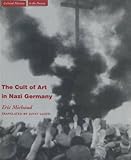
Eric Michaud. The Cult of Art in Nazi Germany. Stanford: Stanford University Press, 2004. 384 S. $26.95 (paper), ISBN 978-0-8047-4327-3; $70.00 (cloth), ISBN 978-0-8047-4326-6.
Reviewed by Keith Holz (Art Department, Western Illinois University, Macomb)
Published on H-German (June, 2005)
Homogenous Nazi Art? A Bold Reading from 1994
From Eric Michaud, professor at the cole des Hautes tudes en Science Sociales, Paris, we now have an English translation of his ambitious 1996 study.[1] The Cult of Art in Nazi Germany approaches the role of art in Nazi Germany and the ideologies that informed it from the philosophically informed, French tradition of critical textual scholarship that coursed from Barthes to Derrida. Although the English title suggests its proximity to art history, it is not easily nudged into this discipline, even among art history's more revisionist strains. Fittingly, the book opens with a disclaimer to this effect (p. ix).
In Michaud's narrative, art is approached for the integral role it played in supplying the visual manifestations of Nazi ideology and occasionally policy, but emphatically not as a mere instrument of National Socialist propaganda or as a reflection of "reality" under Nazi rule. Instead, Michaud claims that art, and aspects of earlier art-for-art's-sake ideologies that he shows the Nazis to have inherited, were part and parcel of the racist views and politics that proclaimed Aryans to be the exclusive people (Volk) capable of producing and bearing culture. Another particularly well-developed thesis engages with how Nazism adapted Christian eschatology for its own timely imperatives, with Hitler playing the role of messiah (chapters 2 and 5). The logic of this world-historical rhetoric of temporality is demonstrated to have underpinned a productive role for art, inasmuch as Nazi art retrieved, projected and ultimately produced a future from archaizing references to the past. Another key to Michaud's account is found in his reliance upon the concept of "the Nazi myth." His concept of myth plainly owes much to Barthes's refinement of this concept to analyze postwar French bourgeois culture and habits, but a more specific point of departure is Philippe Lacoue-Labarthe and Jean-Luc Nancy's article of the same title.[2] Readers attentive enough to follow Michaud's surprisingly non-analytical and deceptively relaxed narrative from beginning to end should adjust their expectations to accept that Michaud's Nazism is, foremost, one pieced together from ideas, ideas discovered in closely read texts from which he attempts to wrest constitutive metaphors and discern a structure for "the Nazi myth." Supposedly it is this accrual of structuring metaphors that provides the thread running through the book's narrative and also shapes and connects the texts, works of art, beliefs, persons, and, to a lesser extent, the events, social structure, laws, and institutions that Germany became under National Socialism.
This reader was struck that the new translation offers no additional preface or note to explain why this ambitious work is now being published in English. One would have wished to learn how the author understands this work in relation to the two burgeoning traditions of scholarly inquiry to which it obviously relates, namely: historical and art historical studies on art and Germany's art world during the Third Reich; and the critical literature on modernism and fascism (including Nazism). Although the volume includes annotated endnotes and a bibliography, readers acquainted with either of these traditions will miss the expected references to works in those robust fields of scholarly endeavor. But one should keep in mind that the volume's theoretical assumptions and methodological procedures appear to have been settled during the mid- to late 1980s, with several important publications from 1990 and 1991 worked in and commented upon in the notes. As the French text was completed in 1994, the absence of reference to American, German, and British scholarship since 1991 should not surprise. More troubling, perhaps, is that the scholars publishing in those other countries since the late 1990s have almost completely overlooked the 1996 publication of this book in French. Language certainly created one barrier between the traditions, yet even with the current translation, more fundamental differences appear to divide them. I also propose that Michaud's unencumbered relationship to recent scholarship should not only be construed as a shortcoming. For by refusing to get bogged down in a full-blown reckoning with voluminous bodies of secondary literature, an essayistic style of writing is enabled which merits appreciation for the way it engages with texts and images, and does so repeatedly, brilliantly, and with originality.
The book's overarching arrangement comprises a sequence of readings of texts on art by leading Nazis and other writers (modern and ancient). Occasionally, readings of works of art or architecture are also included. The five chapters comprise a multifaceted analysis of "the Nazi myth," and in the process seek to reveal the key structures by which that myth was enacted or performed through visual art and culture. A central claim subtending the entire book is that art was elevated to supreme importance in the Nazi Weltanschauung and most significantly within the racist policies implemented in National Socialist Germany. For Michaud, art played a thoroughgoing role in shaping not only the aspirations for, but the very reality of, the Third Reich.
Chapter 1, "Artist and Dictator," traces how Hitler--like other artist-leaders in the early twentieth century--was bestowed with the attributes of power (e.g., through Heinrich Hoffmann's photographs) as well as the ways Hitler was able to fashion the masses to transfigure Germany according to his will. Chapter 2, "The Artist-Fhrer: A Savior," considers a succession of historical texts by numerous writers to interrogate the Christian moorings of this regime and the messianic sources it tapped to define its own quest for eternity and perfection. Also examined here is the identification--through the power of "auto-suggestion"--of the figure of Hitler with Germany and Germany's identification with Hitler as a Christ-like savior. While the occasional work of visual art comes in for analysis, most texts in this chapter are indeed textual. In the following chapter, "Exhibiting the Genius," the case is developed for the wholesale shaping of the Nazi myth in painting, sculpture, photography, and public spectacle, with an extended and intriguing discussion of the role of vision in racist consciousness and culture. Chapter 4, "Reproducing the Genius," considers the pan-European claims for "the new man," and the calling into being of the Volk and its reproduction in art and other imagery. A provocative philosophical digression on earlier thinkers' writings on life imitating art is joined to twentieth-century efforts (well beyond but including those of Nazi ideologues or planners) to call "the new man" into being through art and other imagery. In this chapter, some key exhibition venues for recent art in Nazi Germany are discussed and valuable readings of specific works of Nazi art offered (particularly of female nudes). Michaud stresses that official works of Nazi art functioned by calling into being a desired new kind of human being, and not by merely emulating or reviving already extant types or ideals as commonly assumed in art historical literature. As the title of the fifth and final chapter suggests, "Images of Nazi Time: Accelerations and Immobilizations," the temporal scope and structure of Nazi ideologies is addressed (along with related fascist and modernist ones). Nazi and other fascist ideologies are shown to share with Christian eschatology a retrieval of a past that operated in tandem with an accelerated anticipation of an expected future. Particularly germane in this regard are Michaud's analyses of post-1890 writings which illuminate how images had long been thought to hold the capacity to manipulate the masses to accelerate history. Rich associations are also struck between vision and the Weltanschauung of Hitler, the ideology of work in building the much anticipated future (often discerned from paintings), as well as an original reading of the disturbing modernism as fascism nexus, with Georges Sorel, Gustave Le Bon, Wyndam Lewis, Carl Schmitt, Henri Bergson, and Hitler sounding the main notes.
Before commenting further upon the book's methodology, it is necessary to underscore the book's dizzying range of textual sources. Excerpts are encountered from the most prominent Nazis including Hitler, Goebbels, Rosenberg, and Himmler, but also from writings by Ley, von Schirach, Darr, Schultze-Naumburg, Speer, Willrich, and others. Also discussed are the writings of a wider range of authors that includes Plato, Saint Augustine, Winckelmann, Theodor Gautier, Baudelaire, Oscar Wilde, Ernst Jnger, Gottfried Benn, as well as the painters Fernand Lger and Piet Mondrian. Works of painting, photography, sculpture, and architecture (but never film stills) are also reproduced and drawn into the narrative.[3] Through textual juxtaposition and discussion the author proposes the similarity of modernist writers' and artists' views to those of key Nazi and fascist political leaders. The maneuver of placing views on the art of notorious Nazis in line with those of key modernists funds Michaud's case that Nazism was not an isolated phenomena (or Sonderweg), and was limited neither by national borders nor fixed dates. Like so much of the more recent critical literature linking modernism and fascism, Michaud's argument will contribute to the ongoing erosion of the once widely accepted and cherished association of modern art and artists with democracy.
Offering few comments upon its position within scholarly discourse, this distinctive interpretation of Nazism and the role of art therein invites questions of its intellectual moorings. A major intellectual point of departure of the book appears to have been "The Nazi Myth," a provocative and programmatic talk and essay by Michaud's Paris colleagues, Philippe Lacoue-Labarthe and Jean-Luc Nancy. Cited only once by Michaud in order to differentiate his position from theirs rather than to align them (p. 229, n. 31), a comparison of the two texts makes the proximity of Michaud's book to this earlier "outline of analyses that demands further development" difficult to overlook.[4] In many respects, Michaud's study amounts to a discursive elaboration of the visual cultural dimensions of the conceptually bold, if schematic, program for studying Nazism called for by these two philosophers. Among the basic and guiding propositions Michaud's work shares with "The Nazi Myth" (singular) is the attention to "the fashion by which National Socialism constitutes itself."[5] Also shared is the primacy of "the task ... to understand ... how Nazi ideology (what we will attempt to describe as the Nazi myth) was able to come into existence, and more precisely, why the German figure of totalitarianism is racism."[6] Additionally, Michaud's assumption that racism was not exclusive to Germans was also set forth by these philosophers (no Sonderweg here either).[7] They also share the same innovative readings of Nazism and art, both relying upon readings of Plato's Republic on myth and "plastic art." In addition to discussing the state's need to condemn socially harmful myths, Plato had proposed myth (and art) to be crucial to establishing identity. Lacoue-Labarthe and Nancy contend that "Myth is a fiction, in the strong, active sense of "fashioning," or, as Plato says, of "plastic art": it is, therefore, a fictioning, whose role is to propose, if not to impose, models or types..., types in imitation of which an individual, or a city, or an entire people, can grasp themselves and identify themselves."[8] Michaud's book develops the notion of the relationship of art and myth articulated by Lacoue-Labarthe and Nancy. On the relevance of Plato's concepts of mimesis (imitation) and identification for modern Germany they wrote, "myth, like the work of art that exploits it, is an instrument of identification. It is, in fact, the mimetic instrument par excellence."[9] Also like these philosophers, Michaud relies heavily (justifiably) upon Rosenberg's The Myth of the Twentieth Century, and Hitler's Mein Kampf to attend to how each ideologue desired to realize or construct the Nazi myth. Accounting for the scant credit Michaud gives to Lacoue-Labarthe and Nancy, one might surmise that the radical, transformative theses they advanced for the study of German National Socialism, established a climate and framework of inquiry so familiar and comprehensive that an art historian, like Michaud, saw it pointless in the early 1990s to reference their thoroughgoing influence, however distinctive it appears in retrospect.
Beyond noting the book's position within the wake of "The Nazi Myth," some nod to the substantial literature that has redefined the field since the early 1990's merits comment. Since these years, American, German, and British scholars have addressed art and the Third Reich to produce a body of art historical scholarship characterized by its rich documentation and mining of archival sources. The moorings and aims of this tradition diverge strikingly from those of Michaud. These historians and art historians have sought to answer questions about the relationship of contemporary art and artists to government policies, of art and artists to institutions, of government support for and pillory of art, and of art's significance to government leaders; in short, to write political or institutional histories of art or architecture under the Third Reich. Additionally, several studies have examined the art and careers of individual artists in Germany during the Third Reich (e.g., Barlach, Baumeister, Breker, Nolde, Peiner, Radziwill). In contrast to the state of research when this manuscript was first completed, one can now map the structure of Nazi Germany's artworld and follow the historical shifts in its policies together with the priorities and conundrums of its leading professionals. Yet with its fundamentally different assumptions and a methodology that develops a history of ideas, Michaud's study will hopefully challenge practitioners within this historiographic tradition to revisit many assumptions, including those related to the function of art within Nazi cultural and political institutions as well as the use of art as an instrument to cultivate the masses and create support for the regime and suppress dissent.
The other direction within recent scholarship to address the topic of art's role in creating, or shaping, Nazi Germany is the literature on modernism and fascism (including Nazism). This trajectory of scholarship was recently assessed comprehensively by art historian Mark Antliff, whose review also summarized the French edition of this book.[10] A major achievement of this scholarship has been to undermine many comforts still harbored regarding the discreteness of modernism and fascism (including Nazism). Michaud's book shares in this expanding scholarly trend of contaminating modernism with fascism chiefly by demonstrating the modernist aspects of Nazi art and architecture. Similarly, he demonstrates the conjunctures between German Nazism and its non-German, particularly French and Italian, manifestations in writings about art while refraining completely from any comparisons with the role of art within the Soviet Union. Within this literature, this study of 1994 remains one of the most comprehensively conceived and fully developed studies.
In conclusion, it must be noted that while The Cult of Art in Nazi Germany amounts to an astute assessment of the ways visual culture (especially art and architecture) contributed to "the Nazi myth" and shaped Nazi society, in the process it imparts a highly homogenous sense of the Nazi regime's actual art and cultural policies. There is more than a suggestion that the ideological aspirations and desires analyzed were all successfully translated into policy, law, or public life. The underlying history of ideas methodology tends to neglect the instrumental dimension of culture. Put differently, the book falls short of accounting for National Socialism's shortcomings or failures within the rough and tumble world of bureaucratized political life, and in other realms of cultural and public life as well. Similarly, this study offers little to help sort out questions about the political or economic ends to which various branches of the German government employed art and visual culture. The cogency Michaud suggests for the Nazis' art policy also offers few clues as to why the German government could tailor and pursue divergent cultural and art policies toward other nations (e.g., the contrast between an art policy that was anti-modernist and hostile in relations with Czechoslovakia and an affirmative embrace of much modernist art to foster friendly relations toward France through 1939). But given the author's extensive and often subtle tracking of key ideas and metaphors about art that informed or constituted Nazi thinking, and sometimes policy and society too, Michaud's analysis demands a serious reckoning by scholars concerned with the intersections of Nazism (and other fascisms) and modernist culture. It might also be wished that the author had expended more effort to clarify the major points of each chapter and subsection, and that the author (or translator?) might have rendered the narrative more comprehensible to a wider readership. This is particularly true given--as art historian Hal Foster recently pointed out in his glowing acclaim for the book--the striking similarities between the Bush administration's renewed use of both Christianity and visual imagery to consolidate its popular support for a war of aggression and other policies, making this an all too timely story that more American and British readers should ponder.[11]
Notes
[1]. First published as Une Art de L'ternit: L'image et le temps du national-socialisme (Paris: ditions Gallimard, 1996).
[2]. Philippe Lacoue-Labarthe and Jean-Luc Nancy, Le mythe nazi (La Tour d'Aigues: Editions de l'Aube, 1991), and "The Nazi Myth," translated by Brian Holmes, Critical Inquiry 16 (Winter 1990): pp. 291-312.
[3]. In this regard, the reproductions are the same black and white ones that appeared in the French edition, but which have now faded.
[4]. Lacoue-Labarthe and Nancy, Le mythe nazi, p. 291.
[5]. Ibid., p. 292.
[6]. Ibid., p. 296.
[7]. Ibid., p. 295.
[8]. Ibid., p. 297.
[9]. Ibid., p. 298.
[10]. Mark Antliff, "Fascism, Modernism, and Modernity," The Art Bulletin 84, no. 1 (March 2002): pp. 148-169.
[11]. Hal Foster, in "Best of 2004: Books," Artforum International 48, no. 4 (December 2004): p. 49.
If there is additional discussion of this review, you may access it through the network, at: https://networks.h-net.org/h-german.
Citation:
Keith Holz. Review of Michaud, Eric, The Cult of Art in Nazi Germany.
H-German, H-Net Reviews.
June, 2005.
URL: http://www.h-net.org/reviews/showrev.php?id=10682
Copyright © 2005 by H-Net, all rights reserved. H-Net permits the redistribution and reprinting of this work for nonprofit, educational purposes, with full and accurate attribution to the author, web location, date of publication, originating list, and H-Net: Humanities & Social Sciences Online. For any other proposed use, contact the Reviews editorial staff at hbooks@mail.h-net.org.

