



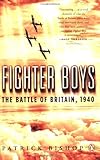
Patrick Bishop. Fighter Boys: The Battle of Britain, 1940. London: Viking, 2004. xiii + 434 pp. $16.00 (cloth), ISBN 978-0-14-200466-1.
Reviewed by Thomas Hughes (Air University, School of Advanced Air and Space Studies)
Published on H-War (June, 2005)
The sixtieth anniversary of the Battle of Britain encouraged renewed examination of this never-forgotten contest, and in recent years a number of books have appeared on the epic fight, producing first rate essays like Richard Overy's The Battle of Britain: The Myth and the Reality. Patrick Bishop's Fighter Boys is one of them. More than other works, this book aspires to uncover what "the fighter boys were really like." This is no easy task, as the "Battle of Britain was mythologised before it was even over and those who took part in it were bathed in the glow of legend" (p. x). Bishop attempts to peel layers of legend from these young men, and he mostly succeeds. Readers interested in robust discussions of the strategy, policy, or senior personalities of the battle will need to read elsewhere, but as social history Bishop's work is adequate in most places, first-rate in some spots, and poor through only a few passages.
The care Bishop takes to describe the cultural and social topography of Fighter Command before the crucial summer of 1940 is the book's greatest strength. The fighter boys' stories before the battle occupy nearly half the book, and Bishop offers a portrayal of them before legend robbed them of their humanity. As a matter of policy, the Royal Air Force wanted Fighter Command to be a citizen air force, "modern and democratic, attracting 'air minded' young men from factory, shop and office" (p. 73). This, according to Bishop, was about how it turned out: by 1940 the flyers were men from aristocratic families, from blue collar backgrounds, from public and private schools, and from all over the empire--a diversity fostered in part by the establishment of a flying reserve that, when called to active duty, served to vary the kinds of men in Fighter Command. There were common characteristics, to be sure: almost all were young, single, optimistic, and social. But most pilots were "too ordinarily complex to be pigeonholed" (p. 6). The way Bishop tracks the RAF from a small elite organization policing the empire in the 1920s to a mass force capable of fighting a major war by 1939 is a singular strength of his work.
Nowhere is this more evident than in Bishop's portrayal of the pilots of No. 1 Group, which went to France as part of the British Expeditionary Force. Led by P.J.H. "Bull" Halahan, the group included Peter "Johnny" Walker from Suffolk, Peter Prosser Hanks from York, Cyril Palmer from the United States, Mark "Hilly" Brown from Canada, Leslie Clisby from Australia, Bill Stratton from New Zealand, John Ignatius Kilmartin from Ireland, and counted four sergeant pilots among them. Taken together, the pilots of No. 1 were Catholic, Protestant, worldly, sheltered, decent, rascals, rich, poor. But they all flew, and forged a bond over Northern France and Dunkirk. Before the Battle of Britain began, they were the war's new baby-faced veterans.
Bishop carries a knack for personal portrayals of the pilots dueling over Southern England in the summer of 1940. Based on personal narrative and memory in the form of diaries, interviews, and published memoirs, Fighter Boys ably describes the daily lives of pilots. Their routines, social patterns, drinking habits, sexual mores, joys, fears and deaths are all grist for Bishop. The book bounces from wing to wing, squadron to squadron, and person to person without sacrificing too much to the broader historical experience. Bishop makes a habit of situating each set of memories against the battle writ large, and this allows the reader to track the fight's ebb and flow. At times, of course, the contest was desperate, but at least the fighter boys "had the virtue of clarity and purpose," and by the fall they had won one of warfare's great victories (p. 187).
Despite obvious strengths in descriptive writing, Bishop does not always strike the right--or at least a complete--note. Some depictions seem facile or contrived. Photographs of World War I ace Albert Ball reveal for Bishop "fatalism behind the easy smile" (p. 15), while "almost all" childhood episodes of the 1940 fighter boys "feel like encounters with fate" (p. 51). As for the other side of the hill, portrayals of Luftwaffe pilots are half-hearted and two-dimensional in comparison to the British flyers. Perhaps this last critique falls beyond the book's scope, but Bishop invites the comparison with a separate chapter on the German pilots and their machines.
Beyond these weaknesses, like all books Fighter Boys has distinct limits. Bishop does not deal extensively with the basic strategy or policy that underlay the German attempt to strike Britain from the air. Basic shifts in Luftwaffe targeting merit nary a mention. Britain's sophisticated defense scheme occupies Bishop a tad more, especially as it relates to radar, but even here the book neglects the command and control of aircraft and ignores the role of coastal watchers--a group of common men and women that seem ripe for Bishop's talent for social history. Bishop is likewise mute on the raging controversy within Fighter Command about force composition--the so-called Big Wing debate. For all these matters, readers will need to supplement Fighter Boys with other assessments of the battle, like Richard Hough and Denis Richards's The Battle of Britain: The Greatest Air Battle of World War II or John Ray's The Battle of Britain: Dowding and the First Victory.
Still, as social history Fighter Boys is excellent. Finely drawn personal portraits act to flesh out the broader history of the battle. Much of the wider contest has been well chronicled elsewhere, and Patrick Bishop's book fills a personal niche in the literature that devotees of the Battle of Britain will surely want to read.
If there is additional discussion of this review, you may access it through the network, at: https://networks.h-net.org/h-war.
Citation:
Thomas Hughes. Review of Bishop, Patrick, Fighter Boys: The Battle of Britain, 1940.
H-War, H-Net Reviews.
June, 2005.
URL: http://www.h-net.org/reviews/showrev.php?id=10621
Copyright © 2005 by H-Net, all rights reserved. H-Net permits the redistribution and reprinting of this work for nonprofit, educational purposes, with full and accurate attribution to the author, web location, date of publication, originating list, and H-Net: Humanities & Social Sciences Online. For any other proposed use, contact the Reviews editorial staff at hbooks@mail.h-net.org.

