



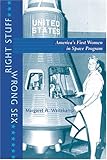
Margaret A. Weitekamp. Right Stuff, Wrong Sex: America's First Women in Space Program. Baltimore: Johns Hopkins University Press, 2004. xi + 232 pp. $45.00 (cloth), ISBN 978-0-8018-7994-4.
Reviewed by Sarah Janda (Department of History and Government, Cameron University)
Published on H-Minerva (June, 2005)
New Frontier, Old Opposition
In the fall of 1959, aerospace expert Dr. William Randolph Lovelace implemented the privately funded Woman in Space program. Considerable funding for the project came from Jacqueline Cochran, one of the most famous female pilots of the twentieth century and a highly successful owner of her own cosmetics company. By situating this program within the diverse fields of gender, aviation, and military history, Weitekamp provides a much needed study of the failure of the Woman in Space program. One great asset of this book is the author's ability to bring alive the personalities of the central figures involved. She begins with an intriguing comparison of Amelia Earhart's feminism and Jackie Cochran's femininity. While Earhart tried to advance opportunities for women in general, Cochran often basked in the novelty of being the "only woman," and made a point of accentuating her feminine characteristics and relying on male chivalry to further her agenda.
Moving beyond the 1930s, Weitekamp argues that the temporary gains women aviators made during World War II came to a halt even before the war ended when the Women Air Force Service Pilots were disbanded and women were banned from flying in the U.S. Air Corps. Prior to the war, most female pilots were upper-class and part of a strong female support network (not unlike women leaders in the New Deal). Following the war, flying increasingly appealed to middle-class women, yet neither society nor the military offered ready acceptance of these female pilots. Ironically, as Weitekamp points out, women's greatest chance for space travel after the war and alongside men existed when the possibility of space travel itself still remained out of reach.
1959 proved a pivotal year for proponents of women in space, as three separate efforts were launched to explore the viability of such an endeavor. Weitekamp reveals some interesting notions about women's supposed fitness for space. She notes that for a moment, women actually appeared to be better candidates than men for space travel, because women generally weigh less, eat less, and require less oxygen. Moreover, some studies indicated that women were better able to withstand cramped spaces and solitary confinement than were men. One even speculated that women have thicker skin than men and would therefore be more resistant to space radiation. Despite these initially positive signs, the bottom line is that in the midst of Cold War America there existed far too little support for putting women into space for the initiative to go beyond exploratory testing.
Ultimately, Weitekamp argues that the Woman in Space program was doomed even before it started because of internal disputes, differing goals, and an inability to stand up against political attacks. Here the individual personalities of key actors such as Randy Lovelace, Jackie Cochran, and Jerrie Cobb, who became famous as the first woman tested to be an astronaut, are crucial to understanding the various tensions within the program. In 1962, when congress began hearings on women in space, the extent of opposition became abundantly clear and resulted in the cancellation of the program. Neither congress nor the president viewed space travel as an appropriate vocation for women. Regardless of the ability of women to meet the physical requirements, the government concluded that the physiology of women--including menstruation--remained prohibitive. Here Weitekamp offers a thorough analysis of the congressional hearings and concludes that both the rise and fall of the program was very much a product of its time, revealing "how aerospace science, cultural politics, and gender relations intersected in the early 1960s" (p. 183).
The author makes use of an impressive number of archival collections in addition to oral interviews with participants in the program. While her work is not the first to point out the gendered fault lines within the space program and social attitudes toward women pilots and astronauts, it is the only comprehensive analysis of the failure of the Woman in Space program. Weitekamp's clear prose, engaging style of story-telling, and rich analysis make this not only an important book but a lively and enjoyable read.
If there is additional discussion of this review, you may access it through the network, at: https://networks.h-net.org/h-minerva.
Citation:
Sarah Janda. Review of Weitekamp, Margaret A., Right Stuff, Wrong Sex: America's First Women in Space Program.
H-Minerva, H-Net Reviews.
June, 2005.
URL: http://www.h-net.org/reviews/showrev.php?id=10613
Copyright © 2005 by H-Net, all rights reserved. H-Net permits the redistribution and reprinting of this work for nonprofit, educational purposes, with full and accurate attribution to the author, web location, date of publication, originating list, and H-Net: Humanities & Social Sciences Online. For any other proposed use, contact the Reviews editorial staff at hbooks@mail.h-net.org.

