

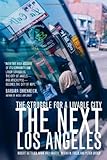
Robert Gottlieb, Mark Vallianatos, Regina Freer, Peter Dreier. The Next Los Angeles: The Struggle for a Livable City. Berkeley: University of California Press, 2005. x + 279 pp. ISBN 978-0-520-23999-9; ISBN 978-0-520-24000-1.
Reviewed by Nathan Landau (Independent Scholar)
Published on H-California (June, 2005)
Villaraigosa's Playbook?
In May, 2005, on his second attempt, Antonio Villaraigosa was elected mayor of Los Angeles. The typical headline read "LA elects its first Latino mayor since the 1870s," but the authors of The Next Los Angeles see a deeper significance. They describe Villaraigosa as the standard bearer of an emerging progressive coalition in Los Angeles and describe his unsuccessful 2001 mayoral campaign in those terms. Though skeptics dismiss the notion, Villaraigosa's election could mark a major turning point in Los Angeles's political history.[1] The Next Los Angeles explains how the progressive coalition in L.A. became this strong and thus becomes the background book for the Villaraigosa years.
Written by four progressive academics at Occidental College, the book is an unusual mix of history, socioeconomic analysis, and politics, with a detailed policy agenda appended. The four, joined by political journalist Harold Meyerson for the chapter on political coalitions, coauthored each chapter. They have created a work of committed scholarship, with an unmistakable pro-progressive viewpoint, supported by solid research and analysis. The authors explain that " ... the term Progressive L.A. is used to describe an emerging social change movement concerned with issues of social and economic justice, democracy, and livability" (pp. 4-5). The authors acknowledge that this usage differs from progressive as defined in The Progressive Era, although they ally themselves with more radical progressives like Jane Addams and Florence Kelley.
The book is a fine introduction to Los Angeles's civic history and politics for people of any political persuasion. With its triptych of history, sociology, and politics/policy it is also an unusual and excellent model for scholarship about any American city. The Next Los Angeles seeks to define nothing less than the past, present, and future of progressive Los Angeles. The book offers "a usable past" for progressives in a city that was often seen as the home of American reaction. In its socioeconomic analysis, it defines a comprehensible present, where immigrant, union, and environmental struggles are joined together. And it offers a prescription for a hopeful future, where the workplace is fairer, the air is cleaner, and transit is better.
In this account, Angelenos have lived under the thumb of various power elites. There was the Chandler family, then owners of the Los Angeles Times, with its open shop mania, the downtown Committee of 25, and then the Riordan electoral apparatus. But Angelenos never stopped trying for a better city. They fought to protect their environment, whether in the 1920s resistance to oil drilling on the beach (p. 20), or the 1990s resistance to inner city trash incinerators (pp. 42-43). They fought for their rights as workers, whether in the 1933 Dressmakers Strike (pp. 21-22) or the 2000 Justice for Janitors movement. Even in the anticommunist 1950s they fought back, if only by integrating an all-Black local of the Musicians' Union with an all-White one.
But Los Angeles's vastness and complexity challenge insurgent and incumbent alike. Though some, such as African-American editor Charlotta Bass (subject of chapter 2, the only individual so honored), preached interracial unity, Blacks and Latinos sometimes viewed each as other as competitors. Neighborhood and homeowner activists often opposed affordable housing in their neighborhoods. Rebuild LA and LA 2000 could draft top down programs, but they could not make those programs stick (this is the subject of chapter 6, especially pp. 175-183). San Fernando Valley activists made a serious, if ultimately unsuccessful, effort to secede from the city of Los Angeles in 2002, arguing that they had a mountain range between them and downtown Los Angeles. As the authors say, "L.A.'s mosaic of movements was, at times, marginalized, not only due to the ferocious counter reaction to their actions and goals, but also as a consequence of the divisiveness within movements, of agendas that became divorced from community issues and needs, and a politics that looked outside Los Angeles' capacity to reinvent itself" (pp. 11-12). The authors argue that a grass-roots community-linked coalition can do better at promulgating and implementing a vision (chapter 7 and appendix).
In the authors' version, the progressive movement built, or rebuilt, from strength to strength in the 1990s. In the face of Republican Mayor Richard Riordan's (elected in 1993) effort to rebuild a downtown political machine, the progressives steadily gained ground on the Los Angeles city council and in other legislative arenas. From there they were able to demand concessions from redevelopment projects and institute living wage requirements for city employees and contractors. In a city even more unequal than the country as a whole, these demands were critical. But Villaraigosa lost the 2001 mayoral election to an unholy alliance of conservative San Fernando Valley Whites and South Los Angeles Blacks that James Hahn cobbled together. The Whites responded to television ads that linked Villaraigosa to drug dealing, while many Blacks relived their affection for Hahn's father, former County Supervisor Kenneth Hahn.
Is Los Angeles's story unique, or is it like other cities? The authors, surprisingly but persuasively, draw their social and political parallels to early twentieth-century New York:
"In many ways, contemporary Los Angeles resembles New York City at the turn of the previous century. At that time, New York was a cauldron of seething problems of poverty, slums, child labor, epidemics, sweatshops, and ethnic conflict. Out of that turmoil, activists forged coalitions of immigrants, labor, public health, and environmental advocates, middle class suffragists, and upper class philanthropists. Tenement and public health reformers worked alongside radical Socialists. While they spoke many languages, the movement found its voice through organizers, clergy, and sympathetic politicians. Their victories anticipated some of the intellectual and policy innovations of the New Deal period" (p. 171).
In other ways, progressives in contemporary Los Angeles face more difficult challenges than progressive era New York. Governmental authority in Los Angeles is distributed among many bodies, including regional agencies such as the Los Angeles Unified School District (which goes far beyond the city's borders), the countywide Metropolitan Transportation Authority, and the four county South Coast Air Quality Management District. Los Angeles is surrounded by eighty-eight other cities in Los Angeles County alone. The authors' political strategy depends on an understanding of Los Angeles as a working class city, mobilized around issues of importance to working class people. Much of Los Angeles, especially Latino and Black Los Angeles, is reasonably understood as working class. But there are also substantial middle class districts, especially on the Westside and in the Valley, with their own interests. In the 2005 election, the Westside and San Fernando Valley together provided 55% of the vote, demonstrating their political importance for the future.
Life in New York is also enriched by a broadly shared sense of New York as an enjoyable urban space, and by a series of gathering places such as Times Square, Union Square, and Rockefeller Center. But The Next Los Angeles has disappointingly little to say about the places of Los Angeles, which could play an important role in a livability strategy. The time seems ripe for reinventing many of these places. The authors critique downtown projects as playthings of the corporate elite. But downtown is the home of a leading Latino-oriented commercial district and public market, and an increasing residential population. Urban strategists might propose approaches to making downtown a key place for the culture and public life of all Angelenos, more like the downtowns of San Francisco or San Diego. The cement lined Los Angeles River is attracting increasing attention. Perhaps its banks could ultimately be transformed into a series of linear parks linking the San Fernando Valley with Northeast, East, and South Los Angeles. There could be a strategy, building on existing community assets, for bringing both public and private investments into South Los Angeles.
The Next Los Angeles is valuable for providing a new perspective on the city. Popular images often equate Los Angeles with Hollywood, but the film industry dominates few areas outside of the Westside. The web is still replete with references to the obsolete notion that Los Angeles is a collection of suburbs in search of a city. When scholars write about Los Angeles, they do not usually describe it as a field for progressive politics. It is often rendered, in movies as well as books like Mike Davis's Ecology of Fear as a disaster waiting to happen (Davis provides a blurb for The Next Los Angeles). Leftist scholars often describe Los Angeles as the toxic product of untrammeled capitalism, as in the collection edited by Edward Soja, The City: Los Angeles and Urban Theory at the End of the Twentieth Century. Los Angeles as a great planning disaster (to borrow Peter Hall's phrase) is the theme of William Fulton's The Reluctant Metropolis. And some still remind readers of Los Angeles as suburban idyll, like D.J. Waldie's Holy Land, a delightful memoir of his lifelong hometown, Lakewood.[2]
If progressive L.A. is to deliver fairer jobs, more affordable housing, a cleaner environment and more, it must do so in the face of conservative America (and contested California). Tom Bradley, L.A.'s mayor from 1973 to 1993, could draw (at least in his early years) on generous federal aid, but this will not be available to Villaraigosa. There are already voices that decry the city of Los Angeles as insufficiently pro-business, voices that will become louder if Villaraigosa moves to implement a progressive agenda. Los Angeles's manufacturers have become increasingly footloose in a globalized economy; so has the movie industry, which can find cheaper English-speaking labor a plane ride away (and in the same time zone) in Vancouver. Internal conservative forces remain; many Valley voters still wish they could have seceded from Los Angeles. An unquiet time seems about to begin and The Next Los Angeles is your roadmap to it.
Notes
[1]. For the view that the election was very important, see Harold Myerson, "New Mayor, New City," L.A. Weekly, May 19, 2005.
[2]. For an account of New York City when union-led coalitions dominated local politics, see Joshua Freeman, Working Class New York: Life and Labor Since World War II (New York: The New Press, 2000).
If there is additional discussion of this review, you may access it through the network, at: https://networks.h-net.org/h-california.
Citation:
Nathan Landau. Review of Gottlieb, Robert; Vallianatos, Mark; Freer, Regina; Dreier, Peter, The Next Los Angeles: The Struggle for a Livable City.
H-California, H-Net Reviews.
June, 2005.
URL: http://www.h-net.org/reviews/showrev.php?id=10611
Copyright © 2005 by H-Net, all rights reserved. H-Net permits the redistribution and reprinting of this work for nonprofit, educational purposes, with full and accurate attribution to the author, web location, date of publication, originating list, and H-Net: Humanities & Social Sciences Online. For any other proposed use, contact the Reviews editorial staff at hbooks@mail.h-net.org.

