



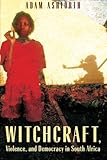
Adam Ashforth. Witchcraft, Violence, and Democracy in South Africa. Chicago: University of Chicago Press, 2005. 396 pp. $25.00 (paper), ISBN 978-0-226-02974-0; $62.50 (cloth), ISBN 978-0-226-02973-3.
Reviewed by Gary Kynoch (Department of History, Dalhousie University)
Published on H-SAfrica (June, 2005)
Living with Witches in Soweto
Although there is a substantial literature dealing with witchcraft and magic in Africa, academics, other than anthropologists, tend to steer clear of these problematic issues. The vast majority of scholars who generate published works are trained in the North where such ideas are treated as cultural curiosities. This produces difficulties at two levels. First, there is the problem of simply not knowing how to incorporate these forces into conventional analyses. For example, what does one make of reports that during the course of a battle the stronger magic of one side caused their opponents' guns to fire fruit; or the belief that prominent politicians owe their power primarily to their mastery of occult forces? Or that witches are important actors in the AIDS epidemic? Second, many Northern academics, along with their African counterparts, are reluctant to engage with the concept of witchcraft for fear of appearing to label Africans as primitive. However, like it or not, notions of magic and witchcraft often play a prominent role in politics, armed conflict, perceptions of health and sickness, and all manner of social relationships. Instead of ignoring this basic reality, we need to acknowledge and investigate these dynamics. Adam Ashforth embraces this challenge with his declaration that "no one can understand life in Africa without understanding witchcraft and the related aspects of insecurity" (p. xiii).
Building prior work in which he documented a friend's quest to overcome the evil forces that were bewitching him,[1] this book attempts a more comprehensive and systematic study of the role of witchcraft in Soweto. Despite having a close association with the area--he was "adopted" by a local family and has lived in Soweto on and off since the early 1990s--Ashforth is still very much an outsider, especially with regard to the subject of this study.
"Before living in Soweto I had never encountered a world where people were presumed to have capacities for causing harm to others by supernatural means. I had never known people who feared sickness and death by witchcraft. I had never had friends accused of killing others by witchcraft. I had never had someone I loved hounded to an untimely death as a witch" (p. xii).
Ashforth became intimately acquainted with these dangers during his time in Soweto and while he grounds this book in established studies on witchcraft, much of his material is gleaned from "years spent gossiping at the kitchen table, drinking in shebeens, downing countless cups of tea and bottles of beer, and drifting in the currents of stories that sweep friends, family and neighbours--along with a multitude of strangers more distant--through life" (p. xv). This degree of personal attachment is perhaps unusual in a scholarly work, but it allows insights into a sensitive subject that a more conventional approach could not hope to achieve.
Beyond simply describing the purchase that witchcraft has on life in Soweto, Ashforth sets out to examine the relationship between witchcraft beliefs and democracy in South Africa. Specifically, he argues that public confidence in government may be undermined by a widespread perception that the state refuses to acknowledge, and therefore provide protection against, the profound threat posed by witches. At the heart of this argument is the claim that most South Africans believe in witchcraft and consider witches to be a mortal danger. In contemporary South Africa, the fear of witchcraft has escalated in tandem with the ravages of the AIDS pandemic. The death of young people who should be in the prime of life and the symptoms of the illnesses contracted by AIDS sufferers are commonly associated with "the malicious assaults of witches" (p. 9). As the death toll mounts, Ashforth speculates that South Africans will begin to question the legitimacy of a government that not only disregards the dangers of witchcraft but criminalizes persecution of those identified as witches.
These are clearly issues of national importance; however, this study focuses on Soweto, arguably South Africa's most prominent black residential settlement, to explore the questions at hand. While acknowledging that economic conditions in Soweto are generally superior to many areas in South Africa, Ashforth emphasises the difficulties, economic and otherwise, that contribute to the prevailing sense of insecurity in the townships. He is particularly concerned with the period since the advent of democracy as Sowetans report that witchcraft has become a much greater problem in the past decade. The end of apartheid has brought many positive changes, but violence, in all its forms, remains a staple of township life. Community solidarity has eroded when compared to the unity of the "struggle" years. At the same time, improved opportunities for black South Africans have enabled a significant minority of Sowetans to accumulate material wealth and enjoy a relatively privileged lifestyle. The less fortunate are often bitter at being left behind and rising inequalities have fuelled community and family conflict in the post-apartheid period. Without "the system" to blame, witchcraft is increasingly considered the source of many of these difficulties. The anxiety engendered by the AIDS crisis has further heightened witchcraft fears.
This analysis makes perfect sense if we accept that escalating concern with witchcraft is a reflection of the insecurity inherent in periods of transformation. However, two central questions remain--at least for outsiders who undoubtedly comprise the primary audience for this book. Why do Sowetans believe in witchcraft and why do they believe it plays such a deadly role in everyday life? When misfortune strikes, be it death, illness, job loss, exam failure, or an accident, why is it that jealous colleagues, neighbours, or family members are suspected of using sorcery? Conversely, when people succeed at various endeavours, why are their achievements so often attributed to witchcraft as opposed to good luck, talent, or hard work?
The answer to the first question is that there is no answer. Ashforth leads us through the academic debates over witchcraft beliefs, including the popular idea that witchcraft is an idiom through which other kinds of social realities are expressed. However, this literature does not contemplate the actual existence of witches or the reality of witchcraft. "It suffers from the singular defect ... of treating statements that Africans clearly intend as literal, or factual, as if they were meant to be metaphorical or figurative" (p. 114). There is little room for middle ground here; the belief in witchcraft, like religion, is simply a matter of faith. Despite his personal reservations, the author accepts that witchcraft is a reality for most Sowetans. He then tackles the second question:
"Life in a world with witches must be lived in the light of a presumption of malice: one must assume that anyone with the motive to harm has access to the means and that people will cause harm because they can.... It is dangerous to assume that an instance of suffering might be accidental or a product of purely impersonal forces devoid of connection with human or spiritual agency.... Thus it is wise, when living in a world of witches, to seek protection against suffering being so caused. And it is also wise, when misfortune does occur, to inquire into who might be responsible, if for no other reason than to afford protection against further mishap" (p. 69).
With this proviso in mind, Ashforth introduces us to the ways that this "world with witches" operates. This is where his personal experience of Soweto comes to the fore--we learn how friends, neighbours, relatives, and strangers have been influenced by witchcraft, the ways in which they conceive of these multiple dangers and the coping mechanisms they employ. For this reader, these anecdotes are the most valuable dimension of an impressive book. Ashforth describes an anguished balancing act as people take measures to protect themselves against the ever present danger of witchcraft yet struggle not to be consumed by their fear. As one of the author's friends remarked when discussing a mysterious and potentially threatening event, "Once you start thinking about that shit, you're finished. Then witchcraft is everywhere" (p. 124).
There are also fascinating chapters on the varied applications of witchcraft and magic, the role of formal religion, especially the Apostolic and Zionist churches, in dealing with issues of spiritual insecurity, the ways that ancestors feature in people's lives, and the South African legal system's fundamental inability to manage the threat posed by witches.
This book succeeds admirably on many levels, yet the connection between witchcraft and national level politics is never clearly established. Ashforth offers no evidence that the government's abject failure to address people's concern with witchcraft is having an impact on the democratic process. On this topic, the voices that he makes such effective use of elsewhere are noticeably silent. No one seems to expect the government to step in to defend them against witches and nowhere do people express dissatisfaction with the government on such grounds. One wonders why Ashforth insists on highlighting the political implications of witchcraft when he can do no more than speculate. That said, Witchcraft, Violence and Democracy is a rich and illuminating treatment of the precariousness of life in Soweto and the workings of witchcraft in a contemporary setting. In writing this book, the author was forced to confront his own scepticism and "make the imaginative leap to treat propositions about invisible forces seriously" (p. xiv). Hopefully, his efforts will inspire others to follow suit.
Note
[1]. Adam Ashforth, Madumo, a Man Bewitched (Chicago: Chicago University Press, 2000).
If there is additional discussion of this review, you may access it through the network, at: https://networks.h-net.org/h-safrica.
Citation:
Gary Kynoch. Review of Ashforth, Adam, Witchcraft, Violence, and Democracy in South Africa.
H-SAfrica, H-Net Reviews.
June, 2005.
URL: http://www.h-net.org/reviews/showrev.php?id=10591
Copyright © 2005 by H-Net, all rights reserved. H-Net permits the redistribution and reprinting of this work for nonprofit, educational purposes, with full and accurate attribution to the author, web location, date of publication, originating list, and H-Net: Humanities & Social Sciences Online. For any other proposed use, contact the Reviews editorial staff at hbooks@mail.h-net.org.

