



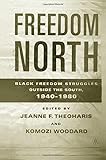
Jeanne Theoharris, Komozi Woodard, eds. Freedom North: Black Freedom Struggles Outside the South, 1940-1980. New York: Palgrave Macmillan, 2001. vii + 326 pp. $26.95 (paper), ISBN 978-0-312-29468-7.
Reviewed by Patrick Jones (Department of History, University of Nebraska-Lincoln)
Published on H-1960s (June, 2005)
Heading North: New Pathways in Civil Rights Historiography
A few weeks into my "Civil Rights Movement" seminar, I place a series of images on the overhead projector. One shows a long, inter-racial procession of movement activists marching down a street lined with modest homes, lifting signs and singing songs. Another depicts a sneering young white man stretching a large confederate flag. Yet another portrays three angry white men, faces contorted in rage, holding a crudely scrawled sign with the words "white power." I ask my students to scan these images for clues that might unlock their meaning. Of course, they have seen such photos before, from Montgomery and Little Rock, Birmingham and Selma, and invariably it is these place-names that come up in the conversation. So powerful are the popular images of the civil rights movement that it is assumed by my students that they are looking at "the South," the archetypal face of non-violent direct action and "massive resistance." Many are thus shocked when I tell them that these images are not from below the Mason-Dixon line, but rather come from my research into race relations and civil rights insurgency in Milwaukee, Wisconsin. For most of them, that realization is jarring. And, of course, that is the point. I want to contest my students' ready notions of the movement as they think they know it. Over the remainder of the semester, we set off on an academic adventure to develop a more complicated understanding of white supremacy and struggles for racial justice.
Admittedly, this brief exercise is a bit cheap and gimmicky, but the visual trickery conveys an important point that is not soon lost on my students: most of us have been taught to accept, uncritically, a certain narrative of the civil rights movement. This narrative focuses mainly on the South and privileges well-known leaders, non-violent direct action, integration, and voting rights. According to this telling, the story of the movement moves north and west only during the latter half of the 1960s in fits of riots and radicalism, dissention and disintegration, repression and racial exclusivity. This shift is often portrayed as the story of opposing dichotomies and as a wrong turn that ultimately accomplished little.
Over the last two decades, historians and sociologists have greatly complicated this popular account by revising our understanding of the Southern movement. This research has begun to create a much more subtle and multifaceted picture of race relations and social change that pushes back the origins of the movement at least as far as WWII, highlights the often hidden contributions of local people and women, reformulates Black Power and armed self-defense, and places southern activism within an international context.[1]
But until recently, the focus continued to stay on the South. When historians did train their gaze on the movement in other areas, it was often to track the Southern movement (and its failures) to the North or to focus on the activism of the Black Panther Party in Oakland.[2] Slowly, this is beginning to change as a new wave of historians (including me) begins to focus concentrated attention on freedom struggles in other regions and consider them within their own unique contexts.
The first fruits of these labors are now being published. Freedom North, which appeared in 2001, is now available in paperback. Edited by Jeanne Theoharris and Komozi Woodard, it is a worthy introduction to, and preview of, this significant new scholarship. As Theoharris writes in the introduction:
"Foregrounding the South has constricted popular understandings of race and racism in the United States during and after WWII--making it seem as if the South was the only part of the country that needed a movement, as if blacks in the rest of the country only became energized to fight after their Southern brothers and sisters did, as if Southern racism was more malignant than the strains found in the rest of the country, as if social activism produced substantive change only in the South" (pp. 2-3).
Freedom North aims to correct this imbalance by drawing together eleven essays that push the boundaries of our knowledge in important new directions.
Several of the pieces in Freedom North focus on aspects of what might be broadly defined as Black Power politics, but approach the subject in innovative ways. Ula Taylor asks, "Why would anyone become a member of the Nation of Islam after the assassination of Malcolm X?" and concludes that the reasons were more theoretical ("a new political source of black personhood and solidarity") and practical (the establishment of black businesses and schools) than religious (pp. 177, 195). Scot Brown demystifies the cultural nationalism of Maulana Karenga's US Organization during the late-1960s by giving a fuller picture of the group's history than its well publicized clashes with the Black Panther Party. He thereby illuminates the roots of modern Afrocentrism. Komozi Woodard portrays Amiri Baraka and the Black Power "experiment" in Newark, New Jersey, as a significant bridge between the political and cultural aspects of black nationalism (p. 287). Jon Rice zeros in on the community-based programs of the Illinois Black Panther Party (based on Chicago's west side), a chapter that was, perhaps surprisingly, dedicated to radical "inter-ethnic coalitions" and "cool to the idea of Pan-African unity" (p. 41). Together, these essays demonstrate that the meaning of Black Power was hotly contested and more variegated than often portrayed. They also make clear that local political, social, and economic contexts critically shaped Black Power's sometimes complimentary and other times contradictory ideologies and strategies.
Two essays in the collection concentrate on school desegregation campaigns in the Northeast. Adina Back chronicles the "Harlem Nine" and their parents' efforts to challenge segregated public education one year after the more well-known events in Little Rock, Arkansas. Jeanne Theoharris recasts the story of Boston's 1974 busing controversy by deemphasizing working-class white resistance and focusing attention on the preceding twenty-five-year struggle for "educational justice" waged by local black activists (p. 144). Both essays suggest that public school inequality in the urban North was more formalized and deliberate than the oft-used term "de facto segregation" indicates, and that organized school desegregation efforts did not trail those in the South. Moreover, by recovering the contributions of Mae Mallory and Ruth Batson, this research compliments other recent work that underscores the central role of women in movement activism.
Articles by Beth Bates and Felicia Kornbluh bridge the gap between civil rights and economic rights. Bates explores working-class black activism for equal employment opportunity in Detroit during WWII and draws interesting connections between these campaigns and the all-black March On Washington Movement. Kornbluh reconsiders the National Welfare Rights Organization's attempt to organize poor black women in several northern cities to gain access to credit and consumer goods at Sears. It is clear from these essays that race and economics were linked in a structure of inequality throughout the North. To overcome this, African Americans crafted campaigns that went far beyond civil rights to challenge the economic control and resource distribution at the heart of segregation.
While each of the pieces in this collection has something to offer, three essays stand out. Johanna Fernandez's article on the Young Lords and Puerto-Rican community organizing in New York City during the late-sixties brings to the fore new issues not often linked with civil rights, including sanitation, lead poisoning, and public health. It highlights important interconnections between African -American and Latino activism, and underscores the need for more research that reaches across ethnic, class, and racial lines. Angela Dillard explores the radical ideological roots of Rev. Albert Cleage Jr.'s black Christian nationalism in Detroit stretching back to the 1930s. Her article suggests a link between religion and Black Power that is too often overlooked. And Robert Self conveys a wonderfully complicated portrait of the "fluid political environment" of African-American activism in Oakland prior to the Black Panthers, where "philosophies and strategies competed with one another, interpenetrated, and overlapped" (p. 95).
As with any collection, Freedom North is a bit uneven and the overall coverage is incomplete. The move to achieve formal electoral political power by African Americans during this period seems underrepresented. For example, the elections of Carl Stokes and Richard Hatcher, the nation's first big-city black mayors, are conspicuously absent from consideration. In addition, important leaders, like Jesse Jackson and his P.U.S.H. coalition, and events, like the Poor People's Campaign or the various efforts by militant black students to establish Black Student Unions and Black Studies Programs on college campuses, might have been included. Moreover, the articles are overwhelmingly focused on coastal cities and large urban areas in the Midwest to the exclusion of more moderate-sized locales in the Northeast, Midwest, Mountain West, Southwest and Pacific Northwest, to say nothing of struggles for racial justice in smaller towns, suburbs and rural areas outside the South. Finally, more might have been included on the relationship between religion and civil rights activism in the North, or on the rich cultural politics of these movements, particularly in the areas of fashion, language, music, and literature.
Yet these criticisms are somewhat unfair. Theoharris acknowledges in her introduction that the point of Freedom North is not to cover all the bases but to contest old patterns of thinking and encourage new pathways of research by introducing fresh work in the field. To that end, the volume is overwhelmingly successful and important. It is a beginning, not a final destination, a signal shot in a new phase of historiography that promises to radically transform our understanding of race relations and civil rights insurgency in the United States. To date, three of the articles in the collection have appeared as full-length monographs.[3] Other significant works on the movement outside the South have emerged or are forthcoming, including a second, similar volume by Theoharris and Woodard.[4]
As a whole, Freedom North underscores the tremendous diversity of racial struggles in the North and West during the post-war period. It also contests the popular conception of the civil rights movement. These movements emerged out of unique local circumstances but also responded to, and shaped, events in the South. Northern civil rights campaigns were as vigorous as the struggles of the South and the massive white resistance they elicited was in every way as virulent and violent as in Little Rock, Oxford, Birmingham, or Selma. The articles in this collection consistently challenge false dichotomies between nonviolence and armed self-defense, between grassroots activism and formal politics, between inter-racialism and racial exclusivity, between civil rights and economic rights, between success and failure, and between North and South. Furthermore, they make apparent that there was no clear evolution from civil rights to Black Power and that a complicated (and sometimes messy) mix of approaches to racial justice vied for attention in black communities from WWII through the 1970s. In the end, these essays raise myriad questions about chronology, goals, tactics, strategy, and ideology and emphasize the importance of local geography to black freedom movements. Most evidently, the book demonstrates the need for more research to further clarify (or complicate) this history.
And there is a more contemporary import to this work. The dominant metaphor of America's racial tragedy used to be the Jim Crow South, but is now the urban ghettos of the North and West. The essays in Freedom North speak forcefully to that experience. To be sure, race relations and civil rights insurgency are, in many ways, considerably more murky in urban America than in the Jim Crow South, and the history of race relations and black freedom struggles outside the South require a reckoning with contemporary issues that not all Americans are ready to entertain. In part, this is because the popular version of the southern civil rights movement is a redemptive narrative of American democratic institutions recognizing and ultimately triumphing over seemingly clear injustices, namely de jure segregation and disfranchisement. With the passage of the Civil Rights Act of 1964 and the Voting Rights Act of 1965, these struggles appeared to be completed and the nation thus began to move "beyond race." Understood this way, the story of the Southern movement has the power to make Americans feel good about themselves and their nation, but it also breeds complacency by obscuring the significant work still to be done if we are to fulfill the promise of racial justice in the United States.
Today, the urban crisis--chronic poverty, failing public schools, police brutality, employment discrimination, inadequate health care, housing segregation, etc.--rages on. And while the vote is relatively secure, meaningful political power remains elusive for many people of color. The criminal justice system is rife with racial inequalities, and a conservative onslaught threatens many of the victories of the civil rights era. To adequately confront this difficult present, we need a clear picture of the past so that we might better understand how we got to this point and how we can develop effective strategies for the future. Freedom North will help readers untangle this knot.
Ultimately, it is my hope that I will no longer need to resort to visual trickery to open up my students' minds to a more complicated vision of race relations and the civil rights movement. Perhaps one day, freedom stories from New York, Boston, Baltimore, Newark, Cleveland, Detroit, Chicago, Milwaukee, Denver, Phoenix, Los Angeles, Seattle and elsewhere will roll off their tongues as readily as Montgomery, Little Rock, Oxford, Birmingham, and Selma. We are off to a good start, and Freedom North is a critical move in that direction, but much more work needs to be done and so we must get to it.
Notes
[1]. Some of the seminal works during this period are John Egerton, Speak Now Against the Day: The Generation Before the Civil Rights Movement in the South (Chapel Hill: University of North Carolina Press, 1995); Patricia Sullivan, Days of Hope: Race and Democracy in the New Deal Era (Chapel Hill: University of North Carolina Press, 1996); Aldon Morris, The Origins of the Civil Rights Movement (New York: Free Press, 1986); Doug McAdam, Political Process and the Development of Black Insurgency, 1930-1970 (Urbana: University of Illinois Press, 1985); John Dittmer, Local People: The Struggle for Civil Rights in Mississippi (Urbana: University of Illinois Press, 1995); Charles Payne, "I've Got the Light of Freedom": The Organizing Tradition and the Mississippi Freedom Struggle (Berkeley: University of California Press, 1996); Chana Kai Lee, For Freedom's Sake: The Life of Fannie Lou Hamer (Urbana: University of Illinois Press, 1999); Joanne Grant, Ella Baker: Freedom Bound (Hoboken: Wiley Publishers, 1998); Vicki Crawford, Women in the Civil Rights Movement: Trailblazers and Torchbearers, 1941-1965 (Bloomington: University of Indiana Press, 1993); Bettye Collier-Thomas and V.P. Franklin, eds., Sisters in Struggle: African American Women in the Civil Rights-Black Power Movement (New York: New York University Press, 2001); Lynne Olson, Freedom's Daughters: The Unsung Heroines of the Civil Rights Movement, 1830-1970 (New York: Scribner, 2002); Barbara Ransby, Ella Baker and the Black Freedom Movement (Chapel Hill: University of North Carolina Press, 2003); Timothy Tyson, Radio Free Dixie: Robert F. Williams and the Roots of Black Power (Chapel Hill: University of North Carolina, 1999); Lance Hill, The Deacons for Defense: Armed Self-Defense and the Civil Rights Movement (Chapel Hill: University of North Carolina Press, 2004); Mary Dudziak, Cold War Civil Rights: Race and the Image of American Democracy (Princeton: Princeton University Press, 2002); Thomas Borstelmann, The Cold War and the Color Line: American Race Relations in the Global Arena (Cambridge: Harvard University Press, 2003); Brenda Gayle Plummer, Window On Freedom: Race, Civil Rights and Foreign Affairs, 1945-1988 (Chapel Hill: University of North Carolina Press, 2003).
[2]. For example, see, James Ralph Jr., Northern Protest: Martin Luther King, Jr., Chicago, and the Civil Rights Movement (Cambridge: Harvard University Press, 1993). The historiography of the Black Panther Party has thus far been dominated by a focus on the Oakland chapter and by personal memoirs. See, for example, Bobby Seale, Seize the Time: The Story of the Black Panther Party and Huey P. Newton (New York: Vintage, 1970); Huey Newton, Revolutionary Suicide (New York: Harcourt Brace Jovanovich, 1973); Elaine Brown, A Taste of Power: A Black Woman's Story (New York: Anchor Books, 1993); Hugh Pearson, The Shadow of the Panther: Huey Newton and the Price of Black Power in America (New York: Addison-Wesley, 1995); David Hilliard, This Side of Glory (Chicago: Lawrence Hill Books, 2001). There are also two recent anthologies on the Black Panther Party that have begun to widen the analysis: Charles Jones, ed., The Black Panther Party Reconsidered (Baltimore: Black Classic Press, 1998); Kathleen Cleaver, Liberation, Imagination and the Black Panther Party (New York: Routledge, 2001).
[3]. Komozi Woodard, A Nation Within A Nation: Amiri Baraka (LeRoi Jones) and Black Power Politics (Chapel Hill: University of North Carolina Press, 1999); Robert Self, American Babylon: Race and the Struggle for Postwar Oakland (Princeton: Princeton University Press, 2003); Scot Brown, Fighting for Us: Maulana Karenga, the US Organization, and Black Cultural Nationalism (New York: New York University Press, 2003).
[4] For example, see, Martha Biondi, To Stand and Fight: The Struggle for New York City in New York City (Cambridge: Harvard University Press, 2003); Peter Levy, Civil War on Race Street: The Civil Rights Movement in Cambridge, Maryland (Gainesville: University Press of Florida, 2003); Jack Dougherty, More Than One Struggle: The Evolution of Black School Reform in Milwaukee (Chapel Hill: University of North Carolina Press, 2004); Chris Rhomberg, No There There: Race, Class and Political Community (Berkeley: University of California Press, 2004); Jeanne Theoharris and Komozi Woodard, eds., Groundwork: Local Black Freedom Movements in America (New York: New York University Press, 2005). In the spirit of full disclosure, I should state that I have an essay in Groundwork on Fr. James Groppi and Black Power politics in Milwaukee.
If there is additional discussion of this review, you may access it through the network, at: https://networks.h-net.org/h-1960s.
Citation:
Patrick Jones. Review of Theoharris, Jeanne; Woodard, Komozi, eds., Freedom North: Black Freedom Struggles Outside the South, 1940-1980.
H-1960s, H-Net Reviews.
June, 2005.
URL: http://www.h-net.org/reviews/showrev.php?id=10590
Copyright © 2005 by H-Net, all rights reserved. H-Net permits the redistribution and reprinting of this work for nonprofit, educational purposes, with full and accurate attribution to the author, web location, date of publication, originating list, and H-Net: Humanities & Social Sciences Online. For any other proposed use, contact the Reviews editorial staff at hbooks@mail.h-net.org.

