



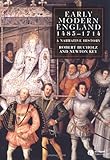
Robert Bucholz, Newton Key. Early Modern England 1485-1714: A Narrative History. Oxford: Blackwell Publishers, 2004. xiv + 440 pp. $109.95 (cloth), ISBN 978-0-631-21392-5; $52.95 (paper), ISBN 978-0-631-21393-2.
Reviewed by Ronald Fritze (Department of History, University of Central Arkansas)
Published on H-Albion (May, 2005)
Chain, Chain, Chain ... Great Chain of Being
Finding a good textbook for upper level history courses can frequently be a challenge. Early modern English or British history is blessed with many fine books that cover aspects of the sixteenth and seventeenth centuries. Some books focus on the Tudor age, some focus on the Stuart era. Other books deal with the first half of the sixteenth century, the later Stuarts, or some other smaller chronological segment. The problem is that at many universities, the course concerned with early modern Britain, Tudor and Stuart England, or whatever it is called, covers the traditional dates of c1485 through 1689/1714. This circumstance has forced instructors to use two or more books just to get a survey of the entire period. Many of these books are also written with the assumption of a British readership. As a result, some basic factual knowledge is assumed that most American undergraduates do not possess. Robert Bucholz and Newton Key have written Early Modern England, 1485-1714: A Narrative History to fill the need for an authoritative, one-volume textbook covering the Tudor and Stuart eras that is written especially for an American audience. They have succeeded in their goal.
As their title states, Bucholz and Key have written a narrative history with an emphasis on politics. But they also manage to bring in social, cultural, economic, and scientific aspects of early modern British society into their presentation. The book is divided into ten chapters along with chapter length introduction and conclusion. Nine of the chapters cover chronological periods. The introduction, chapter 6, and the conclusion, respectively, offer snapshot overviews of England and Britain in c1485, c1604, and c1714. In these chapters environmental history, demographics, economics, social changes, cultural history, and scientific developments all get their due. The introduction does a fine job of presenting the terminology, nomenclature, and concepts of the hierarchical society that was England in 1485 as well as the geography and ethnic divisions of the British Isles. In the process it also introduces the over-arching concept of the "Great Chain of Being" that dominated the world-view of the English people. It will be the leitmotif of the book. Bucholz and Key concede that the term "Great Chain of Being" is an eighteenth-century one but they point out that the conceptual framework of thought that it described existed from the time of classical Greece and was at the heart of the early modern world-view. Basically, English/British people looked at the world around them and organized it in a hierarchical manner. In nature and creation God was at the top with angels, humans, animals from complex to simple, and plants in descending order. Human society formed a microcosm of the macrocosm of nature with the king at its top and the hierarchy proceeding downward to the great nobles and on to the lowliest subjects of the realm at the bottom. In 1485 the vast majority of all people of whatever rank largely accepted this view of the world and society. They also believed that if the Great Chain of Being were disrupted, deadly chaos would follow. The medieval Catholic Church lent its authority in support of the Great Chain of Being since it was also a well-defined hierarchical organization with the pope at its summit. By 1714, Bucholz and Key assert that the Great Chain of Being had been broken although it was by no means obliterated. At the top, monarchy had become limited and constitutional rather than divine right but further down the hierarchy survived and even thrived in the Augustan Age. Definite limits had been placed on the power of the monarchy, a limited form of participatory government had been established, and the rule of law over everyone, including the king, was a reality.
How the Great Chain of Being become broken and how Britain was started down the road to modernity is the unifying theme of Early Modern England. Bucholz and Key describe how Henry VII founded the Tudor dynasty and restored order after the dynastic turmoil of the mid-fifteenth century. It was under Henry VIII that fateful changes in the nature of English society occurred. His divorce, the break with Rome, and the English Reformation, including the dissolution of the monasteries, all profoundly altered England. Religion and the state became fused as never before, but uncertainly and disunity over religion also divided England as never before. This religious division never went away. It also dragged England into dangerous foreign conflicts and entanglements while vastly complicating and poisoning its already difficult relations with Scotland and Ireland. Bucholz and Key see the Tudors as basically competent rulers, i.e., Henry VII, Henry VIII, and Elizabeth I, who managed to maintain stability and order. The Stuarts faced significantly greater challenges. Their kingdom of Scotland, along with England and Ireland, made them the rulers over three lands divided by ethnicity and religion. Only some of the Stuarts were up to the challenge of ruling the three realms. The authors give James VI and I and Charles II reasonably and deservedly positive assessments. Charles I and James II do not fare so well for obvious reasons. They also see the Glorious Revolution as extremely important in its consequences although its success and aftermath are shown to have been highly contingent rather than inevitable. During this whole process, England and later Britain developed from a second-rate power for most of the period into a first-rate power and finally the premier world power in 1714. That transformation was to a great degree the product of the wars with France from 1689 until 1714. William III and Queen Anne had to rule through Parliament and wage war in cooperation with Parliament. They both proved to be competent and successful rulers blessed with the services of some highly skilled ministers, generals, and admirals. A boom in trade also helped enhance England's wealth to an immense degree. Britain in 1714 stood on the verge of modernity and led the way for Europe and the world.
Early Modern England is a much needed textbook. Bucholz and Key have written it in a clear and readable manner. It is entertaining and at times humorous. Some professorial readers might find it at times a little too popular in its tone but most students should like it, assuming they like reading at all. Covering well over two hundred years of history in 440 pages means that some familiar events and developments from the years 1485-1714 will be treated quite briefly or not at all. Overall, however, the authors have done a fine job of deciding what and how much to include. Some scholars may not like the "Great Chain of Being" motif but it does give the text a unity that should assist students to understand and to absorb what they are reading. The volume is well provided with black and white illustrations, many of them rulers or major historical figures discussed in the text. There are fourteen pages of maps, all of them providing a clear and useful supplement to the text. A glossary defines unfamiliar terms which are printed in bold-face type when they first appear in the text. There is also a bibliography and an index. Together all of these features make for a student-friendly book. It is not a simple-minded or dumbed-down presentation. Interested, good students will find Early Modern England to be a useful and entertaining tool for learning. The authors are obviously more comfortable with the seventeenth century than with the sixteenth, which is not surprising given the focuses of their own research. Still, Bucholz and Key present a fair and even-handed account of the Tudor and Stuart era that takes due cognizance of current historiography. Various scholars may not agree with some of their interpretations or emphases, but Early Modern England fills a serious void in the secondary literature and fills it very well.
If there is additional discussion of this review, you may access it through the network, at: https://networks.h-net.org/h-albion.
Citation:
Ronald Fritze. Review of Bucholz, Robert; Key, Newton, Early Modern England 1485-1714: A Narrative History.
H-Albion, H-Net Reviews.
May, 2005.
URL: http://www.h-net.org/reviews/showrev.php?id=10569
Copyright © 2005 by H-Net, all rights reserved. H-Net permits the redistribution and reprinting of this work for nonprofit, educational purposes, with full and accurate attribution to the author, web location, date of publication, originating list, and H-Net: Humanities & Social Sciences Online. For any other proposed use, contact the Reviews editorial staff at hbooks@mail.h-net.org.

