



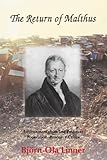
Bjrn-Ola Linnr. The Return of Malthus: Environmentalism and Post-War Population-Resource Crises. Isle of Harris: White Horse Press, 2003. xvi + 303 pp. $75.00 (cloth), ISBN 978-1-874267-51-5.
Reviewed by Michael Egan (Beckman Center for the History of Chemistry, Chemical Heritage Foundation)
Published on H-Environment (May, 2005)
The Population Question
During my dissertation research on biologist Barry Commoner's social and environmental activism, I had the opportunity to visit his office in New York several times to interview him. We talked about his opposition to aboveground nuclear testing; his role in the science information movement; his position on the war in Vietnam; and his concerns about energy production and consumption, urban waste disposal, and myriad other environmental topics, including his current work on genetic theory. Rarely was he so animated as when we discussed debates over population and his infamous confrontation with Paul Ehrlich. Very briefly, Ehrlich's 1968 The Population Bomb warned about the imminent ecological collapse of human civilization under the weight of its own numbers. According to Ehrlich, the only means of avoiding this apocalypse involved an immediate and drastic reduction in birthrates and what he called "zero population growth." Ehrlich's message enjoyed mainstream attention on the eve of Earth Day, and population control became one of the most prominent platforms in the new environmental movement that gained steam at the end of the 1960s and beginning of the 1970s. Commoner took issue with Ehrlich's position, claiming that the global imbalance of wealth and power needed to be corrected in order to reduce population growth. To Commoner, forcibly reducing birthrates, without addressing the more severe socio-economic inequities, bordered on barbarism. After Earth Day, the debate intensified and became increasingly vitriolic. More than thirty years later, both men remain bitter and sensitive--"be sure to tell them I won," Commoner once told me, while Ehrlich would not talk to me--and the population growth question continues to loom over global scarcity and pollution crises. What is the Earth's carrying capacity? Are there too many people? Can we continue to sustainably feed the world's billions? Are we headed toward a precipitous decline caused by our overuse of natural resources? Can science and technology keep pace with the demands of an ever-growing world population? Within the confusion surrounding the population-scarcity crisis, some perspective and context is necessary. Bjrn-Ola Linnr provides both in his excellent book, The Return of Malthus: Environmentalism and Post-War Population-Resource Crises.
Linnr's focus is less a history of demography and population growth than an account of the study and anticipation of resource crises resulting from the staggering human population expansion since the Second World War. Linnr does not resolve all the questions one might have about human overpopulation, but rather introduces us to the population-resource crisis (or scarcity crisis) the problem of a lack of resources to sustain ongoing population growth. While the tenets of the scarcity crisis will naturally be familiar to historians of the conservation movement, Linnr also engages in a socio-economic analysis of scarcity and the potential of resource scarcity in order to bridge his study between environmental history and geo-political history. It is an interesting combination and one that environmental historians intent on expanding the audience for their work might seriously consider pursuing.
As Linnr demonstrates, the population-resource crisis is a controversial problem, dependent on endless variables such as demographic transitions and scientific and technological innovations that might help increase crop yields. Nevertheless, it has had a profound cultural and political effect on western society. In spite of many of Linnr's findings, human population remains a social and environmental issue that transcends race, class, gender, and national boundaries. The history of the potential impact of human population growth is the focus of this study. By and large, this approach works well and conveys the dread many analysts felt as they observed concurrent expansions in the planet's human population, and in production and consumption trends
In The Return of Malthus, Linnr makes a critical contribution to environmental history literature and offers the first comprehensive analysis of global population concerns after World War II. The book is thoroughly researched and brings together a wealth of material from different languages on the postwar population-resource debates, often referred to as the Doomsday Debates. In his introduction, Linnr proposes that the book intends to address three key issues: the development of postwar neo-Malthusianism; the influence of the neo-Malthusianism on postwar conservation ideology; and the process of communication on population-resource issues between scientific communities, conservationists/environmentalists, and the political system. Focusing largely on the western context, Linnr succeeds on all points in a study that ranges from the conclusion of World War II to the end of the twentieth century, concluding with a summary of how, when, and in what context, the neo-Malthusians were right or missed their mark. For anyone interested in population, conservation, or science as well as the global environmental crisis, this is an important book.
One of the especially interesting features of Linnr's work, which relates to each of his three key issues, is the manner in which he points to the significance of the population issue in the cultural context of the postwar world. Linnr is very effective in pointing out how concerns over the scarcity of natural resources--frequently tied to the assumption that overpopulation was putting a strain on sustainable use--were associated with foreign affairs. At the end of the Second World War, as Americans turned their attention to the new Cold War, population growth necessarily became a part of their planning. Surveying economic instability and the communist threat around the world, Linnr illuminates the Cold War tension by pointing out the role of neo-Malthusianism in American foreign policy. On the one hand, neo-Malthusianism was ecological, linking population densities to resource degradation. In the conservationist refrain, this ecological reading remains solvent. But this ecological interpretation also has inherently economic implications, which give rise to a political reading of neo-Malthusian ideas, by linking population densities to national and international politics. Could impoverished countries--not just in the southern hemisphere, but in Europe as well--sustain their populations and realize the kind of affluence that might avert communism? Much economic stability depended upon sustainable resource exploitation, which, many policy analysts worried, was threatened by increasing demand by increasing numbers. Examining both the Truman Doctrine and the Marshall Plan in light of demographic concerns, Linnr offers a rather novel perspective on American foreign policy and national security directly after World War II. "By connecting population growth and food production with national security," Linnr claims, "experts in universities and philanthropic organizations were successful in capturing the attention of political leaders in the United States. In the late 1940s, demography was integrated into American national security planning" (p. 35).
Linnr also provides a detailed account of the population and food expert Georg Borgstrm's career, following his rise in Sweden, his forced resignation, and the resumption of his career at Michigan State University. In addition, Linnr discusses the influence of American neo-Malthusians like Fairfield Osborn and William Vogt, but he strongly emphasizes Borgstrm's work, spanning several chapters. Linnr is very clearly in his element here, and he presents a very interesting story. Borgstrm's case is a fascinating one, and he deserves more attention from environmental historians. Linnr's treatment is very strong, though one almost wants more. A future study focusing exclusively on Borgstrm's work and career would be a welcome addition to the historiography of environmental history. Borgstrm's scientific findings, combined with his oratory powers, strongly influenced subsequent neo-Malthusian enquiries, but they also shaped the direction of western conservationist ideology and natural resource use in the policy arena. Indeed, it appears to be a trend among the prominent neo-Malthusians that they were able to convey the severity of the postwar population-resource crisis with such power and alacrity that they were frequently able to influence not just their conservationist constituencies, but also international bodies. In addition to Borgstrm, Vogt, and Osborn, later neo-Malthusians like Garrett Hardin, Paul Ehrlich, and John Holdren possessed this ability.
Linnr brings his study up to the present by examining the science of food production, raising the successes and failures of the Green Revolution, and the rise of biotechnology in food production, noting that industries like Monsanto seek to capitalize on neo-Malthusian rhetoric to force their way into Africa and Europe. Indeed, Linnr's careful reader might also draw intimate connections between the tensions implicit in resource scarcity and pollution. In many respects, the proliferation of polluting chemicals in agriculture are also a product of the scarcity crisis, demonstrating the multi-faceted nature of this social and environmental crisis.
No work is fully comprehensive, however, and The Return of Malthus leaves some notable gaps for further evaluation. Linnr does well to convey the notion that Malthus's ghost looms over the post-World War II human population-resource crisis, but the reader might not learn as much about Malthus and his ideas as s/he might like. Malthus's career certainly falls outside the time parameters set by Linnr's topic, but Malthus's ongoing influence might warrant more attention to his ideas and the relationship between his 1798 and 1803 treatises and postwar neo-Malthusian thought. Further, this is not a book about the history of population growth. While Linnr is very effective in discussing the debates surrounding the level and scope of environmental crisis associated with population growth, he does not adequately explain the source of the dramatic population explosion. How did human population grow from two billion at the end of the Second World War to six billion by the end of the century? This constitutes growth on an unprecedented scale and warrants our attention. Linnr concentrates his energies on the fact that it happened and whether it constituted a crisis, rather than expounding on how it happened. In fairness, he does note that improved distribution of medicine and infrastructure slowed the global death rate markedly, but this story might be complicated substantially. Determining the causes of the population explosion during the latter half of the twentieth century might understandably require a whole book-length study on its own, of course, but some further consideration here would enrich the contours of the story Linnr is telling, and offer a more nuanced account of the North-South tensions underlying global environmental history. Moreover, little discussion of how we might control population growth is present. Again, Linnr's concentration is on whether the concerns of neo-Malthusians were warranted, but this approach leaves little room for addressing the bigger questions surrounding methods of resolving regional population problems. Finally, as previously noted, in charting the scientific and political debates surrounding population growth and scarcity concerns, Linnr excels.
This is a rich history and Linnr skillfully weaves complicated and international threads together into an accessible and coherent narrative. He is less successful, however, in integrating the environmentalist (as distinct from conservationist) and non-specialist perspectives. This is hardly surprising given the complexity of the population question in post-World War II environmental activism, but again could be teased out further. Linnr does well to present distinctions between the aesthetic-moral, health-based, and economic-demographic variations of environmental degradation and their respective places in the larger history of environmental activism. Indeed, he is to be commended for seeking to complicate and reorganize "environmentalism" in this manner (p. 38), but the population question transcends all three of the variations listed above. None of these criticisms--separately or cumulatively--detracts from the quality of Linnr's scholarship or his presentation of it, but rather they might serve as potential avenues for further study in the environmental history of population-resource crises, the doors to which Linnr has admirably opened.
If there is additional discussion of this review, you may access it through the network, at: https://networks.h-net.org/h-environment.
Citation:
Michael Egan. Review of Linnr, Bjrn-Ola, The Return of Malthus: Environmentalism and Post-War Population-Resource Crises.
H-Environment, H-Net Reviews.
May, 2005.
URL: http://www.h-net.org/reviews/showrev.php?id=10556
Copyright © 2005 by H-Net, all rights reserved. H-Net permits the redistribution and reprinting of this work for nonprofit, educational purposes, with full and accurate attribution to the author, web location, date of publication, originating list, and H-Net: Humanities & Social Sciences Online. For any other proposed use, contact the Reviews editorial staff at hbooks@mail.h-net.org.

