



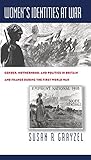
Susan R. Grayzel. Women's Identities at War: Gender, Motherhood, and Politics in Britain and France during the First World War. Chapel Hill: University of North Carolina Press, 1999. x + 334 pp. $65.00 (cloth), ISBN 978-0-8078-2482-5; $27.50 (paper), ISBN 978-0-8078-4810-4.
Reviewed by Anne Kelsch (Department of History, University of North Dakota)
Published on H-Minerva (May, 2005)
Continuity in a Comparative Cultural History of Gender in Wartime
Susan Grayzel's well written and researched analysis of gender and identity in wartime Britain and France fits into a growing and lively historiographic debate over the impact of World War I on European culture. One argument--perhaps articulated most influentially by Paul Fussell in The Great War and Modern Memory (1975) and subsequently reinforced by other cultural historians--states that the war resulted in significant change.[1] Recent national studies of Britain and France have substantiated this "watershed" interpretation by describing a reconstruction of gender in the postwar world.[2] Grayzel's research provides evidence for a very different interpretation that stresses continuity: in her words, "the war's lasting influence on gender was more conservative than innovative" (p. 245). Where others see new structures, Grayzel sees the persistence of old structures and firmly asserts "the gender system was not a casualty of war" (p. 246). Her evidence lies in a consistent cultural discourse which ultimately defined women in their "most natural role." Whether Belgium, industrial labor, uniforms, Khaki fever, rape, venereal disease, pacifism, or mourning provided the context for debate, at the end of the day society defined women first and foremost as mothers. What is perhaps most striking about Grayzel's argument is the comparative element: as she concludes, "despite ... obvious and significant national difference [between England and France], debates about women in both countries consistently demonstrated striking parallels in their assumptions about gender identity" (p. 243).[3] Not only were attitudes towards gender persistent; they transcended enormous historical and cultural differences.
While Grayzel comes to a resolute conclusion about the conservative character of gendered public discourse in wartime England and France, she readily acknowledges the complex and contradictory nature of the attitudes expressed. This in part reflects the vast array of sources she considers: official documents such as police, court, trial, and legislative records as well as letters, novels, plays, propaganda posters, newspapers, periodicals, feminist tracts, monuments, and advertisements. But these contradictory cultural messages also contain a basic consistency: despite the apparent newness of some things, women remained fundamentally in the same position in terms of their relationship to men and to the state. In many sources, the British and French express relief, surprise, and consternation when women's wartime duties defied traditional understandings, the most obvious examples being military service and "male" industrial labor. Women did embrace new roles and perform them well. Changes were also evident in fundamental definitions of identity. Prior to the war, paternity determined a child's identity and citizenship but during the war when German soldiers raped French women French babies resulted. This example (discussed fully in her second chapter, "The Maternal Body as Battlefield: Rape, Gender and National Identity") illustrates Grayzel's point particularly well; although there was an apparent shift from the paternal to the maternal in determining identity, during the public debate over the fate of these children, the persistent reference was to women as mothers. Society empowered motherhood with tremendous redemptive powers, but it did not empower women to separate themselves from this defining role. Consistently, when women took on new work in industry the discussion of that work again came back to its impact on them as mothers. Despite the varied nature of their service, there remained "a certain fundamental and unchallenged belief that the only role that women could alone perform, which rendered their service invaluable, was motherhood" [emphasis in the original] (p. 118).
While this study takes as its primary subject how their societies defined them, rather than the lives of French and British women, much could be gained from a more thorough connecting of gendered discourse to lived experience.[4] This topic is not ignored. For example, in her first chapter, entitled "Defining the Geography of War: Configuring the Boundaries between Fronts," Grayzel takes issue with those who have polarized men's and women's experience of the war. Looking primarily at literary sources, she argues that the lines between home front and battlefront were greatly blurred. Civilians and soldiers shared much in common, and women as well as men experienced first hand the full brunt of conflict. She seeks to correct an insistence on extreme division between home and battle front that suggests "one type of war experience was somehow more authentic than another" (p. 245). In the end, however, a question that remains largely unanswered is whether women's actual experience of the war coincided with wartime discourse. What effect did this ongoing public debate over their roles have in the lives of common British and French women?
This is a lot to ask of a book that already covers tremendous ground in a thoughtful and nuanced way (and was deservedly awarded the British Council Prize from the North American Conference on British Studies). But good work often leaves us asking for more. Grayzel's research raises fascinating questions about class and racial and national identity. It also leaves us wondering if an analysis of the intertwined discourse surrounding masculine identity would offer equal proof of cultural continuity.
Notes
[1]. For example, Modris Eksteins, Rites of Spring: The Great War and the Birth of the Modern Age (Boston: Houghton Mifflin, 1989) and Samuel Hynes, A War Imagined: The First World War and English Culture (New York : Atheneum, 1991).
[2]. See for example, Mary Louise Roberts, Civilization Without Sexes: Reconstructing Gender in Postwar France, 1917-1927 (Chicago: University of Chicago Press, 1994) and Susan Kingsley Kent, Making Peace: The Reconstruction of Gender in Interwar Britain (Princeton: Princeton University Press, 1993).
[3]. Other recent comparative works have also proved enlightening. See Susan Pederson, Family, Dependence, and the Origins of the Welfare State: Britain and France, 1914-1945 (Cambridge: Cambridge University Press, 1993) and Laura Lee Downs, Manufacturing Inequality: Gender Division in the French and British Metal Working Industries (Ithaca: Cornell University Press, 1995).
[4]. For a concise discussion on the debate in women's history over poststructuralism and more traditional historical analysis see Lucy Noakes's review article "Gender, War and Memory: Discourse and Experience in History," Journal of Contemporary History 36 (2001):pp. 663-672.
If there is additional discussion of this review, you may access it through the network, at: https://networks.h-net.org/h-minerva.
Citation:
Anne Kelsch. Review of Grayzel, Susan R., Women's Identities at War: Gender, Motherhood, and Politics in Britain and France during the First World War.
H-Minerva, H-Net Reviews.
May, 2005.
URL: http://www.h-net.org/reviews/showrev.php?id=10519
Copyright © 2005 by H-Net, all rights reserved. H-Net permits the redistribution and reprinting of this work for nonprofit, educational purposes, with full and accurate attribution to the author, web location, date of publication, originating list, and H-Net: Humanities & Social Sciences Online. For any other proposed use, contact the Reviews editorial staff at hbooks@mail.h-net.org.

