



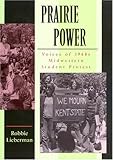
Robbie Lieberman. Prairie Power: Voices of 1960s Midwestern Student Protest. Columbia: University of Missouri Press, 2004. xvi + 264 pp. $44.95 (cloth), ISBN 978-0-8262-1522-2.
Reviewed by Ted Asregadoo (Independent Scholar)
Published on H-1960s (May, 2005)
Voices of Protest
When I ask my students for their impressions of the 1960s, a strange conflation of cultural icons and events takes place. The mood of the room lightens, students giggle and blurt out bumper sticker answers to the initial question: "JFK," "Hippies," "Peace Signs," "Pot," "Watergate," "Iran Hostage Crisis," "Make love, not war," and "Disco" (my personal favorite). When I remind them that Watergate, the American hostage crisis in Iran and disco happened in the 1970s, there is often a kind of shrug of indifference. Who cares about accuracy when commercials, movies, and TV shows have contributed to this cultural conflation? Also, one cannot overlook the cultural and political connections between events and cultural changes in the 1960s and the decades succeeding it.
Locating cultural and political characteristics to some general point in the past is an imperfect process, one prone to quibbling, argumentation, and error. It is an occupational hazard and, of course, a sheer joy for those who are students and scholars of history. Robbie Lieberman, a professor at Southern Illinois University in Carbondale, is no stranger to the "argument without end" of history. And while there are a few things to quibble about in her book, Prairie Power: Voices of the 1960s Midwestern Student Protest, overall she has assembled a much-needed selection of voices that have not really been included in the dominant narratives of the 1960s.
Lieberman's oral histories (categorized in three sections: "National SDS Leaders," "Local Leaders," and "Grassroots Activists") center on the memories of individuals who lived through, and were active during, the mid to late 1960s. The strength of oral history is that it makes the past more accessible to a wider audience because it presents, unfiltered, the voices and experiences of people, not the interpretation and analysis of an academic. This book would be quite effective in an undergraduate class on the 1960s or post-1945 history, since making historical connections sometimes requires a personal connection.
To read the oral histories of Carl Davidson, a former vice president of Students for a Democratic Society (SDS) in 1965-66, or Jane Adams, who was interim national secretary of SDS in 1966, is to hear the voices of individuals striving to change the world and celebrate their youth. Davidson, like many of his contemporaries, was attracted to and identified with groups for whom life on the margins was a gateway to a more authentic existence. Other early influences that affected his adult interests were the Beats, jazz, and even technology (Davidson now edits the journal cy.Rev: A Journey of the Cybernetic Revolution, Sustainable Socialism and Radical Democracy).
Jane Adams, like Davidson, was affected by the Beats. More striking is the way her story illustrates how, for many, the word "liberal" became a term of derision in political parlance. In confronting the racism embedded in American society, the specter of nuclear annihilation, and the power the federal government had in promoting and maintaining "The System," Adams is quite clear on how she and many in her cohort viewed the liberal establishment: "I didn't even like Kennedy. I certainly didn't feel any relationship whatsoever. I mean, Washington was what we were trying to get rid of in important ways. It was the enemy" (p. 72). SDS, according to Adams, had clearly identified what was wrong with corporate liberalism and "The System": "SDS had a thoroughgoing critique that hit people's hearts--nobody else was saying that the war was a product of the system, and that system is corporate liberalism. And once you get into corporate liberalism, you get into everything else, mass-produced out of the universities and the economic side of racism" (p. 75).
What these oral histories fail to reveal, however, is what differentiated Prairie Power from campus movements on either coast. There is a sense of populism that pervades many of the interviews, but it seems ill-defined. Lieberman tries to highlight the term "Prairie Power" in her introduction, since it is the main point of her book. It seems that the term was used to displace the old guard of SDS (i.e., East Coast students from elite universities), or perhaps was rooted in a Texas variant of anarchism. Yet it is a shame that she wasn't able to get her interviewees to further expound on what clearly was a source of identity for those who participated in the project.
Lieberman also does not show how campus issues at the schools she studied (the University of Missouri, the University of Kansas, and Southern Illinois University) differed significantly from those at places like San Francisco State, Berkeley, or Stanford. In both the Midwest and on the West Coast, students demonstrated against in loco parentis restrictions and university ties to the Department of Defense while demanding unlimited free speech and greater minority representation. The similarities between the movements seem to outweigh the differences, which would tend to undermine the unique identity of Prairie Power. Nor is it clear how significant regional identity was in comparison to other factors, such as class, ethnicity, or family background.
Another shortcoming is Lieberman's cursory acknowledgement of, but lack of engagement with, Rebecca Klatch's A Generation Divided: The New Left, the New Right and the 1960s_.[1] Klatch's book includes oral histories of activists from both sides of the ideological spectrum, and broadens the scope of scholarship of the 1960s to consider the ways in which not only the New Left but also conservative groups like the Young Americans for Freedom and Young Republicans as well as libertarians influenced political life on campus and beyond. Of course, Lieberman was under no obligation to look beyond the New Left in her study, but had she done so she might have provided a more comprehensive perspective on the complicated politics of the era.
These reservations do not, however, detract significantly from this important collection of oral interviews. Prairie Power offers scholars and students a great deal of personal insight into a decade and a generation that continue to influence our politics and society.
[1]. Rebecca Klatch, A Generation Divided: The New Left, The New Right and the 1960s_ (Berkeley: University of California Press, 1999).
If there is additional discussion of this review, you may access it through the network, at: https://networks.h-net.org/h-1960s.
Citation:
Ted Asregadoo. Review of Lieberman, Robbie, Prairie Power: Voices of 1960s Midwestern Student Protest.
H-1960s, H-Net Reviews.
May, 2005.
URL: http://www.h-net.org/reviews/showrev.php?id=10515
Copyright © 2005 by H-Net, all rights reserved. H-Net permits the redistribution and reprinting of this work for nonprofit, educational purposes, with full and accurate attribution to the author, web location, date of publication, originating list, and H-Net: Humanities & Social Sciences Online. For any other proposed use, contact the Reviews editorial staff at hbooks@mail.h-net.org.

