



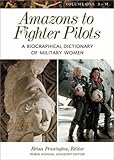
Reina Pennington, ed. Amazons to Fighter Pilots: A Biographical Dictionary of Military Women. Westport: Greenwood Publishing Group, 2003. lxviii + 760 pp. $175.00 (cloth), ISBN 978-0-313-32707-0.
Reviewed by Eugenia Kiesling (U.S. Military Academy)
Published on H-Minerva (May, 2005)
Many Queens, Few Fighter Pilots
Amazons to Fighter Pilots is an encyclopedia with the agenda of contributing to "the continuing debates over the role of women in combat" by offering factual historical information about the actual experience of "military women" (p. xii). For, as editor Reina Pennington of Norwich University observes, the discussion and debate over whether women should participate in combat has occurred in virtual ignorance of the actions of historical women. This encyclopedia is, therefore, both a compendium of data about the historical behavior of women and an argument about women's future prospects as soldiers. If "in the end it is culture and opportunity--nurture and not nature--that determine whether women will fight," then modern western societies ought to provide women with the opportunity for combat (p. lxv).
Amazons to Fighter Pilots claims to be unique in four respects: international scope, comprehensive chronological coverage, level of scholarship, and concentration on women who actually fought. Indeed, the encyclopedia offers more than a comprehensive list of known individual women soldiers. Of the hundreds of thousands of women who have fought in wars, most have left not even their names in the historical record. They would be overlooked did the encyclopedia not also include collections of anonymous women, grouped by organization (e.g. "Australia Defence Forces, women in"), role ("viviandi�¨res"), or historical event ("Algerian War, women in"). Although without such entries the vast majority of fighting women would receive no mention, the vagueness of many such entries tends to undermine their usefulness. Skeptics reading that, in the Algerian War, "female guerrillas numbered in the hundreds" (p. 11) may retort, however unfairly, "name one."
The work contains many aids for the researcher, including four different lists of entries, a comprehensive timeline, and an index. There are also historiographical essays on such subjects as "Women, Medicine, and the Military" and an extensive bibliography.
The problem with the encyclopedia is that its two goals--comprehensiveness and combat--are incompatible. One cannot list every imaginable example of "military women" very broadly defined without losing the intended focus on women who fought. A volume dedicated to the latter would have been very slim, but diluting the notion of fighting was a mistake. Pages picked at random suggest the paucity of true female soldiers. On pp. 126-127 one meets Anne-Marie Aubert de Couserac, Marie Ang�©lique Jos�©phe Duchemin, and Arlene Duerk. In 1758, de Couserac, the wife of the French governor of Acadia, participated in the siege of Louisberg by firing three cannon shots a day, from the besieged city of Louisberg. After the city fell, she tended the wounded. Duchemin served in the army of the French Revolution, first as a sutler and then as a soldier, from 1792 to 1799, but she was the only soldier among the three. Duerk was the first woman to gain flag rank in the United States Navy, as a member of the Nurse Corps, a career open traditionally to women and distinct from combat. De Couserac's target practice does not make her a soldier in any real sense of the word.
Far too many of the entries describe women chosen for their role in leading states or cities rather than armies. Many were not even leaders. Alice de Montmorency earned her place for having given advice to her husband and, in his interest, "served as a recruiter in the north of France and acted as a supply master for the [Albigensian] crusade, ferrying troops and supplies from the north to various sieges and other locations in Languedoc" (pp. 11-12). In her husband's absence, Alice Knyvet held his castle against forces sent by King Edward IV. Her defense took the form of verbal defiance, thus showing "how astute women could manipulate medieval notions of a wife's obligatory subservience to her husband in order to justify their defiance of a greater authority--in this case, that of the English king" (p. 247). She may have been brave and clever, but Alice Knyvet was not a combatant. Similarly, Hojo Masako, "the nun-shogun" described as "perhaps the most important women in Japanese military history," "never saw a battlefield" (p. 204). One may argue as to whether these were "military women," but they do not fit the encyclopedia's purpose of identifying women who actually fought.
Historians of military women necessarily face the problem of separating fact from legend. The author of the entry about "military theorist" Anna Ella Carroll justifies repeating every story, however dubious, on the specious grounds that any omission would exemplify "the ways in which historians have ignored women in the military" (p. 79). The entry is replete with words like "myth," "legend," "allege," "exaggerate," and Carroll, who claimed to have devised General U.S. Grant's 1862 campaign in Tennessee, was not, as described, "in the military." She is a somewhat interesting character, thoroughly deserving of space in an encyclopedia of con artists. To call her a "military theorist," however, makes a mockery of the label and suggests a desperate effort to promote women to that category.
Another entry calls the Bible's "possibly apocryphal" Judith a "military leader and strategist." In the absence of evidence about Judith, one learns mostly about King Nebuchadnezzar. Judith herself apparently traded upon her beauty to gain an invitation to dine with an enemy commander and so to cut off his head after he collapsed with drink (pp. 240-241). Judith's actions so little conform to modern notions of leadership or strategy as to imply that any "military" behavior by a woman qualifies as strategy. Such suspect cases are dangerous as they suggest a desperate search for the thinnest of examples. More honest, but out of tune with the work as a whole, is the entry arguing that Philippa of Hainault was not, contra Froissart, a "military woman" after all (pp. 340-341).
Some of the entries seem to reflect sheer wishful thinking. "Viking Women Warriors" begins with "no reliable historical evidence exists that Viking women fought as warriors" and then speculates that "it is possible that women were occasionally involved in defensive actions" (p. 458). Such loose claims do not further the encyclopedia's argument that historical events justify the admission of contemporary women to military activity.
The volume's contributors represent a wide range of academic disciplines, but the vast majority are experts on aspects of women's rather than military history. Specialists in military history may dislike the non-technical language and authors'often na�¯ve assessments of military actions. The entries are usually vague about the details of rank, unit identification, kinds of military service, forms of war (guerrilla, conventional), and basic military terminology (strategy, tactics, military theory). We learn that Mika Etcheb�©h�¨re, the "commander" of an unspecific "military unit" in the Spanish Civil War, acted as a wise male leader would have done in ensuring that her soldiers had food, coffee, alcohol, and recreation. The subsequent observation that Etcheb�©h�¨re normally let a fourteen-year-old boy do her shooting for her makes one wonder whether she was a soldier, a logician, or some form of cheerleader, and whether the author of the entry knew enough about military leadership to offer a judgment.
Amazons to Fighter Pilots is a useful tool for introducing young people to some heroic women in history. Certainly one of the cover photos, laughing fighter pilots looking sexy in their flight suits, offers an exciting new role model. In the debate over the future contribution of women in combat, the work provides too much ammunition to the other side in the form of entries like that for Eurydice, queen of Macedon, who is identified as a general but who "never got the opportunity to fight" (pp.163-164).
If there is additional discussion of this review, you may access it through the network, at: https://networks.h-net.org/h-minerva.
Citation:
Eugenia Kiesling. Review of Pennington, Reina, ed., Amazons to Fighter Pilots: A Biographical Dictionary of Military Women.
H-Minerva, H-Net Reviews.
May, 2005.
URL: http://www.h-net.org/reviews/showrev.php?id=10514
Copyright © 2005 by H-Net, all rights reserved. H-Net permits the redistribution and reprinting of this work for nonprofit, educational purposes, with full and accurate attribution to the author, web location, date of publication, originating list, and H-Net: Humanities & Social Sciences Online. For any other proposed use, contact the Reviews editorial staff at hbooks@mail.h-net.org.

