



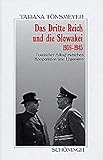
Tatjana Tönsmeyer. Das Dritte Reich und die Slowakei 1939-1945: Politischer Alltag zwischen Kooperation und Eigensinn. Paderborn: Ferdinand Schöningh Verlag, 2003. 387 S. EUR 48.00 (cloth), ISBN 978-3-506-77532-0.
Reviewed by Stephan Lehnstaedt (Institut für Zeitgeschichte München)
Published on H-German (April, 2005)
Close Cooperation? German Policy Towards Slovakia During World War II
We know little about Slovakia's role during the Second World War. Based on large amounts of unpublished sources in former Czechoslovakian archives and a broad review of eastern European literature, this book definitely fills a gap. Tatjana Tönsmeyer's dissertation examines actors and politics of the Third Reich towards Slovakia, particularly focusing on German consultants (Berater) sent there, and, on a smaller scale, the inner-Slovakian conflicts.
Tönsmeyer begins with a general account of German-Slovakian relations and the German reception of Slovakia before and during the war. Following this introduction she starts her analysis of those consultants delegated to Slovakian ministries and Hlinka-party organizations. Formally, they were subordinates to the Auswärtiges Amt, but had actually been chosen by different administrative wings of the German state and the Nazi party to guarantee both the Reich's influence and Slovakian cooperation. In a short collective biography of twenty-eight out of about sixty German emissaries, Tönsmeyer states that their social profile shows a composition quite similar to that of the Reichssicherheitshauptamt (RSHA): They were fairly young men in their thirties, strongly committed to Nazi ideology.[1] Many were SS-members with graduate degrees but usually no long-term professional experience. This is a highly interesting aspect of her account, but nevertheless it remains somewhat unclear whether a sample of this size can really yield a representative result. Moreover, Tönsmeyer fails to link this background with the men's efforts as advisors, which are described later in the book.
A short summary of the conflicts between president Jozef Tiso, a strong Slovakian nationalist trying to keep the Reich at a distance and willing to defend the country's independence as far as possible, and prime minister Vojtech Tuka, a fanatical admirer of Germany committed to Hitler and his ideas until the very last days of his life, completes the setting for Tönsmeyer's description of the consultants' work. This main part of her dissertation, constituting about two-thirds of the book, begins with the advice given to Alexander Mach. As head of the ministry of the interior he employed consultants for police matters, social questions, the Hlinka-Guard, and for the "Final Solution of the Jewish Question," a position filled by a less prominent Eichmann-subordinate, Dieter Wisliceny. The study shows the consultants working mainly on behalf of Germany, urging the Slovakian regime to do what the Reich wanted them to do. On the other hand the leading heads of the Hlinka-government were only interested in German know-how, but not in ideological transfer; so they only collaborated when doing so seemed useful for their own benefit. Thus, conventional treaties--if possible--were often more useful for the Reich's interests, because in such cases cooperation was based on previously written facts. On the other hand, German efforts at influence could be highly successful in cases where mutual interest was identified. These general results are true for nearly all sectors of the administrations dealing with German consultants, as Tönsmeyer's analysis shows for the spheres of economy, defense, mass organizations, and others.
Due to the wide number of fields examined, the depiction of how consultants affected the activities under their supervision rarely penetrates the surface of the consultant's work. The operational methods, how the Germans convinced their counterparts--or rather, tried to convince them--are rarely demonstrated and often simply asserted. The relations between the consultants and the corresponding Reich bureaucracies are only vaguely described. How did the Germans argue? Did they threaten, plea, corrupt? Did the administration in Berlin follow a flexible strategy, and how was it adapted by the consultants? Did they always act as ordered, or did they sometimes disobey in order to pursue their own interests? Those questions are, if at all, only very generally answered. This deficit is even more surprising, as Tönsmeyer explicitly announces in her introduction that she will provide this kind of examination (pp. 23ff). Only in the case of Erich Gebert, advisor for economic issues, are we told in detail how he handled his job and how his influence in the ministry and economy was managed.
Nevertheless, Tönsmeyer compensates for the failure to examine the consultants' work more closely with an extensive outline of German activities in Slovakia delivered with this book. An ally of the Reich that is often completely forgotten is thoroughly examined and all fields where consultants were operating are covered. A more or less classical political history, showing interests and results, brings a first description of a country often ignored by western historiography; remarkable new facts and new interpretations of German foreign policy are presented. The concept of consultants has never before been properly examined, and Tönsmeyer's study shows how diverse their achievements were. Depending on the particular consultant, his orders and his field of work, the realization of Nazi goals could vary from almost total accomplishment to abject failure. Slovakia was not an occupied country with a puppet government that had no will of its own, but a vassal state with its own interests. Where useful, advice and technology transfer was welcome, even if the purpose was only to score against Hlinka-party opponents; but in areas where it was appropriate to ascertain independence, the Reich often did not get what it wanted.
The wide array of topics in this interesting book will make it a reference for Slovakia in the Second World War. It will also be essential for studying German foreign policy towards and collaboration in allied states, economic cooperation, fascist movements and lastly the "Final Solution." The composition of the work with conclusions ending each chapter makes it easy to use for this purpose. On the other hand, Tönsmeyer's work also shows that there is still research to be done, especially when applying a more detailed, methodically differentiated approach.
Note
[1]. Tönsmeyer refers to Michael Wildt, Generation des Unbedingten: Das Führungskorps des Reichssicherheitshauptamtes (Hamburg: Hamburger Edition, 2003); see H-German review at http://www.h-net.org/reviews/showrev.cgi?path=82461096634736.
If there is additional discussion of this review, you may access it through the network, at: https://networks.h-net.org/h-german.
Citation:
Stephan Lehnstaedt. Review of Tönsmeyer, Tatjana, Das Dritte Reich und die Slowakei 1939-1945: Politischer Alltag zwischen Kooperation und Eigensinn.
H-German, H-Net Reviews.
April, 2005.
URL: http://www.h-net.org/reviews/showrev.php?id=10457
Copyright © 2005 by H-Net, all rights reserved. H-Net permits the redistribution and reprinting of this work for nonprofit, educational purposes, with full and accurate attribution to the author, web location, date of publication, originating list, and H-Net: Humanities & Social Sciences Online. For any other proposed use, contact the Reviews editorial staff at hbooks@mail.h-net.org.

