



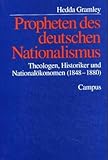
Hedda Gramley. Propheten des deutschen Nationalismus: Theologen, Historiker und Nationalökonomen (1848-1880). Frankfurt am Main: Campus Verlag, 2001. 449 S. EUR 51.00 (kartoniert), ISBN 978-3-593-36731-6.
Reviewed by Tuska Benes (Department of History, College of William and Mary)
Published on H-German (April, 2005)
Nationalism and the Collective Mentality of the German Professoriate
It is well known that intellectuals forged the bands of nationalism in the land of Dichter und Denker. At the latest since Bernhard Giesen's Die Intellektuellen und die Nation (1993) students of German nationalism have acknowledged the pivotal role of the educated cultural elite in defining Germanness.[1] Hedda Gramley has added substance to this literature by examining the rich tapestry of the German professoriate's nationalist "worldview." She concurs that professors served as the "Weichensteller" or "switchmen" (a railway metaphor that at best translates poorly into English) shaping the public consciousness and loyalties of the bourgeoisie from 1848 to 1880 (p. 11). Based on published works, letters, and diaries, she has catalogued the nationalist concerns of thirty theologians, historians, and economists.
Most intriguing are Gramley's methodological contributions. Her work is part of a larger project on nationalism directed by Hans-Ulrich Wehler at the Universität Bielefeld. As such, it exemplifies a relatively new intersection of cultural and social history in Germany. Following Wehler, Gramley assumes that nationalism offered a "new basis of legitimation" and a "venue for justifying and creating meaning" (p. 20) that helped ease the turbulent transition to modernity. Its appeal lay in the ability to bridge ruptures caused by the erosion of traditional values, as well as of existing socio-economic and political structures. Nationalism, for Gramley, was a polyvalent mixture of subjective and objective elements, a system of ideas shaped by the mental world of the intellectual elite, yet responding to and influencing real conditions and behaviors in the German states.
The author specifically adopts language from the history of mentalities to explain the appeal of nationalism. She assumes that the German professoriate shared a "collective mentality" shaped by its members' position in the Bildungsbürgertum. It provided the "mental anchor" for their nationalism, while establishing a Verhaltenspotential or parameter governing their possible loyalties and behavior (p. 21). Gramley reconstructs the origins and historical fluctuations of nationalism as a moment in this collective mentality, as she explores the "particular" micro-mentalities which characterized three disciplinary subfields. Given the reciprocal relationship Gramley sees between mental structures and social action, she interprets nationalist ideas against the (at times one-dimensional) backdrop of biography. Her thirty professors are divided into three generations separated by their experiences of major political turning points.
This theoretical framework is more enticing than the results it provides. In three chapters broken by discipline Gramley outlines the positions theologians, historians, and economists of the Historical School took on the definition of nation and Volk, on the historical foundations of German nationhood, on Prussian national leadership and Bismarck's wars, and on the difficulties of achieving inner national unity. Intriguing individuals, such as the liberal Catholic priest Ignaz von Döllinger (1799-1890) who was excommunicated in 1871, tend to disappear behind a rather static catalogue of collective nationalist views. And the lack of an index makes it difficult to piece together individual contributions. Gramley's compilation will be most useful for scholars already pursuing the themes and variations she develops with depth and precision.
The nationalist sentiments Gramley unearths in the professoriate are not entirely surprising, as the case study of theologians indicates. In her analysis, modernity implied secularization for German professors of religion and a general loss in Christianity's importance as a framework for creating meaning. These academics responded by asserting the relevance of Christian values for building a strong German nation. Gramley suggests that a penchant for historicization was one of the unchanging vectors of German nationalism (p. 28). And both Protestant and Catholic theologians emphasized the "world-historical Christian duty of Germans" (p. 90). The former cited the Reformation as evidence that Germans were a chosen people with a universal religious mission. Catholics claimed their faith ensured national continuity between the thousand-year medieval German Empire and the present day. One of Gramley's conclusions is that German nationalism was closely interwoven with Christian sentiments. Rather than endorse Wehler's claim that nationalism was a "political religion," she argues that religion increased nationalism's appeal as an explanatory mechanism even as its own vitality waned (p. 395).
Gramley's motivation for incorporating the history of mentalities was to open "the view to a 'more equitable' valuation of nationalism and its prophets" in Germany (p. 410). She refuses both to condemn the nationalism of German professors for their "increasing turn to the right and their reluctance to reform" and to excuse it "apologetically" as the product of an anonymous group mentality (p. 410). Rather, she adeptly shows that a collective nationalist sentiment variously permitted both liberal and conservative models of nationhood. The religious-cultural and social sub-levels (Ebenen) of a nationalist mentality could overlap, while its carries differed politically. German nationalism was not inherently xenophobic in the period from 1848 to 1880, as this thorough analysis of the German professoriate's collective mentality indicates.
Note
[1]. Bernhard Giesen, Die Intellektuellen und die Nation. Eine deutsche Achsenzeit (Frankfurt: Suhrkamp, 1993).
If there is additional discussion of this review, you may access it through the network, at: https://networks.h-net.org/h-german.
Citation:
Tuska Benes. Review of Gramley, Hedda, Propheten des deutschen Nationalismus: Theologen, Historiker und Nationalökonomen (1848-1880).
H-German, H-Net Reviews.
April, 2005.
URL: http://www.h-net.org/reviews/showrev.php?id=10426
Copyright © 2005 by H-Net, all rights reserved. H-Net permits the redistribution and reprinting of this work for nonprofit, educational purposes, with full and accurate attribution to the author, web location, date of publication, originating list, and H-Net: Humanities & Social Sciences Online. For any other proposed use, contact the Reviews editorial staff at hbooks@mail.h-net.org.

