



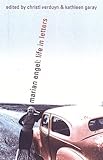
Christl Verduyn, Kathleen Garay, eds. Marian Engel: Life in Letters. Toronto: University of Toronto Press, 2004. xxxi + 295 pp. $40.00 (cloth), ISBN 978-0-8020-3687-2.
Reviewed by Robert G. May (Department of English, Queen's University at Kingston and Royal Military College of Canada)
Published on H-Canada (April, 2005)
Much Love, Marian
About halfway through Marian Engel: Life in Letters, Margaret Laurence confides to her friend Engel, in a 1974 missive, "I find book reviews hell to do, quite frankly--I sweat blood" (p. 123). Even by the early 1970s, the pantheon of Canadian writers, though growing exponentially, was still a relatively small and close-knit bunch. Laurence and other reviewers of Canadian books often found themselves in an awkward position wherein they felt it necessary to celebrate and promote the work of their friends, colleagues, and compatriots while at the same time retaining the requisite integrity to point out its sometimes glaring faults or weaknesses. Laurence could have relaxed, however, had she been asked to review Marian Engel: Life in Letters, for Christl Verduyn and Kathleen Garay's new selection is a finely executed piece of editorship which makes an important contribution to cultural and literary studies in Canada.
The Marian Engel Archive at McMaster University in Hamilton is vast, comprising a very large number of published and unpublished manuscripts, notebooks, journals, and other materials, as well as some three thousand pieces of correspondence both to and from the author (p. xxi). Various other Engel letters are housed at the National Archives of Canada as well as at the archives of several universities in cities as far removed from each other as Vancouver, British Columbia, and Queensland, Australia (p. xxii). From this seemingly limitless "treasure trove" (p. xiii), the editors have done an admirable job of selecting and arranging representative correspondence that traces Engel's "emergence, development, and contribution as a writer" (p. xviii). In the brief general introduction, the editors outline their very sane standards of selection. "Making a final selection from among such a wealth of material has been difficult, but we have been guided in our choice by three criteria: we have sought letters that map the various stages in Engel's life; those which cast light on the literary circle of which she was an increasingly vital member; and those which are simply a joy to read" (p. xxii). The editors' division of the volume into five broad phases of the author's adult life, from her travels abroad in the early 1960s to her final days in the mid-1980s, enables the reader to perceive Engel's literary activities at key points in her career while tracing her overall development as a writer and writer's advocate. The people with whom Engel corresponded, especially in the later chapters, are a veritable who's who of Canadian letters--Margaret Laurence, Hugh MacLennan, Timothy Findley, Robertson Davies, Margaret Atwood, to name only a few--and the editors include an excellent sampling of letters both to and from these important literary figures. While the vast majority of letters provide a glimpse into Engel's hectic life as an author, a parent, and a Chair of the Writers' Union of Canada, other letters seem to have been chosen for their wry wit alone. For example, Austin Clarke's brash and ebullient letter of "CONGRATUFUCKINGLATIONS!" to "Comradess Mariannovich Engelovsky" on her procurement of a Canada Council Grant in 1968 (pp. 69-70) is a highly entertaining read, as is Engel's scathingly sarcastic letter of chastisement in 1965 to the Chief Librarian of the Toronto Public Library for apparently using her $3.50 in late fines to stock the shelves with "crap" (p. 58). Disdainfully, she writes, "Perhaps because many librarians are single, they seem to have no idea what is useful" (p. 59). Engel at her cheekiest is, as the editors write, a joy to read.
A joy to read as well are Verduyn and Garay's brief but informative introductions to each chapter, which give a precis of Engel's literary activities while, at the same time, placing those activities within the larger context of late-twentieth-century Canadian literature and culture. The editors elaborate on this dual focus in their general introduction: "through [Engel's] words and those of her correspondents, new perspectives are revealed on the practice of writing in Canada during the quarter century between 1960 and 1985. This was a fertile and formative time which, some have suggested, marked the birth of the elusive 'Canadian identity' in the arts, and particularly in literature. The wider national cultural picture is illuminated by the letters in the collection" (p. xviii). Even the reader who may already be familiar with major twentieth-century Canadian literary and cultural milestones--the Kingston Conference of 1955 (pp. 6-7), Expo '67 (pp. 51-52), the Canadian publishing renaissance of the 1970s (pp. 151-152), the "internationalization" of Canadian writing in the 1980s (pp. 210-211)--will appreciate the concision of the editors' capsule summaries, which are accurate and informative without being overly technical or long-winded. The chapter introductions also serve the even more important purpose of emphasising Engel's contributions to the Canadian literary scene as a woman writer. "Marian Engel and other literary women of her generation," the editors write, "were keenly conscious of the imbalance in the writing lives of women as compared to men and have written of the special challenges faced by women writers" (p. xix). The editors' selection of letters, in turn, reflects their sensitivity to the extent to which Engel's work itself is preoccupied with "the everyday realities of women's experience and the constraints on female creativity" (p. xx) during the late twentieth century. Engel's 1974 letter to Robert Weaver, in which she laments her inability to forge ahead in her writing career because of pressing domestic and parental responsibilities, is among the collection's most evocative examples of this struggle for recognition of women writers in Canada. "There isn't a goddam reason in the world why anyone should write books anymore," Engel complains, "Publishers expect you to do everything but turn the crank on the press, readers expect masterpieces, and NOTHING will ever get you out of scrubbing pots and pans" (p. 128). Key as well are the numerous letters to and from her friend and contemporary, Margaret Laurence.
Underpinning Marian Engel: Life in Letters is the editors' extensive apparatus of endnotes and footnotes that furnish the reader with a wealth of biographical, historical, and cultural information, thus enriching the reader's engagement with each letter and suggesting avenues for further critical inquiry. Even the specialist reader will appreciate the editors' assiduous efforts to identify vague references to people in Engel's ever-widening circle of acquaintance and to supply sometimes much-needed background data on Engel's diverse movements and activities over the quarter century of her active writing career. In the general introduction, Verduyn and Garay outline the editorial principles behind the notes: "Anticipating that this collection will find its readership well beyond the realm of literary scholars, we have not wished to encumber it with too large a number of notes or to stuff them with an excess of detail. We have adhered to the principle of adding a note only where the information it conveys may assist the reader's understanding" (p. xxiii). For the most part, the editors adhere quite faithfully to these principles of concision and economy. For example, most readers will find very useful the editors' identification of the location in the Engel archives of various typescripts and other unpublished materials, their verification of places and landmarks only obliquely referenced in the letters themselves, and their explanation of historical, biographical, or anecdotal details without which certain letters would be far less meaningful.[1] Verduyn and Garay are also very upfront in the notes about admitting when they have been unable to trace certain references. At times, however, the notes tend towards overzealousness. Very few readers--specialist or non-specialist--need to be told who Charles Dickens (p. 61 n. 16), James Joyce (p. 67 n. 27), and Earnest Hemingway (p. 183 n. 53) are; fewer still who Ronald Reagan (p. 222 n. 44), Billy Graham (p. 256 n. 74), and Margaret Thatcher (p. 260 n. 86) are.
Despite this very minor cavil, though, Verduyn and Garay's Marian Engel: Life in Letters is an important contribution both to Marian Engel scholarship as well as to the literary and cultural history of Canada itself. Both the specialist and the non-specialist will find much to admire and praise in both the execution and the presentation of this new piece of Canadian editorship.
Note
[1]. See especially the editors' identification of the locations of Engel's unpublished detective novel, Death Comes for the Yaya (p. 56 n. 1), the original version of her short story, "Bicycle Story" (p. 99 n. 17), and the typescript of her influential review of Sharon Riis's novel, The True Story of Ida Johnson (p. 170 n. 22). With reference to the verification of places and landmarks, it is helpful to know that Britnell's was "a well-known bookstore in Toronto, which has since closed" (p. 61 n. 17), that OAC stood for Ontario Agricultural College long before it stood for Ontario Arts Council (p. 121 n. 57), or that Engel bought a house in Edmonton in 1977 because she was preparing for her brief post as writer-in-residence at the University of Alberta the following year (p. 177 n. 35). For an explanation of historical, biographical, or anecdotal details, see especially Verduyn and Garay's capsule summary of the FLQ's activities in the late 1960s and early 1970s (p. 65 n. 23), their references to the salient documents of the Canadian Lady Chatterley's Lover trial (p. 111 n. 41), and their explanation of the brief rift that occurred between Engel and Laurence in the early 1980s (p. 233 n. 34). The John Glassco anecdote from the 1970s is also quite amusing (p. 123 n. 64).
If there is additional discussion of this review, you may access it through the network, at: https://networks.h-net.org/h-canada.
Citation:
Robert G. May. Review of Verduyn, Christl; Garay, Kathleen, eds., Marian Engel: Life in Letters.
H-Canada, H-Net Reviews.
April, 2005.
URL: http://www.h-net.org/reviews/showrev.php?id=10424
Copyright © 2005 by H-Net, all rights reserved. H-Net permits the redistribution and reprinting of this work for nonprofit, educational purposes, with full and accurate attribution to the author, web location, date of publication, originating list, and H-Net: Humanities & Social Sciences Online. For any other proposed use, contact the Reviews editorial staff at hbooks@mail.h-net.org.

