



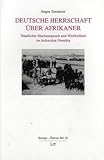
Juergen Zimmerer. Deutsche Herrschaft Ö¼ber Afrikaner: Staatlicher Machtanspruch und Wirklichkeit im kolonialen Namibia. nster: LIT Verlag, 2004. xiv + 329 pp. EUR 35.90 (paper), ISBN 978-3-8258-7473-5.
Reviewed by Michelle Moyd (Department of History, Cornell University)
Published on H-German (April, 2005)
"Herrschaftsutopie" vs. "Herrschaftsrealität": Dissecting German Colonial Practice in Southwest Africa
Last year marked the one-hundredth anniversary of a momentous phase in the history of the former German colony of Southwest Africa (now Namibia). In 1904, the German colonial army (Schutztruppe) went to war with the Herero and Nama, two of the African peoples inhabiting the territory. In prosecuting the war against the Herero and Nama, the Schutztruppe pursued tactics and strategy that have long been clearly identified by historians as genocidal in intent and outcome. Last year's commemorative activities in Germany, including academic conferences, museum exhibits, and mainstream press coverage, engaged with this difficult past on an unprecedented level and helped bring Germany's violent colonial history into a wider public consciousness. The attention paid to the war in Southwest Africa, and particularly to the genocide, is of critical importance in developing more representative modern German historiographies that treat the former colonies and the events that occurred there as more than a sideshow in German history. Equally important, however, is to set the war in a longer historical context--to try to understand where the impulse to genocidal war came from, and then to see what political dynamics the war set in motion after it ended. Without such context, it is easy to dismiss the Namibian war, and perhaps other colonial wars, as anomalous cases that had little to do with the explicit and tacit aims of colonial undertakings. Furthermore, the focus on the genocide directs our attention away from its devastating long-term aftermath, in which the population of Namibia was turned into a captive labor force, practically without rights, protection, or recourse from the vagaries and violence of colonial rule.
Juergen Zimmerer's Deutsche Herrschaft ueber Afrikaner: Staatlicher Machtanspruch und Wirklichkeit in kolonialen Namibia confronts the challenge of putting the Namibian war and genocide within the larger context of German colonial practice and imagination. In six thematic chapters, he explains how the prosecution of the war grew out of German colonial mentalities and practice, and how its effects created a landscape in which certain kinds of "utopian" visions for colonial rule seemed plausible to colonizers on the spot in Southwest Africa. That these utopian visions often conflicted with the realities of everyday colonial practice is perhaps not surprising. But what Zimmerer's richly textured analysis lays bare is the specific and complex mechanisms by which local actors transformed their desires to create a Herrschaftsutopie in Southwest Africa into a Herrschaftsrealität that would order the lives of the various African peoples living and working within the borders of the colony. Zimmerer's painstaking research and detailed presentation allows readers to peer into the everyday thinking of various kinds of colonizers--government officials at different administrative levels, settlers, Schutztruppe officers, mining and railway officials. His approach yields a variegated picture of how these agents participated in the creation of a colonial culture and economy that was based, in the final analysis, on a utopian vision of a "new societal order in Southwest Africa, which is best explained by the concept of the racially privileged society [rassischen Privilegiengesellschaft]" (p. 93). This vision resulted in a three-pronged approach to "native policy [Eingeborenenpolitik]" that included land disenfranchisement for the Herero and Nama, control of their mobility through pass laws and other measures, and formal segregation of whites and blacks, especially in the realm of marriage. Plans to fulfill this vision could only fully be set in motion after the war ended in 1907, when the Herero and Nama populations had been so thoroughly decimated that they could mount no effective resistance to measures designed to permanently subjugate them to colonial interests.
Zimmerer convincingly argues that previous analyses treating the period after the Namibian genocide as the "peace of the graveyard" are too simple. While it is true that after 1907 there were no more episodes of violence of the scale of the 1904-7 war, the mentalities that made the war and genocide possible remained in effect until Germany lost control of the colony in World War I. For example, German fears of further violent threats to their hegemony made colonial administrators sensitive to the lack of an adequate military presence. Rumors of revolts and raids kept white inhabitants on edge, and served the self-interests of the Schutztruppe, since its leaders could argue that their presence was necessary to protect the supposedly vulnerable settlers from further violence (p. 167). The post-war political and economic situation, especially the resultant weakness of the Herero and Nama communities and their leadership structures, cemented a number of colonialist imperatives already under discussion before the war, but which colonial authorities had not yet been able to bring to fruition. This was particularly the case, as Zimmerer expertly demonstrates, with plans for securing a cheap labor force whose members would ideally be under constant control and total surveillance.
But how these issues would play out was fought over amongst colonial interest groups. For example, farmers, miners, and railway administrators all competed with each other for access to the African labor force, and all had different prescriptions for how best to control the movement and employment patterns of Africans, as well as how to attract workers to their enterprises. Settlers, military officers, and colonial administrators came into regular conflict over the regulation of treatment of African laborers with regard to corporal punishment, health care, and nourishment. While white employers rarely received substantial punishments for the considerable abuses they perpetrated against their employees, court documents indicate that colonial government officials were concerned that courts at least appear not to have condoned such behavior, and to show that abusive employers could be punished in the interest of upholding the Rechtsstaat. There was even a position within the government for an expert "native commissar" (Eingeborenenkommissar), whose job it was to advocate for Africans in complaints against colonial employers and settlers, and to act as an expert on African cultures in court cases and administrative undertakings. Thus colonial administrators, who viewed themselves as acting in the interest of the colony as a whole, were often at odds with settlers, employers, and military personnel in defining the best means of controlling the African population to serve colonial needs.
Zimmerer's book also brings to light a number of lesser-known pieces of colonial history that could have implications for future research on German colonies in other parts of Africa. For example, one of the most interesting sections of the book explains how in the midst of the war, detailed discussions took place between German colonial government officials in Windhoek, Togo, Kamerun, and Berlin regarding the proposed deportation of the Witbooi Nama, who were perceived as a particular threat to security given their former status as Schutztruppe auxiliaries. The Witbooi were in fact deported from Southwest Africa to Togo in October 1904, only to be returned to Southwest Africa in June 1906 after a complex series of negotiations between colonial administrators. Of the original 119 Witbooi who had been deported, only 42 were still alive in 1906, and these were then interned at the Haifischinsel internment camp off the coast of Southwest Africa. This tragic outcome was the result of exceedingly detailed initiatives and correspondence between far-flung colonial administrators who were all very interested in protecting state security interests, but largely uninterested in the human toll their actions were taking. This case study highlights the intricacies of colonial decision-making, the effects of these decisions on Africans, and also reminds us to think of the colonies as being embedded in a translocal network composed of colonial functionaries. Up to this point, historiography on the German colonies has treated them as separate units of analysis, but Zimmerer's research shows that the linkages between the colonies and the transmission of ideas from one to another could be a fruitful analytical avenue for future exploration. Similarly, Zimmerer provides several examples of areas in which colonizers in Southwest Africa looked to South Africa and other neighboring British colonies as both positive and negative examples against which to model internal colonial practice regarding work regimes, interracial marriage, and legal codes.
Deutsche Herrschaft also suggests some interesting starting points for future comparative work between German colonies. Zimmerer's excellent discussion of how colonizers in Southwest Africa imagined and implemented a "half-free" labor regime after the end of the war might be nicely compared and contrasted, for example, to the labor regime in German East Africa (today's Tanzania) as analyzed most recently by Thaddeus Sunseri in Vilimani: Labor Migration and Rural Change in Early Colonial Tanzania (2002). Certainly much more comparative work needs to be done on the German colonies in order to more fully appreciate how local circumstances influenced colonizers to behave in specific ways, and to more fully grasp why genocide occurred in Southwest Africa, but not elsewhere.
Zimmerer's book--originally his dissertation--is an exemplary piece of scholarship. Based on extensive archival research in Germany and Namibia, Deutsche Herrschaft sets a high standard of documentation and synthesis that scholars of German colonial history will find most helpful as a resource for future endeavors. Zimmerer is one of the first to make use of the Namibian archives (unavailable until the 1990s) and the new analytic threads he develops will certainly influence the next generation of scholars of German colonialism and Namibian history. Every point that Zimmerer makes is supported by a wealth of specific references to colonial correspondence, and his attention to detail in reading the documents is remarkable. In some places, the sheer amount of detail becomes overwhelming, but Zimmerer's writing is clear, and the book's section headings make it possible to focus on specific parts of the argument if necessary. One drawback of this edition is that there is no index, which makes it difficult to refer back to previous discussions as the reader progresses through this complex history. A chronology of important events would also have been useful in this regard, since Zimmerer's chapters move back and forth across time quite freely. Readers might also wish that Zimmerer had more explicitly engaged with secondary literature in the field beyond the introductory chapter. On the other hand, the confident presentation of his own findings without constantly referring to previous interpretations lends his book an authority that is refreshing in its suggestion that the German colonial project in Southwest Africa was based on a concept of a racial state not far off from that effected in the later apartheid state of South Africa.
One perspective largely missing from Zimmerer's analysis is that of the missionaries present in the colony. He draws on some missionary materials in explaining how they participated in the development of colonial educational policy, and notes their intervention ameliorating circumstances for African prisoners during the war. It would be interesting to know more, however, about how the missionaries fit into the already highly differentiated picture of how the colony functioned, and how missionary perspectives differed or coincided with those of settlers, military men, and colonial administrators.
Readers should not expect to learn much about Namibian cultures or the history of Namibian resistance to colonial rule from this book. Zimmerer explicitly describes his work as a contribution to German history, or to "German history in Africa" (p. 9). Although the peoples of Namibia appear frequently in Zimmerer's evidence, they are not the main actors in his narrative. He clearly explains the fissures present in Southwest African colonial society that opened up limited alternatives for Africans within the colony, and migrants from outside the colony, to choose employers. Although colonial law included mechanisms for protecting the African population from the worst abuses, these were largely ineffectual, and African testimonies were never taken as seriously as those of Europeans. He also points out significant acts of rebellion that occurred after 1907 in the colony, for example at Wilhelmstal in 1910. But the general picture Zimmerer paints is of subject peoples who had little choice but to conform to the regime of fear, expropriation, and punishment that was post-genocide Southwest Africa. For the history of the peoples of Namibia during the colonial period, one must look elsewhere--for example, to Jan-Bart Gewald's Herero Heroes: A Socio-Political History of the Herero of Namibia, 1890-1923 (1999).
In his conclusion, Zimmerer draws a distinction between what he considers the "pre-modern" and "modern" elements of "native policy" in Southwest Africa. According to him, modern elements of native policy included the drive to create an efficient colonial economy (p. 284), and to ensure legal protection for Africans against abuses (p. 286). On the other hand, the pre-modern elements of the system included the ideal of the Herrschaftsutopie and the impetus to construct a society based on racial privilege and the subjugation of the African population. This argument interprets modernity as antithetical to racialized political practice. Scholars such as Jeffrey Herf and Helmut Walser Smith have demonstrated, however, that concepts of modernity were used by Germans in various historical contexts to reinforce such practices. In short, the attempt to disentangle so-called pre-modern and modern elements of colonial practice seems counter-productive to Zimmerer's overarching plea that we begin to think of colonialism in more complex terms.
In contrast to important works by scholars such as Susanne Zantop or Birthe Kundrus that focus on how colonial imaginaries shaped the cultural history of Germany, Deutsche Herrschaft links these same colonial imaginaries with the very concrete realities of colonial rule. Zimmerer shows us how different colonizers envisioned or fantasized a future colonial structure based on a regime of total control of the African population, and how they took concrete steps to realize the visions, or to prevent other visions inimical to their specific interests from happening. Zimmerer effectively connects economic and social colonial practices to the mentalities generated by these practices for both Germans and Namibians. Zimmerer's work steadfastly refuses to accept a monolithic or unified picture of colonial imagination and practice. At the same time, however, it never loses sight of the fundamentally racist and inhumane--albeit "legal"--foundations upon which colonial projects everywhere rested. The fusing of these two analytical threads makes Zimmerer's book an important landmark in the writing of colonial histories, and one which hopefully signals new approaches to Germany's colonial past as part of its modern history.
If there is additional discussion of this review, you may access it through the network, at: https://networks.h-net.org/h-german.
Citation:
Michelle Moyd. Review of Zimmerer, Juergen, Deutsche Herrschaft Ö¼ber Afrikaner: Staatlicher Machtanspruch und Wirklichkeit im kolonialen Namibia.
H-German, H-Net Reviews.
April, 2005.
URL: http://www.h-net.org/reviews/showrev.php?id=10400
Copyright © 2005 by H-Net, all rights reserved. H-Net permits the redistribution and reprinting of this work for nonprofit, educational purposes, with full and accurate attribution to the author, web location, date of publication, originating list, and H-Net: Humanities & Social Sciences Online. For any other proposed use, contact the Reviews editorial staff at hbooks@mail.h-net.org.

