



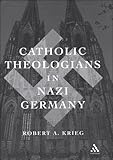
Robert A. Krieg. Catholic Theologians in Nazi Germany. New York: The Continuum International Publishing Group, 2004. ix + 234 pp. $24.95 (cloth), ISBN 978-0-8264-1576-9.
Reviewed by Beth A. Griech-Polelle (Department of History, Bowling Green State University)
Published on H-German (April, 2005)
Clouded Vision and Re-Thinking the Catholic Church's Mission
Robert Krieg's work offers historians a very readable, understandable account of five major German Catholic theologians and their views on the mission of the Catholic Church in a modern world. In a clear and concise manner, Krieg explains the struggle between the neo-Scholastic model of the Church's role in society and the emerging view among some theologians that the Church should function as a voice of moral advocacy and a defender of human rights in general. By examining the teachings of five theologians, Krieg demonstrates the conflicting and evolving notions of what the Church should be while he simultaneously impresses on the reader the idea that what these theologians believed had a substantial impact on the world as they were teaching their ideas to hundreds of seminarians each day.
Chapter 1 addresses the general mindset of the German bishops under the Nazi regime and the evolution of their thinking regarding Catholic involvement in the NSDAP and the state it dominated. Once Hitler was appointed Chancellor of Germany, the bishops met and decided not to risk open confrontation with the new government. Instead, they chose routes of accommodation, such as lifting the prohibition on Nazi Party membership for Catholic laity. Theologically, most of the German bishops approached the National Socialist state from the perspective that had been determined by the First Vatican Council (1869-70) and other papal teachings. What Krieg shows is that the churchmen tended to view the Church itself from a neo-Scholastic view that stressed the idea of a societas perfecta. He shows that this self-definition had serious implications for the way in which the Church could function in a modern nation-state, for the very notion of a "perfect society" meant that the Church was hierarchical, perfect, and distinct and separate from all other human society. It acknowledged that the Church stood apart from modern times as a hierarchical institution (p. 10). The privileging of the neo-Scholastic approach to "truth finding" severely limited Catholic theologians in that it confined them intellectually to a largely medieval past, preventing them from approaching modern problems in any innovative way.
Chapters 2 through 6 offer in-depth analysis of the theologians Karl Eschweiler, Joseph Lortz, Karl Adam, Romano Guardini, and Engelbert Krebs. In particular, the focus of each chapter is how the individual theologian approached the Church-State position. For example, the chapter on Eschweiler reveals the theologian encouraging Catholics and National Socialists to work together to improve the German state. Likewise, each chapter explores the attitudes of the theologians towards the neo-Scholastic model. Eschweiler, for example, saw no reason to limit theology to medieval concepts and pressed for the reconciliation of Catholicism with modernity. He also actively sought cooperation with the National Socialist state authorities, arguing that racial differences were part of divine creation.
At the other end of the political spectrum was Engelbert Krebs, who was already known by the 1920s for attacking the racist views held by some Catholics. Krebs refused to reject the Jewish origins of Catholicism and encouraged Catholics to put love of neighbor as their first priority. Krebs's refusals to remain silent in the face of injustice resulted in his interrogation, arrest, and imprisonment. To Krebs, such views were not merely a matter of political dissent. In his mind, the Catholic Church and its theologians had to be a part of the modern world. Although he saw quite clearly the ills of his society, he believed that modernity could also bring respect for human rights and democracy (p. 151). Unlike Eschweiler, Krebs used the well-defined concepts of neo-Scholastic thought to help him craft a theology engaged with contemporary problems. This approach allowed Krebs to argue that the Church could not withdraw from the world and that it must be a moral voice, speaking for all human beings regardless of race, gender, or ethnicity (p. 150).
Krebs played an important role in directing the research interests of theologian Romano Guardini. Born in Italy, but raised in Germany, Guardini preferred the language of existentialism to that of neo-Scholasticism. Studying under Krebs, Guardini was shaped by his research on Bonaventure and Neoplatonism. This background would influence his work for the rest of his life. At first, under the National Socialist regime, Guardini chose to remain silent even though he regarded Hitler and his party as "barbarians" (p. 115). In 1935, however, he decided to break his silence and began to publish writings that reaffirmed Jesus Christ as the true savior, not Hitler. Ultimately, Guardini's position on idolatry brought him into conflict with the German state. He was denied permission to continue lecturing and threatened with imprisonment. Guardini sought and found refuge in a rural village in southern Germany where he lived until 1946. Romano Guardini's view on modernity and the need to stress the dignity of all human beings influenced, among others, Karl Rahner.
Unlike Krebs and Guardini, Joseph Lortz and Karl Adam did not see the rise of modern, pluralistic societies as beneficial developments. Rather, they viewed western society as a degenerating civilization and looked for ways to combat the increasingly secularized world in which they lived. As a church historian, Lortz joined the NSDAP in 1933, for he believed that Hitler was ushering in a new stage of development in western history. He did recognize some evils in National Socialism, but he argued that Christians joining the party could infuse it with their positive values, thereby dampening the more dangerous elements contained in its Weltanschauung. Lortz would continue to support the idea of reconciling Catholicism to National Socialism until approximately 1937, at which point he tried to resign his Nazi membership (but was not permitted to do so). At war's end, Lortz was required to go through a de-Nazification process and then resumed his scholarly career. Like Eschweiler and Karl Adam, Lortz "judged that modernity was a form of rebellion against God and the church," and he therefore "rejected democracy and favored an authoritarian state that would formally recognize the church" (p. 82).
Krieg's work ends on a positive note, revealing the connections that these various theologians opened up. Although three out of the five under consideration supported Hitler and the National Socialist regime for at least a brief time, their challenges to the dominant theological perspective of the day (which endorsed a view of the Church as a societas perfecta) led to a new generation of scholars who embraced modernity and who could think of the Enlightenment legacy in a positive light. These new scholars helped to shape the teachings of the Second Vatican Council, which endorsed the idea of the church as a moral advocate that works to promote truth and justice for all people. Krieg's work shows how five theologians were constrained by the societas perfecta notion and how a few of them were able to have a profound impact on revising the role of the Catholic Church in the modern world. Krieg's excellent work underscores the idea that the Catholic Church's self-image had to be clarified after living through the darkness of the Hitlerzeit.
If there is additional discussion of this review, you may access it through the network, at: https://networks.h-net.org/h-german.
Citation:
Beth A. Griech-Polelle. Review of Krieg, Robert A., Catholic Theologians in Nazi Germany.
H-German, H-Net Reviews.
April, 2005.
URL: http://www.h-net.org/reviews/showrev.php?id=10396
Copyright © 2005 by H-Net, all rights reserved. H-Net permits the redistribution and reprinting of this work for nonprofit, educational purposes, with full and accurate attribution to the author, web location, date of publication, originating list, and H-Net: Humanities & Social Sciences Online. For any other proposed use, contact the Reviews editorial staff at hbooks@mail.h-net.org.

