



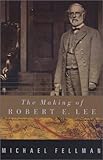
Michael Fellman. The Making of Robert E. Lee. Baltimore: Johns Hopkins University Press, 2003. xx + 360 pp. $18.95 (paper), ISBN 978-0-8018-7411-6.
Reviewed by Wallace Hettle (Department of History, University of Northern Iowa)
Published on H-South (April, 2005)
Robert E. Lee: Icon and Enigma
Michael Fellman's biography of Robert E. Lee, first published by Random House in 2000, has recently been reissued in paper by the Johns Hopkins University Press. Though I read the hardcover edition five years ago, the appearance of the paperback edition is the occasion for which I was invited to write this review. This review allows me to revisit a book which I enjoyed the first time around.
Civil War historians, especially those who study the military, are sometimes accused of being provincial and old-fashioned. This is not the case with Fellman. His earliest work was in nineteenth-century social and cultural history, and he has published books on utopias and nineteenth-century medicine. Fellman brings to his study of Lee a clear grasp of the broader historiography on slaveholders and Victorian manhood.
The result is a book that asks new questions about Lee's personality, relationships, religiosity, and character. Fellman gives as much attention to Lee's friendships as he does to the old chestnuts about Lee's effectiveness as a military commander. This book pays attention to the "inner Lee." Fellman does a masterful job of pursuing Lee's elusive personality, especially through close reading of letters to friends and loved ones. Civil War buffs and neo-Confederates are probably disappointed by Fellman's work, which is fair-minded but irreverent. Military historians will find little, if anything, that is new. That said, there was little need for a new examination of Lee as a commander and no need at all for more Lee hagiography. By working to untangle Lee's somewhat elusive personality, and to place him within nineteenth-century culture, Fellman makes a distinctive contribution to the literature on Lee.
Central to Fellman's understanding of Lee is the idea of self-control or self-mastery. Lee grew up as a member of one of Virginia's first families. At age seven, Lee's father, "Light Horse Harry" Lee of Revolutionary War fame, deserted his family in debt and personal disgrace. Limited family finances dictated a West Point education for Lee, while a famous family and superb connections made an appointment to West Point possible. At the military school Lee excelled, finishing second in his class and drawing on his self-discipline to avoid accruing a single demerit for conduct while enrolled.
The ambitious young Lee married well. His union with Mary Randolph Custis Lee cemented his place in Virginia's elite. Both before his marriage and after, he remained a somewhat flirtatious man who genuinely enjoyed the company of women. Lee's prolific correspondence with young women, which resumed after the Civil War and continued until his death in 1870, intrigues Fellman. Fellman argues that the warmth and affection of some of these letters was effusive even by Victorian epistolary standards. He hints that Lee's racy letters suggest that relations with women were "the largest impediment to self-control" faced by Lee (p. 33).
As a father, Lee tried to infuse virtues of self-discipline into the character of his seven children. As a career military officer, Lee was often absent from his family as they grew up. Fellman argues that Lee's correspondence is marked by anxiety about his abilities as a father. Lee's inner confidence probably grew after his religious conversion in 1853.
Fellman argues that prior to the late 1850s, Lee's "identity was less directly wrapped up in the productivity and submission of slaves" than was the case for most members of the Virginia gentry. That changed when the Lees inherited Arlington and several other Custis estates in 1857. In a supreme irony that Fellman plays down, these slaves were to be manumitted on January 1, 1863--the date on which the Emancipation Proclamation would become effective. Lee was placed in the difficult position of managing and exploiting these slaves while also preparing them for freedom. The responsibility vexed Lee, and continued even after he led the Army of Northern Virginia. Fellman points out Lee's financial stake in the peculiar institution as well as his racism, which appears unvarnished in private correspondence.
Lee's military career is a twice-told tale, and Fellman wisely refuses to let Lee's command of the Army of Northern Virginia swallow up the rest of the book. Fellman's Lee is an audacious commander who is able to gamble and win again and again in a miraculous year of victories extending from the Seven Days' Battles to Chancellorsville. The Gettysburg campaign proved Lee's fallibility. In contrast to the legendary (and fictitious) scene in which Lee rides among his men after Pickett's Charge declaring it was his fault alone, Fellman portrays Lee's willingness to cast blame for failures on subordinates such as J. E. B. Stuart and Jubal Early. Fellman also presents Lee as the original author of the Lost Cause, as he declared in 1865 that "the Army of Northern Virginia has been compelled to yield to overwhelming numbers and resources" (p. 192). Fellman's Lee makes mistakes, but the military portion of the book reveals Fellman to be no Lee-basher. Fellman notes that guerilla warfare was almost unthinkable for Lee because of the social chaos it would have been sure to bring.
Lee's postbellum role as president of Washington College is ably recounted. As a former commandant of West Point, Lee was well prepared to run the small college. His earnest Christianity and belief in self-control provided him with a coherent understanding of how to manage young men. Sometimes Lee's charges were violent in their opposition to Reconstruction, but Lee generally steered clear of public controversy. On occasion, Lee expelled young men who failed to study or who disturbed the peace in Lexington.
Lee's admirers have suggested that the general rose above sectionalism in this last period of his life. Fellman uses Lee's private correspondence to suggest that Lee remained angry about Reconstruction and the loss of his wife's beloved Arlington, which was converted into a military cemetery. Lee remained primarily concerned with the formation of genteel character at the college, but Fellman argues convincingly that the former general never transcended sectionalism.
Fellman should be commended for the way he blends social, cultural, and military history. Fortunately, the new paper edition of the book makes it possible for those of us who teach the Civil War to assign this fine biography to our classes.
If there is additional discussion of this review, you may access it through the network, at: https://networks.h-net.org/h-south.
Citation:
Wallace Hettle. Review of Fellman, Michael, The Making of Robert E. Lee.
H-South, H-Net Reviews.
April, 2005.
URL: http://www.h-net.org/reviews/showrev.php?id=10395
Copyright © 2005 by H-Net, all rights reserved. H-Net permits the redistribution and reprinting of this work for nonprofit, educational purposes, with full and accurate attribution to the author, web location, date of publication, originating list, and H-Net: Humanities & Social Sciences Online. For any other proposed use, contact the Reviews editorial staff at hbooks@mail.h-net.org.

