



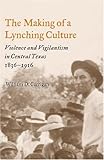
William D. Carrigan. The Making of a Lynching Culture: Violence and Vigilantism in Central Texas, 1836-1916. Urbana and Chicago: University of Illinois Press, 2004. xi + 308 pp. $35.00 (cloth), ISBN 978-0-252-02951-6.
Reviewed by Bertram Wyatt-Brown (Richard J. Milbauer Professor Emeritus, University of Florida, and Visiting Scholar, The Johns Hopkins University)
Published on H-Law (March, 2005)
Lynching Western Style in Broader Perspective
For the first three-quarters of the twentieth century, the subject of Southern public violence was apparently too raw, too sinister for historians to handle. With scarcely a handful of exceptions, scholarly works seldom probed the horrible truth of Southern white extralegal justice with much depth or comprehensiveness. News of the murder of James Earl Chaney, Andrew Goodman, and Michael Schwerner in the Mississippi summer of 1964, for instance, did not, it seems, prompt extended investigations into similar patterns of racist atrocity nor into the mechanisms, justifications, and psychology of a violence-burdened Southern white culture. Leonard Dinnerstein's classic, The Leo Frank Case (1968), stood almost alone. In 1979, eleven years later, Jacquelyn Dowd Hall's Revolt against Chivalry: Jessie Daniel Ames and the Women's Campaign against Lynching represented a fine investigative beginning. Yet her study concerned the inspirited struggle of Southern white liberal women to stop the practice. It was never intended to be a thorough account of lynch mobs themselves.
Since the early 1980s, however, an outpouring of works has emerged on the troubling capacity of excited crowds and even governments to inflict lawless pain and death. The studies range from early times to the present and cover a wide range of cultures and nations. Among such catastrophes explored were the efficiencies of the Nazi death camps and the organized slaughter of populations of all ages in Cambodia, the Balkans, and Rwanda. These events were suddenly given full historical and, if more recent, exemplary journalistic and personal treatment of a high order. This transformation represents an amazing shift from prior, almost global reticence about disturbing signs of man's unlimited capacity for satanic behavior despite the horrors of Stalin's mass murders in the 1930s and Hitler's attempt to wipe out an entire race. For instance, Sophie's Choice (1976) was one of the first serious psychological studies of the Holocaust, albeit in fiction. An admirer congratulated William Styron for the boldness to call attention to the subject of the Nazi terror. He remarked, "The absence of any historical memory in this country is simply bizarre."[1] That deficiency was eventually to change, not only with regard to the Shoah but also Southern lynch-law.
William Carrigan's study benefits from what has now become a rich heritage of studies. James Inverarity's article on Populism and lynching in 1976 and James R. McGovern's Anatomy of a Lynching: The Killing of Claude Neal (1982) began a growing trend toward serious studies of the gruesome phenomenon. Both narratives of individual cases and broad analyses soon followed. W. Fitzhugh Brundage, Lynching in the New South (1993) and Christopher Waldrep, Roots of Disorder: Race and Criminal Justice in the American South, 1817-80 (2002), along with other penetrating works such as James Denham, "A Rogue's Paradise" (1996), Stewart E. Tolnay and E. M. Beck, A Festival of Violence (1995), and Nancy McLean's brilliant article on the Leo Frank case (1991), were among the notably engrossing interpretations of Southern violence.[2] Howard Smead's investigation of Charles Mack Parker's murder in 1959, and Dennis Downey and Raymond Hyser's exploration of the death of Zachariah Walker, in Coatesville, Pennsylvania in 1911, may serve as accomplished examples of individual cases. [3] Many others of a high caliber could be cited as well.
These studies have been informative, well documented, elegantly composed, and highly interpretive. They have established that lynching was practiced largely in consequence of economic and racial tensions. Although others races were sometimes victims, the vast majority subjected to lash and rope were Afro-Americans. The reasons arose from the post-Civil war elimination of bondage; Northern disillusionment with Republican Reconstruction; the promise of black emancipation and rise of white solidarity on racial matters, North and South; black disfranchisement; and Jim Crow laws--all of which made the under-race more vulnerable to oppression. Comparative studies as well as richly detailed single tragedies have provided a solid historical understanding of lynch-law. William Carrigan's examination of nineteenth-century central Texas does not make as many comparisons with other parts of the South as the material covered calls for. Rather, he offers a series of individual cases but he does effectively trace the tragic continuity of violence. The author titles his work The Making of a Lynching Culture, but truth be told, he chronicles a history, not a culture.
As a result, this work is not so "ground-breaking" as the dust-jacket promises. Instead, he surveys the unenviable record of the Waco region from first white American settlement in the 1830s to the horrendous torture and killing of Jesse Washington before 15,000 joyous participants in 1916. The compilation of extralegal reprisals for alleged crimes through the decades in this frontier area would horrify most of the participants' great-grand children of today.[4] Carrigan demonstrates a pattern of rough justice that includes lethal assaults against Native Americans and Mexicans in the 1830s as well as vigilante reprisals against Anglo-Americans accused of horse-thieving, cattle rustling, murder, and other crimes, whether substantially proved or not. Stressing the lack of strong instruments of law in an underdeveloped, underpopulated area, Carrigan revives the frontier thesis of Frederick Jackson Turner. That explanation for the early days of settlement seems plausible but only for that transitory period.
Turner's resurrected thesis can hardly explain later traditions of violence when a more orderly society gradually developed stronger instruments of legal control. Besides, it scarcely needs mention that other frontiers such as the Western Reserve and northeastern Ohio, settled by righteous New Englanders for the most part, were not particularly prone to homicide and mayhem. The same was true for other parts of the Northwest. In any event in Texas, the Civil War and the hotly contested divisions between Unionists and Confederates led to the most celebrated case, the hanging of over forty North Texas pro-Union sympathizers in October 1862. In Tainted Breeze: The Great Hanging at Gainesville, Texas, 1862 (1994), Richard B. McCaslin describes in vivid detail the atrocities committed, tracing the pattern, as Carrigan does, to frontier conditions. The depredations of war, one could argue, drove the moral perimeter backward to former lawlessness.
When Carrigan's frontier theme gradually loses relevance, the author replaces it with the familiar and long understood issue of virulent, intractable racism. Much of his subsequent account has validity. It is true that public displays of white superiority and black people's subordination were not so frequent in the Old South where plantation justice could be administered either by owners or slave patrols, without regard to law, in the solitude of forest, field, and isolated dwelling. To explain the almost single-minded consensus of nonslaveholders and slave proprietors about black submissiveness, Carrigan correctly notes the fluidity of class distinctions on the frontier and the imperative for unity in facing Indian dangers. In addition, the wealthier, slaveowning members of a community served their lesser neighbors as lenders of tools, farm animals, or funds when need arose. Gratitude, deference, and political and racial solidarity were expected in return. Carrigan points out, "white men of all classes shared a belief in a form of republicanism that legitimated the power and wealth possessed by planters and slaveholders" (p. 87). That observation, of course, has application in most other parts of the plantation districts of the South.
With the emerging crisis of disunion and civil war, Carrigan presents circumstances familiar to historians of other sections of the South. Northern opposition to slavery in the territories, John Brown's Raid, and the election of "Black Republican" Abraham Lincoln culminated in a frenzy of secessionist enthusiasm that forced Texas Unionists into virtual silence in 1860. Carrigan reports a murder, a year later, in which an English victim deserved his death--so declared the killer in his defense. The hapless Englishman, he asserted, had advocated freedom for the slaves. Although certainly not inclined to leniency about that proposition, the jury convicted the killer. In reaction, the murderer's friends and a company of Rebel soldiers plucked him out of jail. At once he enlisted in Confederate service. Perhaps the breakdown of law, with Civil War mobs freeing the guilty or hanging the guiltless, was more acute in the Waco district than elsewhere in the slave states.
With regard to postwar violence, Carrigan seems not to have missed a single incident of lawless activity. He observes, "Given a culture that often reified violence as a positive good, it would have been remarkable had central Texans abandoned vigilantism during the late nineteenth century" (p. 105). Still more dismaying was the perpetuation of myths about these activities. Storytellers enshrined lynch-law in a romantic haze in which stalwart Redeemers overthrew the so-called villainous Yankees and their black henchmen. In the interest of community solidarity, however, memories of the fierce divisions between the few whites sympathetic to freed people's aspirations and the "straight-outs," as extremists called themselves, quickly disappeared into a deep well of selective amnesia.
According to Carrigan's careful examination of court records, white on white extralegal action declined as the court system gradually grew stronger. Nonetheless, grand juries often failed to indict; prosecutors failed to try 68 percent of those indicted; juries acquitted 55 percent of the accused; and penalties for rape and other crimes were often a mockery of justice (p. 107). These facts cry out for an explanation beyond the "unsettled" state of the area and the political factionalism of Reconstruction. Clearly there was something in the character of the inhabitants that treated issues of law and order so cavalierly. Carrigan offers no rationale.
During the closing years of the nineteenth century, lynchings of every sort declined, Carrigan informs us. Yet the ones that did occur drew ever larger crowds of participants. Another distinction is that most executions of blacks included ritualized tortures and mutilations. Death came quickly, however, to white offenders stigmatized as horse-thieves, murderers, and brigands. Carrigan provides the customary explanation: racism. But more was involved than that. He does not perceive the sense of humiliation that white citizens harbored in those difficult postwar years. They had not only lost a futile struggle that left them nothing but penury and ruin but they also no longer possessed an iron grip over the underclass of blacks. What an ignominious fall from God's grace and man's esteem. Scapegoating was the favored means of vindication: throw the blame on the recently freed slaves and their Unionist friends, not on white Southerners' own folly. It is no wonder that the overthrow of Republican Reconstruction in 1873, with the election of Governor Richard Coke, represented more than a sweet partisan victory. It heralded the return of complete white sovereignty. A newspaper had campaigned that Texans would soon "destroy with a keen sword the Radical cabal which has ruined us and now insults us" (p. 138). Carrigan fails to mention that such words as these reflected the old ethic of honor and the dread of shame that were so deeply bred into the Southern white soul. Instead, the historian argues correctly, but without reference to the underlying white sanctions, that the continuation of the old planter elite in both local and state politics kept the flame of white supremacy and Ku Klux mobocracy alive. Black land and property holdings remained abysmally low. Men of color could not register or vote; legal rights disappeared; and, self-defense only aroused white fury. Black protests against oppression failed to elicit sympathy or support. All these elements of Afro-American repression were present. What is largely missing from Carrigan's gripping story is the moral reasons for white hostilities.
In dealing with the near disappearance of lynching between 1897 and 1905, Carrigan raises an interesting point, but he does not reach deep enough into the Southern psyche. Was that drop in lynch-law the consequence of rising cotton prices and community prosperity? The findings of Stewart Tolnay and E. M. Beck would suggest as much. They argue that mob action had become "an integral element of an agricultural economy that required a large, cheap, and docile labor force."[5] In contrast, Carrigan fails to demonstrate a connection between the local economic setting and the popular execution of blacks. With so much work already done on the tie between economic factors and lynch-law, he could have developed that theme more expertly.
Moving on, Carrigan recounts, but does not fully analyze, a sudden explosion of the practice beginning again in 1905. Huge crowds in Waco participated in the torturing, mutilation, and burning of victims, often under charges of sexual assault and rape of white women. The courts failed to indict anyone for taking the law into their own hands. Blacks who protested met white reprisals for their temerity with whip and fist. Black laborers began to leave the region in large numbers, drawn to Northern cities by the prospect of better wages and evenhanded justice. Nonetheless, the serious loss of cheap labor did not result in Judge Lynch's summary retirement. The brutality of Jesse Washington's torture and burning while alive, before at least 15,000 in 1916, gave Waco unflattering national and international attention. The Great War was raging in Europe and Woodrow Wilson was soon to call for a crusade to make safe the principles of democracy. The outside press declared Texas lynch-law a disgrace that gave the lie to American ideals. Even Southern papers reacted in a negative vein, although conditions were not much better elsewhere in the region. Carrigan presents the facts, but could have pursued these issues more thoroughly. While the author has given as straightforward and well-told a chronicle as a reader might encounter, his work raises more questions than he answers.
In sum, a major interpretive opportunity has been lost. Frontier conditions, white supremacist antipathies, determination to preserve the racial status quo, economic fluctuations and even the Democratic struggle to regain full political control do not wholly account for the ferocity and frequency of lynch-law. Carrigan deserves commendation for his exposition of these factors. Yet, they do not account for the white on white atrocities. These were less frequent and less grisly, but they cannot be forgotten. Missing from his endnotes and text is the cultural and religious aspect of what the late sociologist Harold Garfinkel titled "degradation ceremonies." By that term he meant the obliteration of the victim's former identity and its replacement with a symbolic image of satanism personified.[6]
Extralegal action was not initiated solely because the laws were too lenient, slow, and weakly enforced. These were the obvious rationales that participants used--and with some truth. But the purpose of mob punishment was also to purify the moral integrity and honor of the community, to set an awesomely grim example to possible miscreants, to re-establish what the participants, rich and poor, regarded as proper order, and to shame, torture, and execute the culprit so that he no longer bore resemblance to the rest of humanity. That intent required, community participants believed, a human sacrifice. Other sociologists, anthropologists, and mainly European and British historians have broadened Garfinkel's interpretation.[7] Since the advances of the Enlightenment, the established system of justice could no longer, of course, scarify, brand, and emasculate offenders. But legally sanctioned capital punishment, then as now, remained highly popular in the former slave states.[8]
Lynchers did not believe that they were undermining or high-handedly disregarding ordinary procedures of law. For them, lynch law was by no means a matter of incompatibility with codified structures, but instead a helpful and necessary addition. The professionals--attorneys, sheriffs, judges, bailiffs, clerks of court and the like--stood for traditional order. But popular justice conferred upon the ordinary white the prerogative of ensuring that community values held equal and sometimes paramount sovereignty: vox populi. Carrigan quotes a typical justification written by J. N. Bennett in 1893. The editor noted that youths "follow the example set them by their fathers." When they reach adulthood, he continued, they had "ingrained in them that lynch law is right and proper, and worthy of applause" (p. 142). Indeed, crowd approval was all-important in solidifying the cause in which the citizens engaged. Carrigan might have exploited such contemporary insights to reach broader conclusions.
Those "family values," as then considered, formed the basis of Southern life and social hierarchy. Donald Matthews has acutely observed, "There was something quite transcendent to the experiences of individuals and groups in a public lynching; but that transcendence has been difficult to engage in a meaningful way except to recount that it was there--not knowing exactly what 'it' was in 'its' mystery and horror even though mystery can sometimes be understood in images."[9] The image of a burning human writhing in agony in the flames was somehow inspirational, ineffable for those witnessing and participating. To visit upon the sinner the fires of hell was simply to carry out on earth the fate awaiting him on the other side. Without remorse or sense of guilt, the perpetrators rejoiced that an evil had been stricken from their midst. The English anthropologist Mary Douglas argues that pollution, abuse, and death are often used in human sacrifices of this kind to cleanse the moral atmosphere of the community. The act imposes order upon untidiness. It serves as atonement for the sins and mistakes of the living.[10] Human sacrifices were performed centuries before the Crucifixion and centuries afterward. Orlando Patterson observes that in 1998 Jasper, Texas, a scene of ritual lynching took place. It was, he states, "the ultimate form of blood-sacrifice."[11]
Conformity to group in thought and behavior governed the public mind in which individuality disappeared in the unity of all. The collective behavior of lynch mobs, Neil J. Smelser argues, was a mobilization around a common set of beliefs which were "akin" in character to "magical beliefs."[12] The process of separating the races was performed to "establish boundaries between them, and make dangerous the breaching of those boundaries." This process implied no religious violation. According to a Georgia newsman in 1897, the Old Testament, Numbers 25, verses 6 to 9, offered "an account of the first great lynching, seen in the Bible condemnation of the gratification of lust and God's commendation of the lyncher."[13] Spiritual faith and lynching were no less a part of a whole in the American South than were the harsh penalties of sharia, the Islamic code, from which Westerners now recoil.
Thus, lynching involved a complex set of emotions and reactions--a Rabelaisian carnival-like celebration, a serious drama of death that made life itself seem more precious to the witnesses, a sense of religious fervor and divine retribution in the immolation of the offender, and what the participants considered hilarious horse-play. All these elements intermingled with economic and racist factors. We know the latter motives best because they easily fit our secular, modern conception of things. In contrast, the mysterious sources of pleasure from inflicting cruelty repel us, but ordinary people in Nazi Germany, Abu Ghraib prison, or central Texas have found themselves exhilarated by such emotions. The shaming of someone despised brings out laughing responses as well as the cruel side because the victim's agonized contortions are so uncontrolled and infantile in appearance.[14] The historian Michael J. Pfeifer points out, in a recent study, with reference to Midwestern mob actions, "as a vivid performance and projection of popular, extralegal authority in a locale, the lynching event mustered [the] familiar custom" of "good men"--the respectable citizenry. Some might be appalled, he notes, but others reveled in the bacchanalian rites.[15]
Although William Carrigan might have more creatively utilized the findings of Donald Mathews, Orlando Patterson, Trudier Harris, and others, he has provided both a strong, if depressing, and poignant narrative.[16] He could have been bolder and more innovative, but we must appreciate his serious, detailed, and informative account. Certainly what he writes about the continuity of violence in central Texas had its appalling parallels throughout the bi-racial society of the American South from the section's founding to the not so distant past. As a result, his work has wider implications than its title suggests. It could have done more to integrate the sociological aspects of this universal tendency toward ritual inhumanity. Perhaps that task remains for a new and dynamic series of works that interpret the hidden and overt meanings and tragedies of lynching.
Notes
[1]. William Styron, Sophie's Choice (New York: Random House, 1976); Bohdan Wytwycky, Ph.D., Newark, NJ, to William Styron, July 2, 1981, William Styron Papers, Perkins Special Collections, Duke University Library. On the Rwanda genocide, see Philip Gourevitch, We Wish to Inform You That Tomorrow We Will Be Killed with Our Families: Stories from Rwanda (New York: Farrar, Straus, Giroux, 1998); and Linda Melvern, A People Betrayed: The Role of the West in Rwanda's Genocide (New York: St. Martin's Press, 2000); Romeo A. Dallaire, Shake Hands with the Devil: The Failure of Humanity in Rwanda (New York: Random House, 2005). On Cambodia, see Ben Kiernan, The Pol Pot Regime: Race, Power, and Genocide in Cambodia under the Khmer Rouge, 1975-79 (New Haven: Yale University Press, 1996). On the Balkans, see Susan L. Woodward, Balkan Tragedy: Chaos and Dissolution after the Cold War (Washington, D.C.: Brookings Institute, 1995).
[2]. Nancy McLean, "The Leo Frank Case Reconsidered: Gender and Sexual Politics in the Making of Reactionary Populism," Journal of American History 78 (December 1991): pp. 917-947. Like Joel Williamson, McLean captures something of the psychosexual aspect of the practice. Joel Williamson, The Crucible of Race: Black/White Relations in the American South since Emancipation (New York: Oxford University Press, 1984), esp. pp. 185-189. Brundage does so as well, Lynching in the New South: Virginia and Georgia, 1880-1930 (Urbana: University of Illinois Press, 1993), pp. 64-66. Other works include William Fitzhugh Brundage, ed., Under Sentence of Death: Lynching in the South (Chapel Hill: University of North Carolina Press, 1996); and Christopher Waldrep, Roots of Disorder: Race and Criminal Justice in the American South, 1817-80 (Urbana: University of Illinois Press, 1998). This bibliography scarcely does justice to the many other probing and exemplary works in the field.
[3]. Howard Smead, Blood Justice: The Lynching of Charles Mack Parker (New York: Oxford University Press, 1986); and Dennis B. Downey and Raymond M. Hyser, No Crooked Death: Coatesville, Pennsylvania, and the Lynching of Zachariah Walker (Urbana: University of Illinois, Press, 1991).
[4]. In 1998, in Jasper, Texas, townspeople reacted strongly against the lynching of a black citizen, a quite different outcome from prior incidents in the earlier part of the century. See Orlando Patterson, Rituals of Blood: Consequences of Slavery in Two American Centuries (Washington, D.C.: Civitas, 1999), pp. 171-173.
[5]. Tolnay and Beck, A Festival of Violence, p. 255. They also point out that the wealthier landholders saw lynchings as a means to keep wide the division between lower-class whites and blacks. As soon as blacks reacted by fleeing to the North and West, lynchings declined.
[6]. Harold Garfinkel, "Conditions of Successful Degradation Ceremonies," American Journal of Sociology 61 (January 1956): pp. 420-424; Howard Becker, Outsiders: Studies in the Sociology of Deviance (New York: The Free Press, 1963). Structural analyses have fallen out of favor, but Erving Goffman, Harold Garfinkel, and others are still relevant in my opinion.
[7]. See Kai T. Erikson, Wayward Puritans (New York: Wiley, 1966); Natalie Z. Davis, "The Reasons for Misrule: Youth Groups and Charivaris in Sixteenth-Century France," Past and Present 50 (February 1971): pp. 43-57; and E. P. Thompson, "Rough Music: Le Charivari Anglais," Annales E.S.C. 27 (March-April 1972): pp. 285-312.
[8]. See Sir Leon Radzinowicz, A History of English Criminal Law and its Administration from 1750 5 vols. (London: Stevens, 1948-56): vol. 1.
[9]. Donald G. Matthews, "The Southern Rite of Human Sacrifice," Journal of Southern Religion (2000), p. 4, http://jsr.as.wvu.edu/mathews2.htm .
[10]. See Mary Douglas, Purity and Danger: An Analysis of Concept of Pollution and Taboo (Boston: Ark, 1985).
[11]. Orlando Patterson, Rituals of Blood, p. 181.
[12]. Neil J. Smelser, Theory of Collective Behavior (New York: Free Press, 1962), p. 8.
[13]. Quoted in Edward L. Ayers, Vengeance and Justice: Crime and Punishment in the Nineteenth-Century American South (New York: Oxford University Press, 1984), p. 247.
[14]. On the theme of common folk becoming willing participants in horror, see James Waller, Becoming Evil: How Ordinary People Commit Genocide and Mass Killing (New York: Oxford University Press, 2002); and Daniel J. Goldhagen, Christopher R. Browning, Leon Wieseltier, The "Willing Executioners"-"Ordinary Men" Debate: Selections from the Symposium, April 8, 1996 (Washington, D.C.: United States Holocaust Research Institute, 1996). See also Bertram Wyatt-Brown, Southern Honor: Ethics and Behavior in the Old South (New York: Oxford University Press, 1982), pp. 453-462. I argue that lynching was the most extreme form of the ancient charivari which could be as mild and ribald as tricks played on a bride and bridegroom on their wedding night. In all charivaris the object is to shame, playfully or cruelly, the objects of public feelings and to affirm the solidarity of the community in such actions. They may take on a religious form, and it is a form of crowd behavior, undertaken by "ordinary people," in which emotional state distinctions of rank, diversity, and moral discriminations are lost in the fervency of the moment.
[15]. Michael J. Pfeifer, Rough Justice: Lynching and American Society, 1874-1947 (Urbana: University of Illinois Press, 2004), pp. 47, 51. Pfeifer offers an excellent integration of all cultural and economic factors involved in a lynching culture, with his special reference to the West and Midwest as well as the South.
[16]. Trudier Harris, Exorcizing Blackness: Historical and Literary Lynching and Burning Rituals (Bloomington: Indiana University Press, 1984); Leon F. Litwack, Trouble in Mind: Black Southerners in the Age of Jim Crow (New York: Knopf, 1998); Victor Turner, "Sacrifice as Quintessential Process: Prophylaxis or Abandonment?" History of Religions 16 (1977): pp. 189-215; and Susan L. Mizruchi, The Science of Sacrifice: American Literature and Modern Social Theory (Princeton: Princeton University Press, 1998).
If there is additional discussion of this review, you may access it through the network, at: https://networks.h-net.org/h-law.
Citation:
Bertram Wyatt-Brown. Review of Carrigan, William D., The Making of a Lynching Culture: Violence and Vigilantism in Central Texas, 1836-1916.
H-Law, H-Net Reviews.
March, 2005.
URL: http://www.h-net.org/reviews/showrev.php?id=10391
Copyright © 2005 by H-Net, all rights reserved. H-Net permits the redistribution and reprinting of this work for nonprofit, educational purposes, with full and accurate attribution to the author, web location, date of publication, originating list, and H-Net: Humanities & Social Sciences Online. For any other proposed use, contact the Reviews editorial staff at hbooks@mail.h-net.org.

