



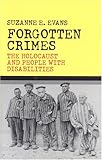
Suzanne E. Evans. Forgotten Crimes: The Holocaust and People with Disabilities. Chicago: Ivan R. Dee Publisher, 2004. 201 pp. $26.00 (cloth), ISBN 978-1-56663-565-3.
Reviewed by Sara Vogt (Disability Studies Program, University of Illinois at Chicago)
Published on H-German (March, 2005)
In October 1939--backdated September 1, 1939 to coincide with the onset of World War Two--Adolf Hitler issued a directive that extended the authority of physicians to include decisions about the "mercy killing" (Gnadentod) of the incurably ill.[1] This sentence-long letter addressed to his personal physician, Dr. med. Karl Brandt, and the head of the Kanzelei des Führers, Philipp Bouhler, served as the unofficial order that commenced the secret systematic killing program responsible for murdering over 250,000 children and adults with psychiatric, cognitive, and physical disabilities. For the reader unfamiliar with the Nazi regime's targeting of people with disabilities in their efforts to create a strong and pure race, Forgotten Crimes by Suzanne E. Evans may be an appropriate point of entry.
Written in conjunction with Disability Rights Advocates (DRA), a California-based nonprofit organization that facilitates the integration and full participation of people with disabilities in all aspects of life, this book is apparently a result of their Disability Holocaust Project (while authored by Evans, a lawyer, journalist, and Ph.D. student in American History at the University of California, Berkeley, the copyright belongs to the DRA, and it is unclear whether this volume was a collective or individual endeavor). As stated in the acknowledgements section, the aim of the Disability Holocaust Project is four-fold: (1) to shatter the silence that has surrounded the fate of people with disabilities during the Holocaust; (2) to heighten public awareness about the current plight of people with disabilities; (3) to utilize the shared history of the Holocaust as a vehicle for building greater cooperation between organizations of people with disabilities; and (4) to relate pre-Holocaust Nazi concepts to pernicious contemporary attitudes and enhance awareness of the existing stigmatization of people with disabilities (p. 5).
Indeed, Evans makes a strong case for why it is important for Holocaust or Disability scholars, amateur and professional, to examine this all-too-often lost history. Evans is very convincing in connecting the systematic slaughter of hundreds of thousands of people with disabilities to contemporary Holocaust and Disability Studies projects that aim to understand the past better, as well as to frame current scientific and political endeavors within their socio-historical landscapes. Such remembering, Evans states, is "crucial to an understanding of both (1) how and why people with disabilities continue to be marginalized in contemporary society, and (2) the attitudes and moral failures that allowed the Holocaust to happen" (p. 20).
It is important to note that Bengt Lindqvist makes it clear in his preface that the intended audience for Forgotten Crimes extends beyond historians and academics, into the sphere of the general public (p. 10). For this reason, many academic readers may find themselves frustrated while reading Evans's exploration into the world of the Holocaust. While she provides a good synthesis of English-language material that examines the sterilization and killing programs and their disabled victims (especially that of Henry Friedlander and Michael Burleigh[2]), Evans often resorts to multiple, paragraph-long quotes of her sources, leading the reader to believe that it might be better simply to consult these original works. In effect, Evans succeeds in further emphasizing the connections these authors have already made between racial hygienic policies and programs and those labeled "lives unworthy of life" (lebensunwerten Lebens). In doing so, however, Forgotten Crimes amounts to a book-length literature review of English-language readings on the topic, which may leave the scholarly reader unsatisfied.
Still, if her aim is to introduce the topic of disability and the Holocaust to unfamiliar readers, leaving them yearning for more information, she does just that. By presenting findings of projects already dealing with the sterilization, coerced labor, and murder of people with disabilities during the National Socialist era, readers become quickly familiar with her original sources in a compact format. They can then consult these original sources and others armed with a general overview of many extant English-language materials. Of course, in order to present a more complete picture of the work already done on this topic, it would have been more thorough to consult sources in other languages, at least in German, but that seems to have been out of the scope of her current project. Nevertheless, Forgotten Crimes provides a quick and interesting introduction to the situation of people with disabilities during the Holocaust and surely leaves the reader convinced that the topic warrants more attention for a better understanding of both Holocaust and disability issues.
Notes
[1]. Ernst Klee, "Euthanasie" im NS-Staat. Die "Vernichtung lebensunwerten Lebens" (Frankfurt am Main: Fischer Verlag, 1983), p. 100.
[2]. Henry Friedlander, The Origins of Nazi Genocide: From Euthanasia to the Final Solution (Chapel Hill: University of North Carolina Press, 1995); Michael Burleigh, Death and Deliverance: "Euthanasia" in Germany, 1900-1945 (Cambridge: Cambridge University Press, 1994).
If there is additional discussion of this review, you may access it through the network, at: https://networks.h-net.org/h-german.
Citation:
Sara Vogt. Review of Evans, Suzanne E., Forgotten Crimes: The Holocaust and People with Disabilities.
H-German, H-Net Reviews.
March, 2005.
URL: http://www.h-net.org/reviews/showrev.php?id=10288
Copyright © 2005 by H-Net, all rights reserved. H-Net permits the redistribution and reprinting of this work for nonprofit, educational purposes, with full and accurate attribution to the author, web location, date of publication, originating list, and H-Net: Humanities & Social Sciences Online. For any other proposed use, contact the Reviews editorial staff at hbooks@mail.h-net.org.

