



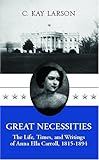
C. Kay Larson. Great Necessities: The Life, Times, and Writings of Anna Ella Carroll, 1815-1894. Philadelphia: Xlibris Corporation, 2004. 693 pp. $38.99 (cloth), ISBN 978-1-4134-2749-3; $28.99 (paper), ISBN 978-1-4134-2748-6.
Reviewed by Janet L. Coryell (History Department, Western Michigan University)
Published on H-Minerva (March, 2005)
The Myth That Will Never Die
In 1861, the Union invaded the Confederacy by sailing up the Tennessee and Cumberland Rivers, capturing Forts Henry and Donelson, and successfully beginning the campaign that eventually won the western theater of the war.
For years after the war, Anna Ella Carroll of Maryland, a political pamphleteer and writer acquainted with numerous leading politicians from the 1850s, claimed that she was responsible for creating the Tennessee invasion strategy. She appealed to Congress to pay her for her labor as a military strategist. She also wrote several pamphlets, at least one of which the government had printed at its expense, which laid out the legal rationale for some of President Abraham Lincoln's actions during the war. She also wished to be paid for these writings.
No conclusive evidence exists that proves that Carroll had developed the strategy. Indeed, she herself credited a riverboat pilot with the information at the close of the war. No contract existed between Carroll and the government for publishing additional writings after her first work, Reply to Breckinridge, either. But for twenty years and more, she dedicated her literary efforts to convincing Congress and the American public that she was, in the words of one supporter, "The Woman Who Saved the Union."
Carroll has long assumed a mythic stature in American history. Her claims cannot be proven, since the evidence to prove them does not exist. But her story attracts authors determined to prove that she was a woman denied historical recognition because of her gender. C. Kay Larson has written another tome to add to the collection. It is a poorly researched book, deeply flawed in its logic and in its presentation. It presents no new information. It rests on outdated and incomplete historiography and ignores virtually all of the work on women and the Civil War published in the last twenty years. Its value rests solely in its reproduction of Carroll's pamphlets, which are found in the back of the book.
In her introduction Larson promises that, by telling the story of Carroll's life and writings, she will deliver "significant new insights into the antebellum era and the Civil War," casting "new light" on religion's role in American politics, on secession, and on Lincoln's administration and "its conduct of the [Civil] war" (p. 21). Using a biography of Carroll as her base, she ranges far afield, tied sometimes only tenuously to her subject matter.
In the interest of full disclosure, I must declare that I, too, wrote a biography of Carroll, Neither Heroine Nor Fool, published by Kent State University Press in 1990. I also have continued to work on Carroll's career at odd times in the last fifteen years, and have published numerous encyclopedia articles on Carroll. I believe I showed quite convincingly in my biography that she did not do all that she claimed to do and that, most particularly, she greatly exaggerated her role in convincing the government to follow "her" plan of invasion in Tennessee. Larson disagrees. She adds to the question of whether Carroll deserved credit for her military strategy the assertion that it was Edwin Stanton's support of the Carroll plan of invasion that was directly responsible for his appointment as secretary of war, replacing the crooked Simon Cameron in Lincoln's cabinet.
It is the evaluation of Carroll's military strategy that most readers of this work will probably focus on, since that event is the best known part of Carroll's career. In setting out her argument in favor of Carroll as the author with the best access to the president to transmit the plan to him, Larson does not include all the evidence available, or prefers to take what evidence there is at face value. Larson's most important piece of evidence of Carroll's role in the Tennessee Campaign is a letter from Benjamin Wade dated April 4, 1876, which she quotes entirely within the text. The letter, in which Wade, who had been chairman of the Committee on the Conduct of the War, allegedly wrote that "if ever there was a righteous claim on earth, you would have one," would seem proof positive for Carroll's claim that she should be recognized as author of the Tennessee invasion strategy and paid for it. But while the letter is dated 1876, it was not printed in any of the several petitions to Congress or articles to the public demanding recognition and payment for her work after that date, including one written by Matilda Joslyn Gage on behalf of Carroll in 1880. The letter appears in full first in an 1881 pamphlet. In 1881, Wade had been dead for three years.
The letter itself could be a convincing document. But given the number of times Carroll had appealed for funds prior to 1881, it is fundamentally illogical to assume that Carroll would have held the letter back from publication until Wade was gone from the scene, especially since she quoted a number of other letters from Wade in her earlier attempts to get paid. The original document of the 1876 letter does not seem to have survived. It has not been found in either Wade's nor Carroll's letters. If Wade did write the letter attributed to him, he could not confirm it. And other letters from prominent people that Carroll used in her petitions and claims survive only in her handwriting, not in the handwriting of the purported author.
Larson also seems to ignore the role in constructing the strategy that was played by Charles Scott, the riverboat pilot who gave Carroll the information regarding the rivers, the way they flowed, and the logic of going up the Tennessee and Cumberland instead of down the Mississippi. But it was Carroll herself who actually sat down and wrote a letter to the Washington National Intelligencer on April 12, 1865, praising Scott's role in suggesting to the government that it use the Tennessee and Cumberland Rivers to invade the South. Larson seems to have missed this letter, one which questions her interpretation of Carroll's work as a military strategist (despite listing my work in her bibliography).
The second major point Larson attempts to make is that Edwin Stanton was appointed as secretary of war because he believed in Carroll's plan and outgoing secretary Simon Cameron did not. Larson claims to be puzzled by any other interpretation than the link to Carroll's plan for Stanton's appointment.
The more commonly accepted interpretation is that Stanton was appointed because he was there, in large part, and already second in command to Cameron. President Lincoln knew Stanton and respected his abilities, if not his personality, and leading members of the Cabinet could tolerate him. True, he was a Democrat, a point Larson uses to suggest that it must have been the importance of Carroll's plan that helped Lincoln overlook Stanton's politics. And true, Stanton had, in fact, served in James Buchanan's cabinet, a point that Larson argues shows that Stanton's support of Carroll's plan was so important it outweighed his history. But, being a Democrat would not exclude Stanton from the Cabinet; other appointees had been Democrats and Lincoln had even brought into his cabinet Seward and Cameron, who had been his rivals for the nomination for the presidency. This was a man who liked to keep his enemies where he could keep an eye on them.
Larson's primary evidence in support of her interpretation is, once again, the letter allegedly written by Wade in 1876, which did not appear in print prior to 1881. In it Wade claims that he had suggested Stanton to Lincoln because Stanton understood how useful Carroll's plan was and he (Stanton) would execute the plan once in office. This letter, in which Lincoln appears to be somewhat of a dolt who had to be advised by Wade, is simply not terribly convincing evidence. Wade's ideas regarding military strategy seem particularly suspect, given that he was stupid enough to attend the first battle of Bull Run and was nearly captured by the Confederates. The broader context of Lincoln's overall frustration in 1861 with General George B. McClellan and the lack of movement anywhere toward engaging the enemy as well as Simon Cameron's utter corruption of the War Department in the time he commanded it also seems to be missing from this interpretation.
Lastly, the plan to invade up the Tennessee and Cumberland Rivers was simple, straightforward military strategy. It seems unlikely that Carroll would be the only person to figure this out and point it out to the administration. For instance, there was a letter to the editor in the New York Times in mid-November of 1861 from a Tennessean, as he or she signed it, that suggested the same plan. General Henry Halleck, placed in charge of the Department of Missouri in November 1861 (before Carroll submitted her suggestions) wrote books on military strategy and taught at West Point. One cannot assume he was too clueless not to notice the rivers' direction. General Ulysses Grant, Halleck's subordinate, had spent all fall awaiting more gunboats after capturing Smithland and Paducah at the mouths of the two rivers and getting ready for the fight to come. He wrote in his memoirs that after the Battle of Belmont on November 7, "the troops under my command did little except prepare for the long struggle which proved to be before them."[1] That preparation included waiting for armored gunboats that could navigate the river. More contemporaneous to the event, a letter Grant wrote to Representative Elihu Washburne on March 22, 1862 also pointed out his awareness of the military strategy: "Our gunboats were running up the Ten. and Cumberland rivers all fall and winter watching the progress of the rebels on these works [Forts Henry and Donelson]. Gen. Halleck no doubt thought of this route long ago and I am shure [sic] I did."[2] And so had James Eads, who had built the armor-plated gunboats for the Union to use. Close the Tennessee and Cumberland rivers, he wrote to the Navy Department in April of 1861, "and starvation is inevitable in six months."[3]
Carroll's career as a military strategist is vastly overblown, at best. At worst, it is a myth. But since my biography was published, nearly yearly I have received queries and articles about Carroll that dredge up the same story over and over again. Americans do love a military hero, and a military heroine who bucked the system, saved the Union, and was ignored because she was a woman, is even better. It is the myth that will not die. That fact does not make the myth real, however. A lie, no matter how convincingly made and loudly and longly proclaimed, is still a lie. Carroll's claim to fame is exaggerated, as were her versions of her life events throughout her life. But, boy, how she makes a good story.
Larson is also on a mission to show that not only did Carroll save the Union with her military strategy, but also that her pamphlets on political issues were a useful part of the administration's defense of its actions. Here, Larson has a point and she does a decent job of deconstructing the pamphlets and their meaning. Carroll wrote several pamphlets, one printed by the government, that exposited upon Lincoln's powers as a war president, the problems with confiscation acts, and the rights of the citizens in the rebellious states as the war dragged on. Larson reprints the pamphlets in the back and explains them in the text in great detail. The pamphlets themselves are useful. They are not, however, easy to read, considering the degree to which they are about constitutional theory. They are reflective of Lincoln and other thinkers of the era.
Larson promises a great deal in her introduction. She points out that she is not a professional historian (by which she means an academic historian, one presumes), but a Civil War buff. There is nothing inherently wrong with that, but if Larson is going to write in the field of history, she needs to be aware of the work in the discipline. Therein lies one of the biggest problems of this book. Her work is marred by her failure to consult recent works in the fields in which she labors, particularly the fields of antebellum politics and women's history. These works are critical to understanding the period in which Carroll was doing her work.
Larson notes that she has "discarded the idea that activist women were the rare exceptions," (p. 20) and has discovered that women were involved in politics prior to 1920. If she had read any of the plethora of research written in the last twenty-five years on the lives of politically active women in the period, on Southern women, on women politicos, she might learn even more, not the least of which is that Carroll was one of many women involved in politics in the antebellum period, along with other women such as Jane Swisshelm, Louisa S. C. McCord, and Jane McManus Storms Cazneau. If she had looked at the countless works on women in the Civil War published in the last fifteen years, that might have enlightened her as well. Larson's declared goal of setting the world straight on the various issues in her book cannot be met when the process of learning about what others have written about the era and about Carroll are neglected. A real historian will cast her net widely in order to visit both sides of the question.
"To write about Anna Ella Carroll is to write about someone who has fallen into an abyss of history," Larson begins her introduction (p. 15). Carroll has had, at last count, over twenty articles (about half of which are scholarly ones), at least nine full-length biographies or novels, seven pamphlets, two major lawsuits, and six media productions (radio, plays, movies, and television) covering her life. If it's an abyss, it's a crowded one. This inadequately researched work can be tossed into the pile. We will never know what Anna Ella Carroll really did; this work adds only a little to our knowledge regarding her work as a writer. The rest is irretrievable.
Notes
[1]. Ulysses S. Grant, Personal Memoirs of U. S. Grant, (New York: Charles L. Webster and Company, 1885), Vol. 1, p. 284.
[2]. Ulysses S. Grant to Elihu B. Washburne, 22 March 1862, The Papers of Ulysses S. Grant, ed. John Y. Simon (Carbondale: Southern Illinois University Press, 1985), Vol. 4, p. 409.
[3]. James. B. Eads to the Secretary of the Navy, Official Records of the Union and Confederate Navies in the War of the Rebellion, (Washington: GPO, 1894-1922), Series 1, Vol. 22, p. 279.
If there is additional discussion of this review, you may access it through the network, at: https://networks.h-net.org/h-minerva.
Citation:
Janet L. Coryell. Review of Larson, C. Kay, Great Necessities: The Life, Times, and Writings of Anna Ella Carroll, 1815-1894.
H-Minerva, H-Net Reviews.
March, 2005.
URL: http://www.h-net.org/reviews/showrev.php?id=10269
Copyright © 2005 by H-Net, all rights reserved. H-Net permits the redistribution and reprinting of this work for nonprofit, educational purposes, with full and accurate attribution to the author, web location, date of publication, originating list, and H-Net: Humanities & Social Sciences Online. For any other proposed use, contact the Reviews editorial staff at hbooks@mail.h-net.org.

